Dissonant Notes

Index

About

  • Jihadi Rehab: Covert operations and Blowback for a corrupt UK–Saudi partnership

    Dec 29th, 2024

    The recent collapse of the Baathist state in Syria has brought into sharp focus the nature of the jihadi, mercenary groups that waged war on it. And moreover, the question of who funded and supplied them with logistical, intelligence, PR, propaganda and other support.

    As the British government welcomes the assumption of power in Syria by a group they had officially designated a ‘proscribed terrorist organisation’. It once again faces public pressure to prevent jihadis entering (or reentering) the UK.

    As MI6 head Alex Younger had noted publicly, such jihadists may be very capable.

    “They are likely to have acquired both the skills and connections that make them potentially very dangerous and also experienced extreme radicalisation…”

    He could say this with confidence, because MI6 had itself been active in facilitating and equipping such men. Now, the prospect is raised that those chickens will come home to roost, as they did once before in the foyer of Manchester Arena, in May 2017.

    I try here to connect some dots between the deals and arrangements – shrouded in official secrecy – Her Majesty’s Government (HMG) came to, in respect of its longstanding strategic partnership with the Kingdom of Saudi Arabia, and international Islamist militancy in Libya and Syria.


    Seven years ago the BBC reported that the some of the funding
    for a government contractor in Syria, developing the ‘Free Syrian Police Force’ had flowed into the hands of members of Al-Nusra (the main branch of al Qaeda in Syria) and a proscribed terrorist organisation. The Panorama episode around Adam Smith International’s activity on behalf of HMG caused a stir. But the story really represented just the tip of the iceberg.

    My previous article, outlined briefly the international coalition for regime change, which brought together Saudi, Qatari and Turkish backers of the Muslim brotherhood and al-Qaeda, with the US & UK, and Israel – against Iranian, Shi’ite and Arab Nationalist powers; in an extensively planned and orchestrated Machiavellian campaign.

    There is evidence such plans for proxy warfare may have been conceived, on behalf of an expansionist Israel, as far back as 1996. There were two other significant parts of the axis I should have mentioned; countries that played key roles; one as core part of Nato, France; and the other as the home of al-Qaeda’s leadership, Pakistan.

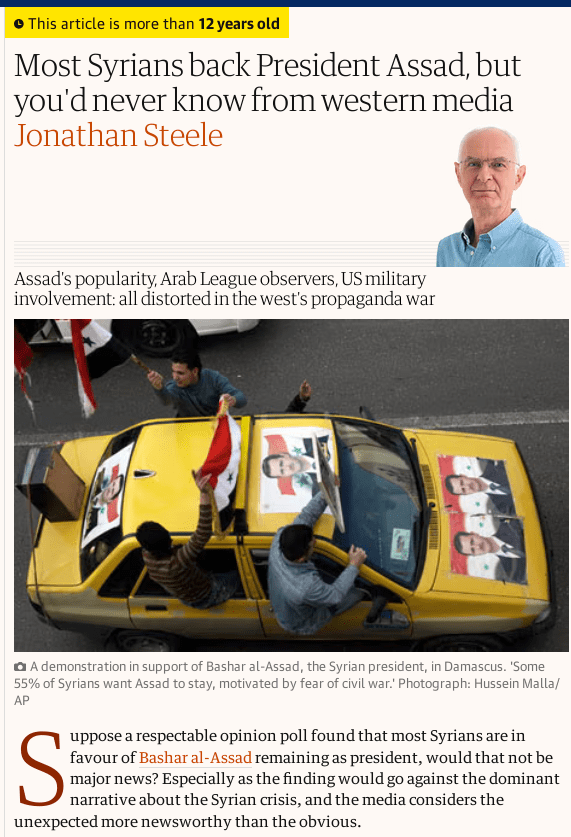
    The scheme involved ‘off the books’ procurement of weapons. As well as recruitment of Islamist extremists from not just the Gulf, Libya and Pakistan, but also regions of the Balkans, the Caucuses and central Asia. All to take part in the “Syrian Revolution” – a project of former colonial powers and some of the world’s most reactionary autocracies. In a country whose President’s actual popularity ratings compared quite favourably with those of western leaders.
    First stop, Libya

    It’s hard to know where to start in attempting to outline all the machinations, but the Elysee Palace seems as good a place as any.
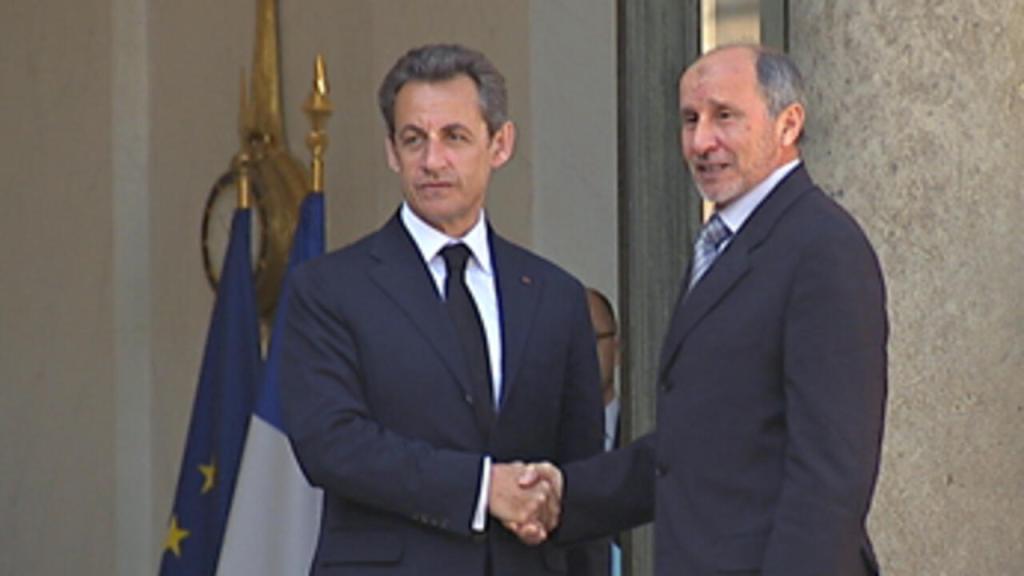
    April 20, 2011 The head of the Libyan ‘National Transition Council’ seen with French President

    April 20, 2011 The head of the Libyan ‘National Transition Council’ seen with the French President

    After the overthrow of the Libyan Arab Jamahiriya and Gaddafi’s horrific murder. The British would recount the work of their special services. A report in Reuters explained about the work of one their assets (Mlegta) in encouraging Libyan security officials to betray Gaddafi. According to him:

    Rebel leaders discussed their idea with French President Nicolas Sarkozy at a meeting at the Elysee Palace on April 20.

    That meeting was one of five in Paris in April and May, according to Mlegta. Most were attended by the chiefs of staff of NATO countries involved in the bombing campaign, which had begun in March, as well as military officials from Qatar and the United Arab Emirates.

    After presenting the rebels’ plan “from A to Z”, Mlegta handed NATO officials three memory cards: the one packed with information about regime strongholds in Tripoli; another with updated information on regime sites as well as details of 65 Gaddafi officers sympathetic to the rebels who had been secretly supplied with NATO radiophones; and a third which contained the plot to take Tripoli.

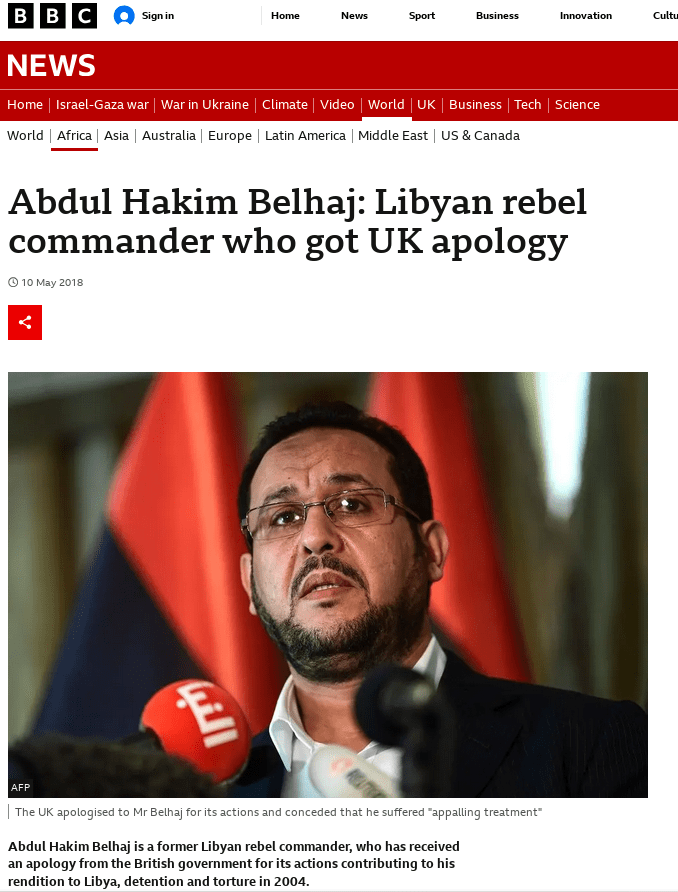
    That the rebels were largely constituted by Islamic extremists would, undoubtedly, have been well known to western security agencies. Indeed, the top rebel military commander Abdel Hakim Belhaj appointed to run operations in Tripoli had previously been renditioned by the CIA for his role in running al-Qaeda training camps in Afghanistan.

    Before that Belhaj had been active in the Libyan Islamic Fighting Group (LIFG), which had previously cooperated with the British in trying to assassinate Gaddafi in 1995 and 1996. He certainly has an ‘interesting’ resume.

    When Qaddafi protested to the world’s media that the violence in his country earlier in 2011 was due to al-Qaeda, the western press and media simply mocked and insulted him.

    Why was Libya a target ?

    For many reasons, but among them:

    • It was an Arab Nationalist ally to Syria
    • Resource nationalist – refusing to do deals with western oil companies on their terms
    • Useful staging post for funneling fighters into Syria. It had long been home to a proportionately high number of al-Qaeda fighters
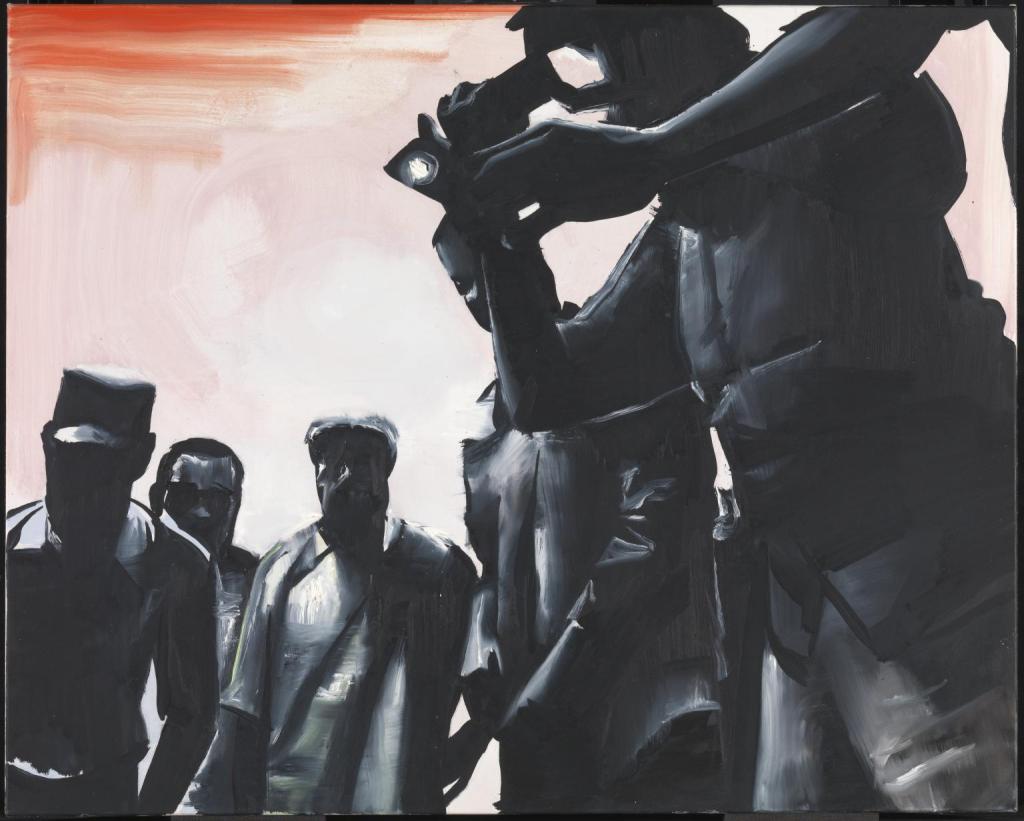
    ‘Gaddafi 2’ (2011) by Polish artist Wilhelm Sasnal

    Covert Operations and The Ratline

    After Gaddafi fell, Libya would, as noted by a 2012 Library of Congress research report, “become the centre of a network designed to send jihadists to Syria.” Bases in Libya would, under the watchful eyes of NATO, serve as training and logistics hubs for militants focused on taking down the Baathist state.

    Indeed, elements of the LIFG were active in Syria from the outset of the insurgency there. Belhaj himself travelled to Turkey’s border with Syria in November 2011 to meet with the leadership of the ‘Free Syrian Army’ – discussing arrangements for sending weapons and a stream of foreign fighters to the ‘rebels’ in Syria.

    As former CIA analyst Phil Giraldi informed in late 2011:

    Unmarked NATO warplanes are arriving at Turkish military bases close to Iskenderum on the Syrian border, delivering weapons from the late Muammar Gaddafi’s arsenals as well as volunteers from the Libyan Transitional National Council who are experienced in pitting local volunteers against trained soldiers, a skill they acquired confronting Gaddafi’s army. Iskenderum is also the seat of the Free Syrian Army, the armed wing of the Syrian National Council. French and British special forces trainers are on the ground, assisting the Syrian rebels while the CIA and U.S. Spec Ops are providing communications equipment and intelligence to assist the rebel cause, enabling the fighters to avoid concentrations of Syrian soldiers.

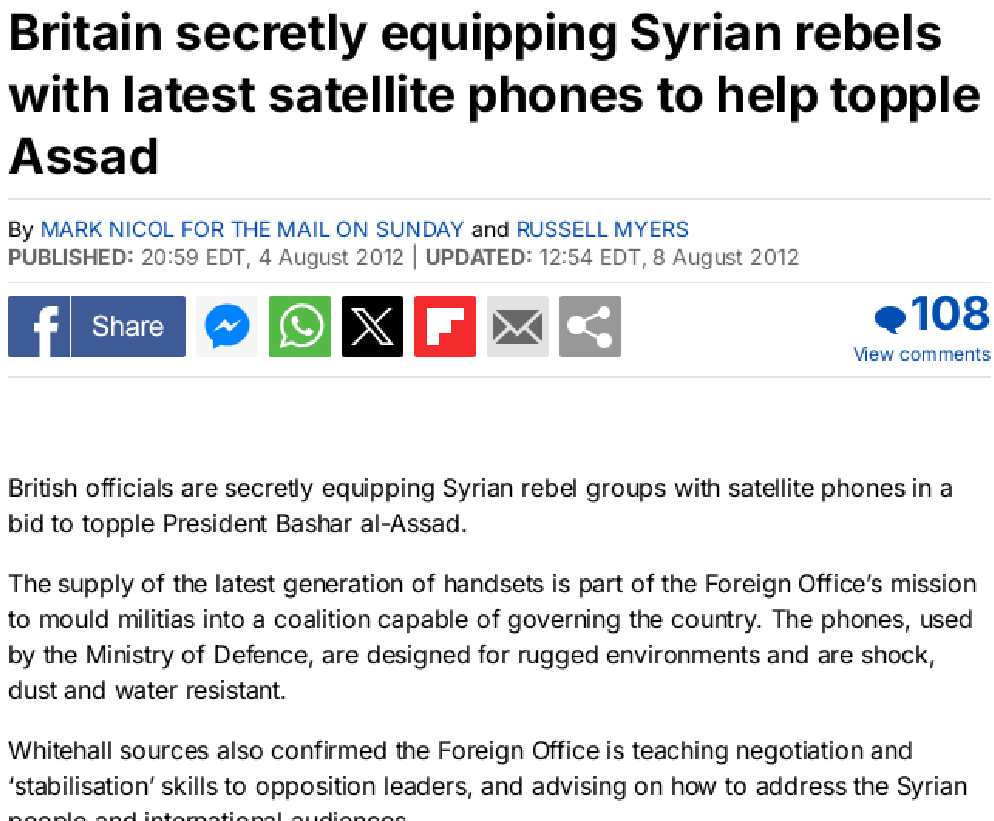
    MI6 were reported in 2012 to be covertly supplying with satellite phones, with the SAS active ‘in country’ training the “rebels”.
    Useful overviews of Britain’s covert operations in Syria has been provided by Mark Curtis. I won’t attempt to catalogue things here, but suffice it to say that HMG’s investment in the regime change project was longstanding, deep and extensive, and deployed both hard-power and soft-power capabilities.

    Funding for the proxy military campaign in Syria, though, largely came from Qatar and Saudi Arabia. Whilst operations were largely directed from Turkey. Training of the militants also took place in Jordan – where much of the CIA rebel training programme money was spent. It hosts dedicated special ops training camps.

    In 2012 Turkey established an ‘operations room’ for the ‘rebels’ military campaign. This was after a request to establish such a “nerve centre” was made by one of the Saudi King Abdullah’s four sons, Prince Abdulaziz- who had a longstanding career in the Saudi Arabian National Guard (SANG). This ‘nerve centre’ was set up near Turkey’s border with Syria at Adana. Nato’s Incirlik airbase is also situated in Adana. The Reuters report mentioned that the Turks were keen to get more technical support for running operations, especially around drones.

    In my last article, I found that the head of the Saudi Ministry of the Interior Mohammed bin Nayef (MBN) and his right hand man Saad al Jabri had, using MBN’s personal counter-terrorism account, set up front companies. Given the somewhat surprising nature of those expenditures, these ‘vehicles in the private sector’ appear to have been used to provide logistical support to ‘rehabilitated’ al Qaeda militants sent on to fight in Yemen, Libya and Syria.

    Circumstantial evidence strongly points to the SANG as being one channel used by the west to arm the ‘rebels’ at arms-length. SANG – the troops of the Interior Ministry – purchased, among other US made systems, a large supply of TOW anti-tank missiles in the years 2012-15. A weapons system that then happened to turn up in the hands of takfiri militants across Syria.

    The Memorandum and the ‘fast ball’

    By late 2013, the British were seeing their scheme, to funnel Sunni militants into insurgency operations, start to get out of hand. A report in the Telegraph said British and European jihadis in Syria were being encouraged and prepared to wage Jihad in their home countries.

    This was then, the backdrop to a Memorandum of Understanding then British Home Secretary Theresa May signed in Riyadh in March 2014. The MoU was not publicised at the time and only vague details were reported a year later; with the Government refusing to disclose further details. A Freedom of Information request for more details about the agreement was rejected:

    ‘The public interest falls in favour of applying these exemptions as the memorandum of understanding (MoU) contains information relating to the UKs security co-operation with Saudi Arabia, the release of which would damage the UKs bilateral relationship.’

    But from snippets and developments at the time, I think it is possible to get a sense of what was agreed. The deal was said to concern British ‘help’ with the ‘modernisation’ of the Saudi Interior Ministry.

    Theresa May must have met MBN and al Jabri, when agreeing the MoU in March 2014.

    It seems likely that the British side’s assistance to the Saudis consisted of technology, training and supplies for the SANG; the latter including supplies of CS gas and upgrades to crowd control vehicles.

    There happens to be a long standing British military mission to the SANG. As Declassified UK reported in 2019:

    The British embassy in Riyadh admitted in 2012 that the UK military officers involved in the mission “take their orders directly from His Royal Highness, Prince Miteb bin Abdullah bin Abdulaziz, Cabinet Minister and Head of the Saudi Arabian National Guard”.

    In return for ‘technical support’, MBN likely offered the British help on counter-terrorism, as the two monarchies struggled to keep their ‘useful idiot’ jihadis in check.

    As was noted on gov.uk:

    On 31 January, the Saudi Arabian government published the full text of its new counter-terrorism and terrorism financing legislation, outlining the procedures and punishments to be applied. Later, on 7 March, the Ministry of Interior issued a decree creating Saudi Arabia’s first list of proscribed organisations. Amongst the groups included were Al Qaeda and its affiliates (including the Al Nusra Front, Al Qaeda-Iraq, and Al Qaeda in the Arabian Peninsula), Saudi Hezbollah, certain Houthi groups in Yemen and the Muslim Brotherhood.

    Shortly after the MoU was signed a civil servant at the Ministry of Defense (MoD) related in an email that he had receieved a ‘fast ball’ from the Saudis. It was from Prince Mutaib (or ‘Miteb’) and at the MoD in relation to its longstanding SANGCOM programme (providing communications systems for the SANG). It appears they were made an offer they couldn’t refuse. MoD officials judged the proposal as effectively impossible to turn down.

    Snatching up the contract would though, following Prince Miteb’s instruction, mean making special payments to a private company owned by Salah Fustok ( or ‘Fustuq’) – a Saudi-Lebanese arms dealer with close family ties to the Saudi Royals. Such payments were apparently routine in relation to SANGCOM and would be denoted in MoD records only as ‘bought in services’.

    The contract would be with a British company called GPT Special Project Management. What the contract was for, HMG prefers to keep secret; despite court proceedings about the corrupt payments and kickbacks.

    According to 2017 research for Corruption Watch, GPT was set up to provide services only to the UK MoD, and only for the SANGCOM programme.
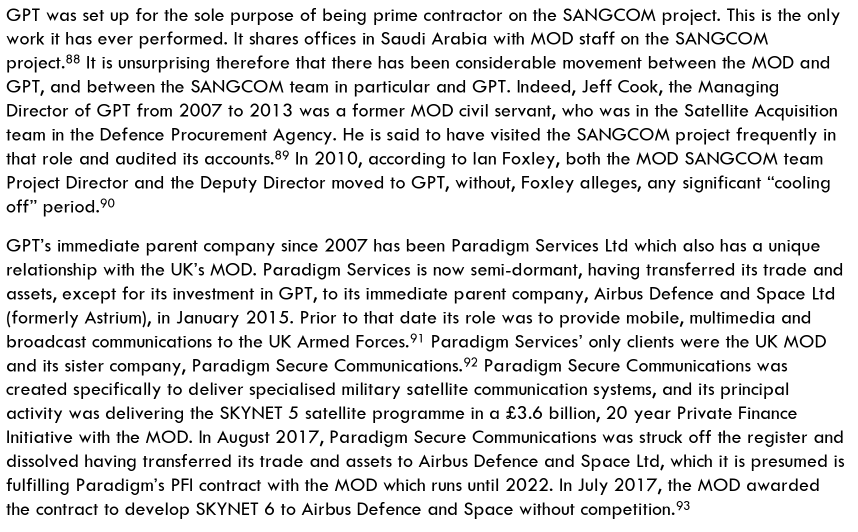
    GPT has, though, been owned by a plethora of defence sector providers. GPT provided ‘space services’, through its parent company Paradigm Services Ltd and the latter’s sister company ‘Paradigm Secure Communications’ – that provided ‘MilSatCom’ equipment and services, using the British military’s ‘Skynet 5’ communications satellites, first launched in 2003.

    A MoD civil servant and board member with both GPT SPM and Paradigm described their capabilities in a 2013 feature in MilSat Magazine:

    ..The Skynet 5 fleet of four satellites are the most powerful, commercially controlled, military X-band satellites launched to date…The satellites were specifically designed to mission critical, sensitive command and control communications systems, where loss of communications is not an option… This makes the satellites ideal for supporting smaller, low powered tactical terminals that are deployed across multiple theaters of operation.

    The Skynet 5 satellites are also used to control military drone flights, according to the website Drone Wars.

    After it was struck off the Companies register, Paradigm Secure Communications’ assets were transferred to Airbus Defence and Space Ltd. Which also provides satellite communications and imagery services.

    The ‘fast-balled’ GPT SPM contract was, according to emails released under and FOI request, to work in a “very sensitive environment”.

    Salah Fustok was a key middle-man for arms sales to the SANG and said to be linked with western private military and intelligence contracters, like Vinnell Corp; who happen also to be longstanding providers of training for the SANG. Turkey is another of Vinnell’s clients.

    Putting this together, suggests that Syrian rebels (eg al-Nusra militants) were using satellite phones and other comms equipment that depended on the same satellites the UK military uses.

    And that, possibly, real time satellite imagery or connectivity for drone reconnaissance was provided to the ‘nerve centres’ directing those proxy operations. And what’s more, that corrupt payments to arms dealers and Saudi royals were signed off by British civil servants in order to make that happen.

    Rehabilitation

    Perhaps Prince Miteb’s ‘fast ball’ took advantage of the British need for cooperation on counter-terrorism; given the situation British security agencies had created for themselves, with their policy – extant since 2006, according to former army and police intelligence officer Charles Shoebridge – of enabling travel for persons that could otherwise be under terror control-orders at home.

    However, given the nature of the UK-Saudi relationship there would probably have been a few ways for MBN’s Ministry and the SANG to exert a bit of ‘sharp power’. As Mark Curtis has noted:

    It is hard to pinpoint whether Saudi Arabia is a client of the UK or the other way round: probably both, since both sets of elites have been happily joined at the hip.

    While keeping up tough talk about prosecuting jihadis for domestic consumption, the Home Office, in consequence of the double game they were playing, had to develop a softer, rehabilitation focused approach to returnees. Senior defence figures deemed it inappropriate to treat harshly, men that had been encouraged to take up the fight, and allowed to travel on a nod and a wink.
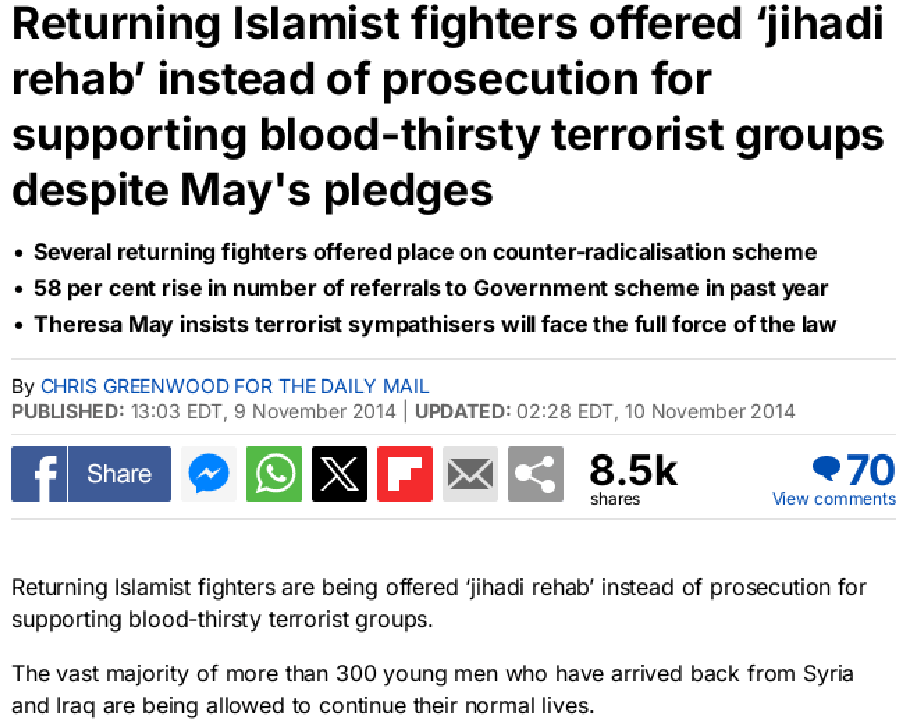
    A 2019 report in the Guardian states that 119 convicted or suspected terrorists were living out in the community. A Danish rehabilitation programme had earlier been seen as a pilot to monitor. Perhaps both drew inspiration from the approach MBN had pioneered a decade earlier.

    In any case, it was not practical to prosecute the men. As court hearings would inevitably incriminate the security agencies. Who had, to all intents and purposes, been supplying the same terrorist outfits that prosecutors were accusing defendants of participating in.
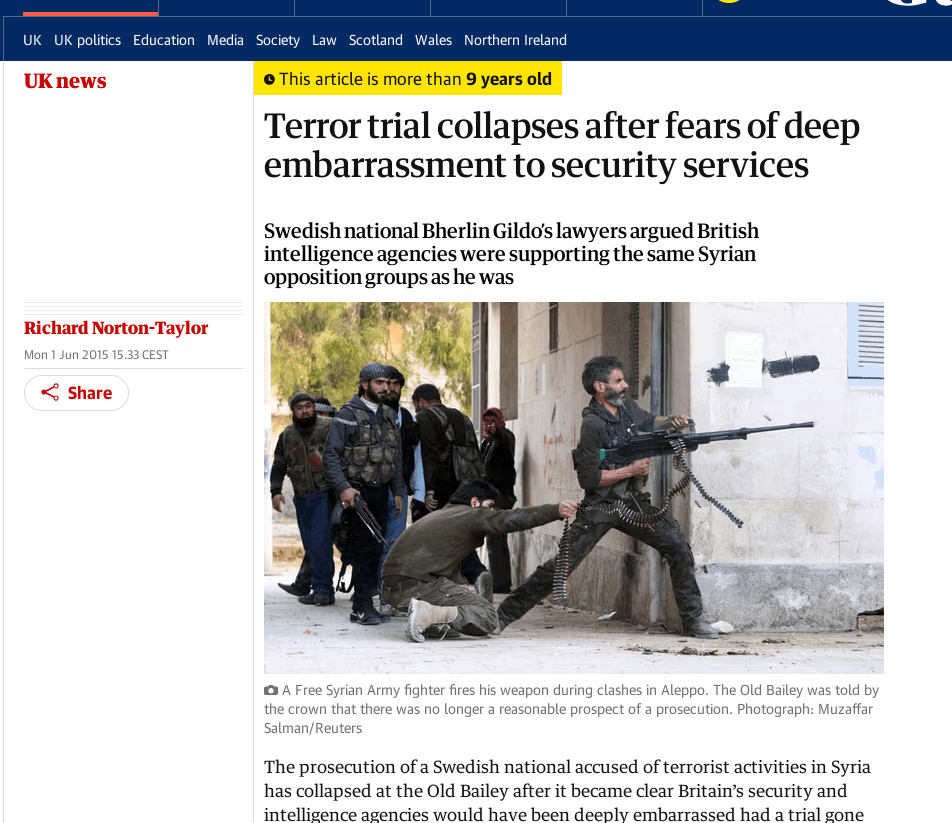
    The Guardian

    Manchester

    The British government’s official enquiry into the Manchester arena bombing had to hold secret ‘closed sessions’. No doubt to avoid even more significant ’embarrassment’ to the security services.

    The subject deserves more detailed treatment, but I’ll make a few observations that seem pertinent.

    It seems likely that the need to avoid risking damaging disclosures of MI6’s extensive collaborations with al-Qaeda linked militants, was one reason why Salman Abedi was not picked up upon returning to the country, despite multiple warnings about him.

    Salman’s father Ramadan Abedi had a history of cooperation with MI6. Whilst among his associates were figures linked to al-Qaeda senior leadership, including:

    • Abdel Hakim Belhaj – former head of LIFG
    • Abu Anis al Libi – who had been instructed to develop AQ network in Libya by al Azawari.
    • Abdul Basset al Azzouz – an expert bomb-maker, who had lived close to the Abedis in Manchester

    Given Ramadan’s background, he could potentially cause headaches for the British security state, if he was so minded.

    Subsequently, Ramadan’s oldest son Ismael was allowed to leave the country despite being due to appear at the Arena enquiry. Ramadan and his wife were said to be keeping a low profile in Libya.

    Attempting to account for their inaction before the bombing, British officialdom has intimated that Salman Abedi was not picked up because Libya was not at that time on their counter-terrorism radar.; with the policies for returning foreign fighters being focused on Syria.

    This is not a plausible line. Not when knowledge of an extensive terror network in Libya was in the public domain. For instance:

    • 2012: reports of a jihadist safehaven in Derna the north-east of Libya under leadership of Basset al Azzouz: “The threat to Western security posed by al Qaeda in eastern Libya was mainly “over-the-horizon” according to the official – but had the potential to become significant because of Libya’s proximity to Europe.”
    • 2014: mainstream reports of ISIS being in control around Derna

    Salman Abedi, it was reported after the attack, had met in Libya with members of, “Katibat al-Battar al-Libi, a core Islamic State unit that was headquartered in Syria before some of its members dispersed to Libya.” Many of its members were reported to have returned from Syria to Derna.

    It is likely that through such contacts, Salman and his brother Hashem acquired the wherewithawal to put the explosive device together – with its sophisticated detonator. The al-Battar group was linked to the perpetrators of the 2015 Paris attacks. Which included the Stade de France suicide bombing attempt. Security sources said that that bomb had the same fingerprints as the Manchester attack.

    Sharp Power

    I concluded my previous article on MBN’s ‘savvy’ approach to counter-terrorism, discussing his demise as Crown Prince at the hands of his cousin Mohammed bin Salman (MBS). This took place within a couple of weeks of the Manchester bombing. As the Palace coup played out, the Saudis enacted measures against Qatar.

    As MBS consolidated his powerbase, purges would also remove Prince Miteb from his position of influence. Payments made to MBN’s and Miteb’s front companies and personal accounts provided a pretext of ‘fighting corruption’ for their arrests. Like Saad al Jabri, Salah Fustok is now also said to be a wanted man in Riyadh.

    But MBS’s agenda to replace MBN had been in the offing for couple of years, with some encouragement from the UAE’s Crown Prince MBZ . There are indications, from Canadian court filings made by al Jabri that MBS had, by summer 2015, turned against the Kingdom’s involvement in the Syrian conflict. And this was again under the influence of MBZ, who was pursuing an anti-Muslim Brotherhood agenda.

    Mohammed bin Salman has been considered the driver of Saudi Arabia’s war on Yemen. But in leaked emails where the UAE’s ambassador in Washington and pro-Israeli (and anti-Qatar) thinktankers intrigued against MBN, it was said that by spring 2017, MBS already wanted out of the war.

    However, these influencers felt that there was some leverage over him that could be exploited, so as to keep the war running. Suggesting that the military campaign against Yemen, may have been a convenient enactment of the interests of other powers. Powers that can be found among those who had before comprised the ‘Friends of Yemen’.

    One can only speculate about the nature of any leverage held over bin-Salman. It would, though, be just one more example of a double-ended ‘sharp power’ game playing out between the Gulf monarchies and their longstanding western sponsors. A Machiavellian game often tending to revolve around accommodating the strategic concerns of Israel.
  • Jihadi Rehab: Regime change and the ‘Prince of Counterterrorism’

    Sep 21st, 2024

    US grand strategy and Saudi counterterrorism: turning domestic insurgents into mercenaries

    Prior to his ouster in a palace coup Crown Prince Mohammed bin Nayef was viewed by US and British intel agencies as someone they could very much do business with. Indeed, he had been educated in the US and later received training from the FBI and Scotland Yard.

    Mohammed bin Nayef (MBN) had been for over a decade the Saudi regime’s most influential security official. Former director George Tenet regarded MBN as the CIA’s closest partner in fighting Al Qaeda, and the threat it posed to the House of Saud during 2003-6. The Prince “was someone in whom we developed a great deal of trust and respect,” Tenet said.

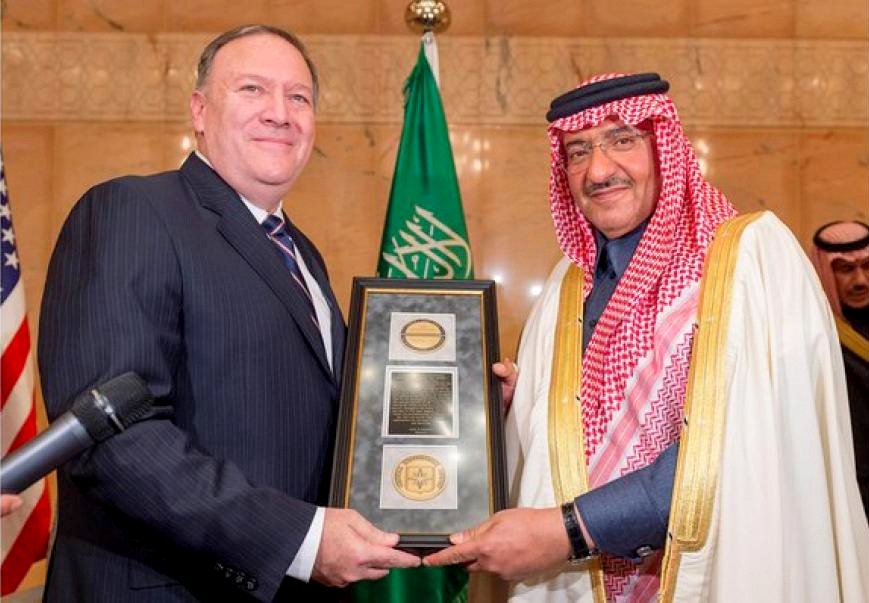
    MBN would become head of Saudi intelligence in February 2012. Under his adviser and intel chief Saad Aljabri, MBN’s security ministries ran a network of informants inside Al-Qaeda in the Kingdom. The CIA would award MBN a medal in 2017. He had received the Legion d’honneur from the French also.

    Lauded as the most successful Arab intelligence officer, he had access to President Obama’s inner circle. His approach to ‘counterterrorism’ in the desert kingdom was praised as “savvy” and “accomplished”.

    Heading up the Ministry of the Interior, he was sometimes criticised in hand-wringing articles from US thinktanks and liberal media for treating human rights activists as ‘terrorists’. But it was approach to extreme Sunni militancy that interests me here.

    That Al Qaeda was first formed by Saudi salafists and received much of its funding from powerful families in the country was an open secret, especially after the 9-11 attacks. This was a tricky issue for both the House of Saud and its sponsors in Washington and London.

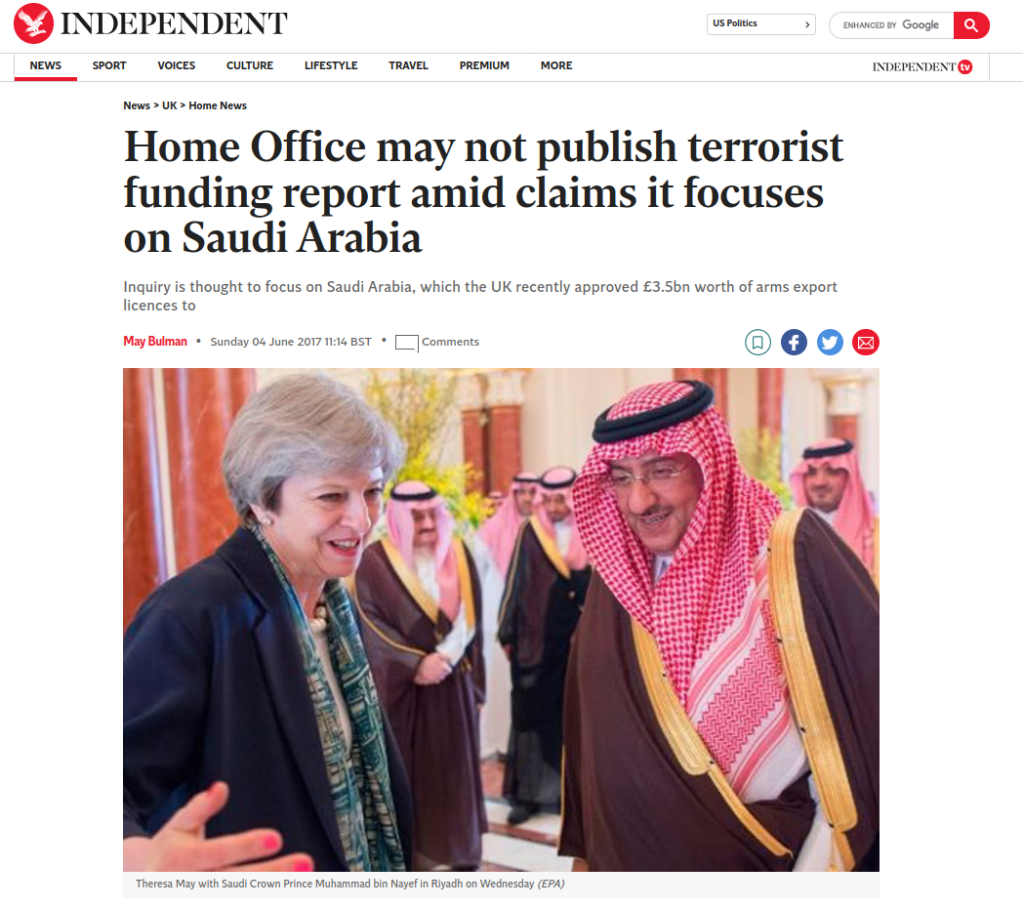
    A report reluctantly commissioned by Theresa May’s Home Office in January 2016 on funding for Islamist terrorism was subsequently left unpublished.

    The shelving came to light in the aftermath of the Manchester Arena bombing, in May 2017. As a spokesman for the Liberal Democrats wrote:

    It is no secret that Saudi Arabia in particular provides funding to hundreds of mosques in the UK, espousing a very hardline Wahhabist interpretation of Islam. It is often in these institutions that British extremism takes root.

    The report’s contents were considered too sensitive to publish, given the UK’s close cooperation with the Saudi regime. Prime Minister May had previously defended the extensive relationship as being effective counterterrorism, “keeping the streets of Britain safe“.

    A decade or so earlier MBN’s innovations in ‘counterterrorism’ centred around the ‘rehabilitation’ of militants. Special prisons were built, including the ‘Mohammed bin Nayed Centre for Counselling and Care’. Dubbed in the media as ‘Betty Ford for jihadists’ (mostly captured Al-Qaeda operatives).

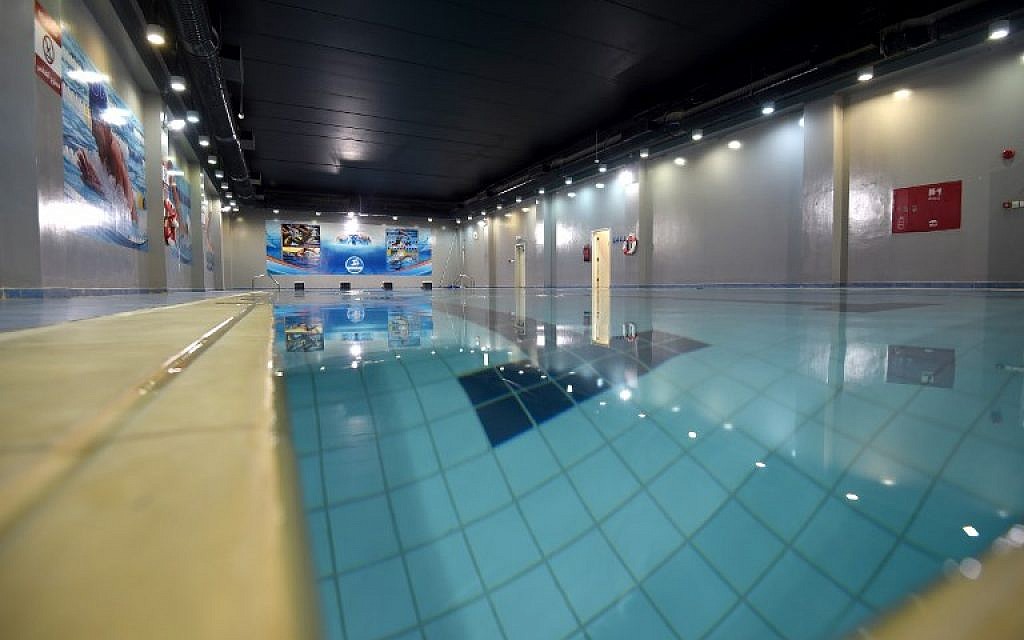
    Times of Israel: “With its indoor swimming pool, sun-splashed patios and liveried staff, the Saudi complex has the trappings of a five-star resort, but it is actually a rehab center — for violent jihadists.”

    Described as ‘cushy’ the approach would involve perks for its ‘beneficiaries’, including gyms, and passes out to attend weddings and funerals. Families of the inmates would be involved in their ‘care’ and would receive allowances for housing, medical treatment and education. And so would have a stake in the successful ‘rehabilitation’ of the wayward men.

    But it appears this level of indulgence and largess was not extended to human rights activists. A critique of the policy found that:

    The programmes’s counsellors reportedly seek less to disabuse imprisoned militants of their hard-line views than to reinforce the primacy of the Saudi state in determining the appropriate use of violence.

    While non-violent rights activists were usually banned from travel overseas, ‘graduates’ of the centre could have international travel facilitated for them. As a father of a graduate said: “If you’re in Al Qaeda, they reason with you, give you money, a car, a wife.”

    There was, reportedly, a high rate of recidivism with many militants arrested after Al Qaeda attacks, turning out to be have been graduates of the special prisons. It also appears that jihadists returning from Afghanistan, Syria and elsewhere would often be sent for a stay at the special centres.

    The House of Saud had gambled that they would not be overthrown by Al Qaeda, as long as they continued to tolerate Wahhabi schools and found a modus viviendi with domestic militants.

    This ‘innovative’ approach to managing the Kingdom’s problem with Al Qaeda seems to have developed in the same period as a shift in American policy on the Middle East and North Africa (MENA) region. It is in this context that MBNs counterterrorist programmes must be understood.

    This shift in US strategy took place in the years following the invasion of Iraq. It was reported on by Seymour Hersh in a February 2007 article for the New Yorker entitled ‘The Redirection’. Given all that has passed since, it can in my view, be considered a landmark piece of reportage.

    According to Hersh’s reporting, US policy making circles were dismayed to see that the invasion of Iraq had led to an upsurge of Iranian influence in the region. Although they had recently focused their post 9-11 efforts on targeting Sunni militancy, a strong anti-Iranian sentiment among the US policy elite would mean a ‘redirection’, towards weakening Iran and its perceived allies in the region – chiefly Syria and Hezbollah.

    Citizens in the US, Britain and elsewhere had protested en masse against the invasion of Iraq. So there clearly wasn’t public appetite for further large-scale military operations in the region. A different approach would have to be employed in order to realise the objectives.

    The Machiavellian plan would see US agencies, and their British sidekicks, forge an alliance between the House of Saud, salafist militancy, Qatar, Turkey and themselves, with the approval of Israel.
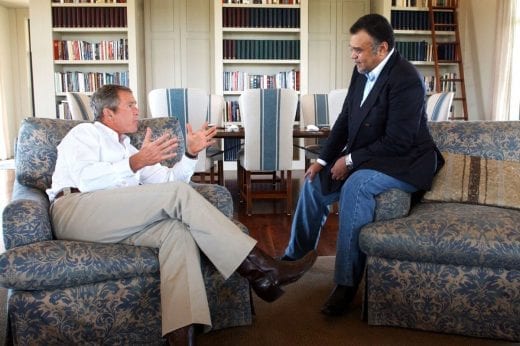
    ‘Bandar Bush’ was Saudi national security chief at the time of the ‘Redirection’

    The danger of working with the Salafis was self-evident. Sources that spoke to Hersh acknowledged they would be, “mobilising the worst kind of Islamic radicals. Once you get them out of the box, you can’t put them back.” And that the Salafis were “sick and hateful…if you try to outsmart them, they will outsmart us. It will be ugly.”

    But US policy makers considered weakening Shi’ite influence in the region and smashing the remnants of Arab Nationalism as their primary objectives. The political outlook of the Salafist Muslim Brotherhood had long been understood as being more amenable to the economic and corporate imperatives of the anglo-american deep state.

    A fellow at the Council of Foreign Relations Hersh spoke to:

    ..compared the current situation to the period in which Al Qaeda first emerged. In the nineteen-eighties and the early nineties, the Saudi government offered to subsidize the covert American C.I.A. proxy war against the Soviet Union in Afghanistan. Hundreds of young Saudis were sent into the border areas of Pakistan, where they set up religious schools, training bases, and recruiting facilities. Then, as now, many of the operatives who were paid with Saudi money were Salafis. Among them, of course, were Osama bin Laden and his associates, who founded Al Qaeda, in 1988.

    This time, the U.S. government consultant told me, Bandar and other Saudis have assured the White House that “they will keep a very close eye on the religious fundamentalists. Their message to us was ‘We’ve created this movement, and we can control it.’ It’s not that we don’t want the Salafis to throw bombs; it’s who they throw them at—Hezbollah, Moqtada al-Sadr, Iran, and at the Syrians, if they continue to work with Hezbollah and Iran.”

    As the programme was to be largely funded by the Saudis and Qataris, Congressional and Parliamentary oversight could be bypassed by the three letter agencies involved. It could be done ‘off the books’, in a similar fashion to the Iran-Contra funding scheme for operations against Nicaragua’s Sandinistas in the 1980s.

    Hersh’s article is evidence that the quote unquote ‘Syrian Revolution’ was not so much a groundswell from the streets after the Arab Spring, but something having its roots, more perhaps, in Fort Meade, Maryland and Vauxhall Cross, London. Sy Hersh’s reporting implies that US clandestine activities in support of the Muslim Brotherhood against the Baathist state were already underway by late 2006. This is over four years before the Arab Spring and the supposed ‘Syrian revolution’.

    American General Wesley Clark said publicly in 2007, that shortly after 9-11 Pentagon officials told him the plan was to: “take out 7 countries in 5 years: Iraq, Syria, Lebanon, Libya, Somalia, Sudan, Iran.“

    I’m sceptical about the motives and timing of his ‘disclosure’. Others have sensed faux naivete in the interview. But it seems the public were being prepared to accept further chaos in MENA, and to have the impression that this was consistent with prior strategizing.

    In 2013, former French foreign minister Roland Dumas would let slip on a talk show, that in 2009 he had met with officials at the British foreign office who were planning to oust the government of Syria.

    While the BBC had been active in Syria (pdf) since at least 2004 working to make it a more conducive place for liberal ‘civil society’ and western ‘development’ NGOs.

    It appears to be the case that MBN’s success in taking on domestic Al Qaeda militancy in the mid-2000s was to serve as a basis to enable the ‘redirection’ of jihadis; from domestic insurgency into effective mercenaries for regime change in Libya and Syria, and as a counterweight to the growing Ansarallah (Houthi) movement in Yemen.

    Viewed in this context the rationale for elements of MBNs unusual ‘counterterrorism’ spending can be discerned. Ostensibly, the spending was undertaken with the aim to “recruit personnel and develop intelligence service contacts to penetrate Al-Qaeda.” But a few more details about the secret programmes have since come to light in relation to the case of Saad Aljabri.

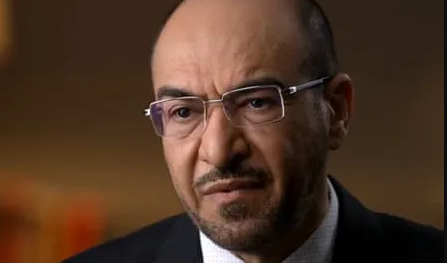
    Saad Aljabri described as “deep state liason between Saudi Arabi and western powers”

    Aljabri was MBN’s right-hand man at the Ministry of Interior, a most senior non-royal security official, regarded by US officials as a ‘deep state liason’ between the Kingdom and the ‘five-eyes’ powers.

    He is, though, now holed up in Canada after slipping out of the Kingdom to Turkey in May 2017, not long before his patron’s ouster and house arrest.

    Security agencies there acknowledge that he is a likely target for Mohamed bin Salman’s hit squads. He seems to be a man who knows rather too much, as this account of the Palace coup relates: “He knows every foible, every misstep that Saudi royals have made.“

    “In my opinion, he holds the keys to Pandora’s box for the current Crown Prince” said a former Canadian intel officer. “Any secrets they have, business dealings, security issues — it is information I’m sure the current Crown Prince wouldn’t want in public.”

    Aljabri, accused of embezzlement, is the subject of lawsuits by state linked firms in Saudi. But the firms were first set up through MBN’s personal counterterrorism account. A network of front companies was established as “vehicles in the private sector to disguise sensitive activities.“

    Aljabri and MBN’s defenders point to a December 2007 decree from King Abdullah authorising the spending. They say they were following ‘standard practice’ for intelligence agencies. A practice they had presumably picked up from their tutors in the western security apparatus. The 2007 decree authorised outlays for:

    • Secret airports
    • Aviation transport services
    • Contracts with a Turkish construction company
    • Security resources (including weapons and encrypted communications)

    Somewhat surprising items for a domestic counterterrorism budget. The proportion of Interior Ministry revenues flowing into MBN’s own counterterrorism account would be boosted in subsequent years.

    US and Canadian officials would prefer that the lawsuits against Aljabri be settled out of court to avoid disclosure of any sensitive details about covert US-Saudi programmes. In Boston, one of the cases has been thrown out of court. The director of US National Intelligence, Avril Haines invoked state secrets privilege to prevent disclosure of classified information damaging to ‘national security’. Similar motions have been filed by the Canadian CSIS in Ontario courts.

    It seems that the door for MBN’s ouster in June 2017 was opened as the progress of the proxy military operations against the Syrian Arab Republic ground to a halt. And the consequences of adopting a ‘counterterrorism’ approach that enabled Al Qaeda linked sick salafis got out of hand, not least for the British; who had adopted their own soft approach to homegrown jihadis. I’ll take a closer look in a subsequent article.

    Interested readers can find many sources on the connections of Manchester Arena suicide bomber on the page on A Closer Look on Syria

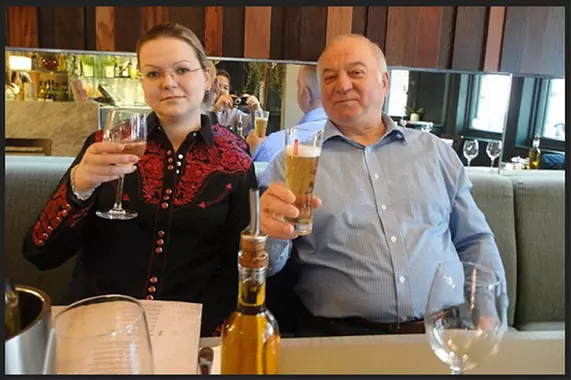
  • What really happened to the Salisbury “nerve agent” victims?

    Mar 30th, 2024

    Featured Image: Fire service personnel use absorbent powder to soak up vomit they believed to contain fentanyl. (March 4, 2018)

    The 2018 Novichok affair poisoned relations not only between Russia and Britain, but also more widely between western governments and Moscow. The international response to the British claims resulted in greatly reduced diplomatic engagement.

    Others have highlighted the many absurditities of the official narrative and the clear incompleteness of the official evidence for it. And I’ve previously covered the later events in Amesbury that were to be linked to the Skripal affair.

    This article puts forward an account that reconciles evidence the Skripals were treated for a fentanyl/opioid overdose, with subsequent official findings that biomedical samples indicated exposure to a nerve agent. The article is somewhat narrowly focused, avoiding other questions as to who first poisoned the pair, or for what motive.

    For some time I had wondered how the OPCW found indications of nerve agent exposure in the biomedical samples, when the reports and testimony suggested the pair had been exposed to fentanyl. I now think I can see how this came about or was, rather, brought about

    This outline is intended as schematic, and as a starting point for further enquiry from a non-expert perspective, rather than as a definitive account.

    After briefly presenting the evidence that the Skripals’ medical emergency was indeed due to fentanyl – or a similar opioid analgesic – and not a nerve agent; I’ll outline how, in principle, biomedical samples indicating nerve agent exposure could be consistent with medical treatment for symptoms of overdose of an opioid analgesic. Such a scenario is consistent both with the reporting and official statements concerning not only the Skripals, but also the other purported Wiltshire ‘Novichok’ victims.

    Available evidence supports that their treatment plans were contrived and adapted, with the desired biomedical test results in mind.

    First things first – they did not fall ill due to poisoning with a nerve agent

    Initial reports indicated they were treated for fentanyl overdose:

    • Paramedic responding to Salisbury drama thought drugs were cause, Salisbury Journal, March 15, 2018

    A PARAMEDIC who was among the first to respond to
    Sergei Skripal and his daughter told the Prime Minister they had
    initially treated the pair for drugs. … The man, named Ian, said he
    had been in the first ambulance service response car on the scene. Mrs May asked him: “At that stage you could only treat for what you can see?”

    Salisbury MP John Glen interjected to say he had heard initial reports the incident was drug-related. To which the paramedic replied: “Absolutely that’s what I was treating for, that’s what we treated them for initially.”

    That this was the the initial diagnosis and course of treatment would be later corroborated by testimony from a ward sister at the hospital, who told BBC Newsnight that there was no mention of ‘nerve agent’ in the original assessment and treatment of the pair. This was the case for at least 36 hours.

    Other media reports in the days following discounted nerve agent exposure. The Daily Mirror reported a source from the Defence Science and Technology Laboratory (DSTL) at Porton Down:

    Scientists at the secret lab, which has state-of-the-art equipment to look for trace amounts of substances, have reportedly ruled out nuclear material or a nerve agent in preliminary toxicology tests...

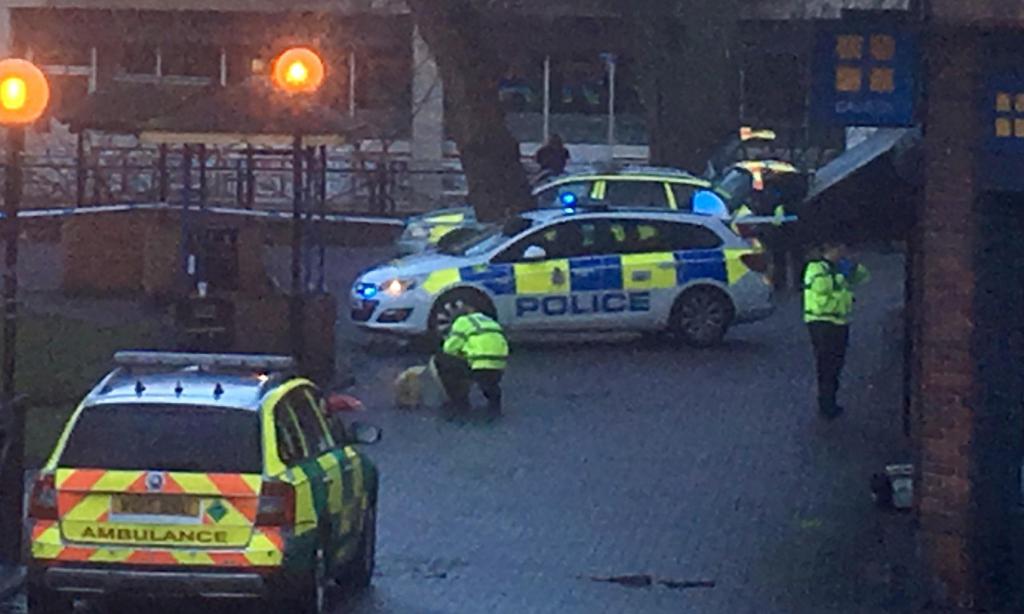
    Police offices at the scene after the Skripals were taken to hospital. Unaffected by the military grade nerve agent, like evryone else who atteded the SKripals there.
    Police officers at the scene after the Skripals were taken to hospital. Unaffected by the ‘military grade nerve agent’

    Despite:

    • the first responders, – including, apparently the CBRN trained Chief Nursing Office of the British army – who attended the Skripals not noting signs of nerve agent
    • or being affected themselves by nerve agent exposure
    • and a DSTL source having previously ruled out nerve agent
    • and Police and Public Health England both assuring no risk to public
    • and hospital staff not considering nerve agent poisoning during the first 36 hours, but treating for opioid overdose – (the details of blood tests taken by the hospital in this period are unaccounted for).

    It was subsequently announced by Her Majesty’s Government that the Skripals were poisoned by ‘Novichok’ which was, they said, a very deadly and uniquely Russian chemical nerve agent…

    So how would the Skripals have been treated? And how could the OPCW’s samples indicate exposure to a nerve agent?

    After admission to the hospital they were found to be needing help with their breathing, and Yulia was ‘intubated’ – a tube inserted down her throat. As is consistent with standard practice in treating ‘respiratory depression’, the primary symptom of opioid analgesic overdose.

    Fig: Decision Tree for Managing Opioid analgesic Overdose in adults

    The standard response to fentanyl overdose is use of naloxone. It is likely, then, that the first line of treatment by a paramedic, and then in hospital would be naloxone injections. Which are a relatively simple procedure. Naloxone kits are now even distributed to families of addicts

    But the Skripal’s case was not an ordinary one, concerning persons with substance abuse problems. The pair’s identity becoming public was to greatly impact the hospital’s management of the case. Here is a summary of events at the hospital.

    When the Skripals were found, an opioid overdose was suspected…

    “The evening that Yulia and Sergei were admitted, at that point we were led to believe that they have taken an overdose, so there was no mention of nerve agent poisoning,” … ward sister in charge of the shift on March 4, told BBC2’s Newsnight in an interview broadcast on Tuesday. “They were needing their support with their breathing and support with their cardiovascular system.”

    “At first, when they first came in, there was no indication of the fact that it was a nerve agent. And therefore, we take our normal protection when any patient comes in but would have not at that point taken any extra precaution in terms of protecting ourselves,” ..

    But by the morning of the 6th the management of the case had drastically changed. London’s Counter Terror Policing Network (CTPN) had taken over the investigation. Police Officer Nick Bailey presented to the Hospital and specialists from Porton Down began to ‘advise’ the medics.

    From that point on, doctors at Salisbury Hospital began to administer medical treatment, the details of which are kept secret due to medical “confidentiality” concerns. The hospital continued to receive advice from international experts, including the Porton Down chemical weapons research laboratory.

    “Clinical decisions were ours, but we would be foolish not to take their advice, which we did. And I think that helped,” intensive care consultant Dr. Jukes noted. “When we began seeing some improvements, it happened a lot quicker than anticipated. Certainly, when you look at these groups of nerve agents, the expectations from the textbooks, the journals suggested a much longer period of recovery.”

    The pair had been put into induced comas.

    ‘Anticholinergic syndrome’ would be among the effects of a fentanyl or other opioid analgesic overdose.

    In general, the symptoms of opioid intoxication and nerve agents are dissimilar, with somewhat opposite actions. But cholinergic symptomology quite similar to that of nerve agent exposure can be caused by opioid reversal, such as that produced by naloxone’s opioid receptor antagonism. Naloxone treatment causes ‘precipitated opioid withdrawal‘ which is said to be intensely painful and disorientating.

    Precipitated opioid withdrawal is characterised by the rapid onset of opioid withdrawal symptoms (such as aches, nausea and vomiting, diarrhoea and abdominal cramps, dilated pupils, running nose, yawning) …

    It can, then, be clinically necessary to mitigate the rapid loss of analgesia caused by opioid reversal.

    Moreover, naloxone may be only briefly effective against long acting opioid analgesics. The effects of certain fentanyl analogues like carfentanil are said to be even less responsive to naloxone treatment.

    But other ‘respiratory stimulants’ can be used to reverse opioid intoxication. One such agent is physostigimine – considered a “a safe antidote to treat anticholinergic overdose”.

    Physostigmine is classed as a ‘reversible cholinesterase inhibitor’. While nerve agents are ‘irreversible cholinesterase inhibitors’.

    Although it’s a standard drug that a hospital would have in its inventory, phsyostigimine also happens to be well known in the field of chemical warfare. So it is possible that once Porton Down’s experts began ‘advising’ medics, this drug was employed instead of naloxone.

    Its use would, also, cause symptoms of precipitated opioid withdrawal. So it would be considered desirable to combine it with something to attenuate the intense withdrawal symptoms.

    Combining use of the physostigimine as a respiratory stimulant, with the irreversible cholinesterase inhibitor diisopropylflourophosphate (DFP) – a weakly toxic analogue of sarin – appears to be a way for the ‘experts’ to kill two birds with one stone, three birds even.

    Molecular structure of DFP

    DFP has an analgesic effect that would attenuate the symptoms of withdrawal produced by physostigimine’s opioid receptor antagonism.

    The hospital would likely also have DFP available in its inventory. It can be used in eyedrops to treat miosis or glaucoma.

    It happens that physostigimine is known to have a prophylactic effect against exposure to the ‘irreversible’ effects of nerve agents, including DFP. It is often used in experiments for this prophylactic effect.

    Using the two agents in combination would be a method to pull the patients out of the symptoms of opioid analgesic intoxication, with the DFP and physostigimine mutually mitigating one another’s adverse effects.

    Use of DFP would then leave biomarkers consistent with nerve agent exposure in the samples taken by the OPCW. I suspect this, or something along quite similar lines, is the explanation of how OPCW found signs of a “toxic chemical that displays the properties of a nerve agent” in samples taken in a public hospital setting.

    Given that the British government was making great play internationally of the poisoning, it seems the advisers from Porton Down devised a treatment plan to suggest to the hospital doctors, that would leave biomedical traces consistent with exposure to nerve agent. So I suggest that after abandoning naloxone, such a combination of physostigimine and DFP was used to treat the Skripals’ symptoms of opioid analgesic intoxication.

    The summaries made public by the OPCW of the closed reports don’t say anything about ‘Novichoks’, but only a “toxic chemical that displays the properties of a nerve agent”.

    And this is said to be the same agent indicated by biomedical samples taken from Dawn Sturgess and Charlie Rowley. This implies that Amesbury pair also received a similar treatment plan, once the management of that case was also taken over by security agencies.

    As the UK requested that the OPCW reports be kept closed, we do not have the details of the test results. That this secrecy was requested would tend to imply that the results were only weakly supportive of the Novichok claims. Why request secrecy if they had stronger confirmation of the claims, given the intense international scrutiny?

    Testing for biomarkers of organophosphate nerve agents can leave considerable indeterminacy; as the agents bind to the enzymes, and are often quickly metabolised in the body. The testing processes often can’t necessarily exclude exposure to another chemical substance with structural similarities.

    It seems likely then that DS Nick Bailey was really a volunteer, ‘dummy’ patient sent to the hospital by the British secret services in order to corroborate the government’s narrative of the use of a Russian chemical weapon on the streets of a sleepy English Cathedral city.

    Portrayed in a British TV dramatisation

    Perhaps he did receive opioids during his two weeks in hospital, used to manage the discomfort, alongside a physostigimine/DFP type combination. If he was treated with such a managed combination of mutually mitigating drugs, it would cause little harm, but would leave the required traces to support the desired narrative. Like Charlie Rowley he seemed to make a full physical recovery

    He later said on TV

    “… The drugs I was put on at the hospital had side effects as well and it’s quite difficult to differentiate between the Novichok and the drugs I was on. I had hallucinations and vomiting. It was terrifying.

    Such symptoms could be consistent with the cholinergic effects of physostigimine.

    Update November 3, 2024 – Like a dummy, I didn’t know the difference between ‘intubation’ and a ‘tracheostomy’. Thinking that Yulia’s scar was attributable to intubation. The article has been amended.

    A Salisbury Hospital Doctor’s witness statement released for the Dawn Sturgess Inquiry confirmed that she needed mechanical ventilation and was intubated in the initial stages of her treatment.

    Tracheostomies were performed on the Skripals much later on March 21st, according to his witness statement. A rather abrupt and drastic intervention on both of them, after the pair’s conditions had obviously been stable for some time. This happened to be just ahead of the visit of the OPCW team to collect blood samples.

    Another Doctor’s statement informed that Yulia regained consciousness, during a pause in her sedation on March 8, four days after her admission and showed no obvious signs of having sustained neurological damage.

    Coda

    The account given here would imply that when the OPCW team visited Salisbury to take environmental samples, they were guided by British officials to ‘hot spots’ where evidence of ‘Novichok’ had been planted.

    Specific criticism of this outline is welcome in the comments. I take what I have presented above to be a plausible and logically based account of what could have happened, that’s consistent with the publicly available evidence.

    As against a strange tale of a delayed action rare Russian nerve agent in a perfume bottle, smeared on a door handle, by conspicuous and unprofessional seeming agents – quite a comedic sounding assassination plot.

    Using an exotic, unpractical poison, the very name of which inculpates you.
  • Al-Ahli – The view from London

    Nov 14th, 2023

    …As I indicated last week, we have taken care to look at all the evidence currently available. Mr Speaker, I can now share our assessment with the House. On the basis of the deep knowledge and analysis of our intelligence and weapons experts…the British government judges that the explosion was likely caused by a missile – or part of one – that was launched from within Gaza towards Israel.
    The misreporting of this incident had a negative effect in the region – including on a vital US diplomatic effort – and on tensions here at home. We need to learn the lessons and ensure that in future there is no rush to judgment. 

    This is how the British Prime Minister addressed the House of Commons, about the horrific Al Ahli attack, on October 23, 2023.

    You’ll probably have registered the qualifier ‘likely’ used in the statement. It’s curious, because in recent times the official conclusions of British Intel agencies on high profile international incidents such as this, have often been prefaced with ‘highly likely’.

    For what it’s worth, my own assessment remains that this was an intentional attack by the Israeli Air Force with a bomb and not a missile. Others with greater investigatory experience and skills than me have also reached this conclusion reviewing both the impact scene and video footage of the night skies. See this comprehensive report by Michael Kobs.

    Although the type of bomb used is not 100% confirmed, as I speculated in the week following the attack, it was most probably a variant of the GBU-39 ‘Small Diameter Bomb’. Photos and videos of the scene the next morning reveal pieces of debris that could fit with the ‘Diamond Back’ wing assembly employed on these munitions. (See also the updates on my last post).

    A screen grab from mobile phone video footage. The metallic rectangular object (centre, in front of the child’s backpack) looks like the underside of a ‘diamond back’ wing

    I suspect the object bottom right in the BBC graphic is a part of a diamond back’s cover.

    I wrote before that a variant of this type of smart bomb – the GBU-39 (A/B) Focused Lethality Munition (FLM) – had properties that could fit with the observed general characteristics of the blast.

    A museum model of Boeing’s FLM

    Michael Kobs’ report is conclusive that the blast was not an air burst. Although there are some unusual features of the impact site indicating it was probably not a regular high explosive munition with a conventional bomb casing. The Boeing FLM with its Dense Inert Metal Explosive looks the most likely candidate. As a Defense Industry Daily article on the FLM informed:

    A carbon-fiber bomb body disintegrates instead of fragmenting, which adds explosive force nearby but largely removes shrapnel issues beyond. Inside, metal particles turn the explosive material into short-range projectiles.

    This, in my view, accounts best for the unusual features at the impact scene – wide effects, but low amount of fragmentation marks. Videos of the aftermath that evening are truly shocking. Even if the death toll according to authorities in Gaza might be inflated, the courtyard was evidently packed with families.

    To me, all this now seems fairly clear. What I do find hard to understand, though, is how the initial sense of media reporting on the night could have seen such a ready volte-face.

    A BBC TV reporter who said, as the horrific aftermath was unfolding:

    ‘It’s hard to see what else this could be really, given the size of the explosion, other than an Israeli airstrike or several airstrikes because when we’ve seen rockets fired out of Gaza, we never see explosions of that scale. ‘We might see half a dozen or maybe a few more people being killed in such rocket attacks but we’ve never seen anything on the scale of this sort of explosion on the video I was watching earlier, which as you say, is still to be verified.’

    …was, in the days following, publicly shamed for this quite reasonable and appropriate assessment.

    BBC senior management would apologise for ‘speculating’, as the Israelis put out a gish-gash of self-contradictory messaging in their attempts to deflect the blame. Kobs’ report demolishes these claims, along with those of a London based academic ‘research agency.’

    But could the analysts of official British agencies have earnestly reached the conclusion that it was a missile from Gaza. And what does their term “likely caused” really imply?

    If we assume that an assessment of ‘highly likely’ would be intended to signal a high degree of confidence – as their US counterparts were said to have in the same conclusions. Does ‘likely’ signal just moderate confidence, or less perhaps?

    A worthwhile (2017) article from former Canadian Intel analyst Patrick Armstrong – ‘When Intelligence Isn’t‘ – can help us understand what could be going on behind pronouncements like this from officialdom. In these times, national security analysts can have high confidence, most of all, in knowing what their paymasters expect them to say.

    It seems likely to me then, that some of the British analysts felt uncomfortable and wanted to signal their distance from the conclusion they inevitably had to draw.

    The British establishment hasn’t exactly been coy about showing where its sympathies lie since Hamas’ raids on October 7. A dissenting voice from within its ranks who called for a ceasefire in parliament quickly experienced a ‘fall from grace‘.

    10 Downing Street in the days after October 7

    Will the increasingly massive civilian death toll in Gaza prompt the illumination of Downing Street with the Palestinian flag in a display of solidarity? It seems unlikely, given that widespread calls for the British Government to demand a ceasefire are dismissed by the leadership of both main parties. That would, they assure the public, only be ‘perfomative’ and ‘symbolism’ and wouldn’t really achieve anything.


    For more on the Al Ahli Hospital Bombing see the A Closer Look on Syria wiki pages

  • What hit Al-Ahli Hospital in Gaza?

    Oct 24th, 2023

    On October 17, 6.59pm local time an explosive strike hit the courtyard of the Anglican Al-Ahli Hospital, in the Gaza strip. Reports suggest many people were crowded in the courtyard outside at the time. This video from the morning after gives some impression.

    After reports began to circulate Hannanya Naftali an advisor to the Israel PM tweeted:

    “BREAKING: Israel Air Force struck a Hamas terrorist base inside a hospital in Gaza. A multiple number of terrorists are dead.”

    Soon after he deleted the tweet.

    In the days after there has been much focus on video evidence from CCTV cameras with different views of events in the skies over Gaza, with claims from the Israel Defence Forces that an intercepted rocket fired by Palestinian combatants had fallen on the hospital grounds, and hence the IDF was not responsible.

    Major Western media outlets would swing round to amplify this claim. An informational barrage, seemingly intended to obscure the facts and distract audiences from the wider context. The IDF also released a doctored audio purportedly of Palestinian Islamic Jihad fighters acknowledging the explosion was due to one of their downed rockets. Both these claims have now been debunked.

    My analysis here does not focus on the released CCTV footage and speculation about what the lights in the sky might show. Instead I focus on the strike itself, the scene, and the best inferences that can be made about the weapon deployed, based on a wider background of relevant sources.

    There are number of unusual aspects to the strike and the nature of the blast and impact that seem confounding. Here, I mean to show how they are reconciled. Analysis of the scene and the crater – some of which is compiled on the ACLOS research wiki – is consistent with the following:

    • A small crater
    • Westerly or WNW direction of origin
    • Steep angle of impact
    • A sizeable blast
    • Some indication of downward pressure, suggesting possible above ground detonation (air burst)
    • Lack of major damage to the buildings
    • High casualties
    • Sound signature characteristic of a guided bomb, immediately before detonation, but with no sound of a jet overhead
    • Reportedly, a lack of fragments from the munition found at the scene

    That Palestinian resistance groups have such a weapon in their inventory is not sustainable.

    By examining the range of weapons the IDF uses for strikes in densely packed urban environments – and accepting the logical necessity than that an attribution to any particular weapon system must show properties consistent with all of the above – one can narrow down the options. This looks to me to be a more logical approach than pouring over CCTV footage. Which is likely to be of limited relevance. There is no reason why such footage would necessarily give any indication of the nature of this particular strike. The IDF was conducting multiple operations at the time, as it had been since the beginning of its retribution on Gaza.

    In the days after Hamas’ raids into the south of Israel, Boeing accelerated the shipping of 1000 smart bombs. These were GBU-39 Small Diameter Bombs (SDB) which Israel had purchased in 2021 for $735 million, according to Defense Post. A plane with such a shipment arrived in Israel on October 11.

    This ‘small diameter bomb’ has a relatively small warhead compared with other bombs. A glide bomb with fold-out wings, it can be deployed as a stand-off weapon from up to 60 miles away, according to the manufacturers. The Israeli Air Force routinely conducts air strikes in the region – including against targets in Syria – while operating over the Mediterranean. An engagement like this would be consistent with crater analysis implying the bomb came from the West or WNW.

    Analysis of the scene indicated a steep trajectory rather than a shallow one. These ”sky-riders” can come into the target not at vertical, but at a steep trajectory (as shown here). They can be fused to detonate on impact or just above (in an air burst).

    Source

    The GBU 39 is specifically designed to minimise collateral damage in close environments. One variant in particular the GBU-39A/B FLM (Focused Lethality Munition) comes with a carbon composite case rather than a steel one, for the purposes of minimising fragmentation – as opposed to optimising penetration. These cases simply disintegrate in the explosion. It also uses a multiphase blast explosive with enhanced explosive effects/lethality (See here on ACLOS for more).

    As I understand it a multiphase blast comprises first a ‘gas phase’ with build up of pressure and then a ‘particulate phase’ that imparts momentum. If the detonation was with a proximity fuze, then this looks consistent with both the signs of downward pressure and the direction implied by the spray pattern around the impact crater.

    In my view, the characteristics of the GBU-39 FLM fit with the takeaway features from analysis of the scene of impact.

    • Small crater
    • Steep angle of impact
    • A sizeable blast
    • Some indication of downward pressure effects, suggesting possible above ground detonation (air burst)
    • Lack of major damage to the buildings
    • High casualties

    They also, I believe, account for the characteristic sound signature heard on the footage immediately before the explosion. In addition a FLM bomb with a disintegrating carbon composite case would explain the inability of Palestinian authorities to produce fragments/ shrapnel from the weapon itself. It also fits with the original claim from Hannanya Naftali that it was their Air Force who struck at the hospital.

    Update 26/10/23

    This screenshot from video of the scene clearly shows two parts matching those of the GBU-39’s fold-out wing assembly. It is surprising the Palestinian authorities have not produced them. They may have been discarded, and their significance overlooked. But now we have concrete supporting evidence.

    Some have suggested Hellfire missiles fired from UAV’s or helicopters may account for the carnage. I believe this is inconsistent with the incoming sound signature, and the explosive force. And such missiles do not have parts like we see here.

    ——–

    For the time being I do not speculate on the motivation for the targeting. Scott Ritter has suggested that the IDF could have received intel of a high profile target at the location. In any case it appears that the courtyard was crowded with Palestinians seeking safety and medical aid.

    To the best of my knowledge the death toll and causality figures produced by Palestinian authorities still lack independent verification.

    Update 28/10/23

    This close up from a photo of the scene (lead image above) also shows an object which also looks to match with the GBU-39’s wing parts.

    Another investigator, with greater technical background and forensic skills than me, thinks apparently that the level of fragmentation is not consistent with a carbon case – as with the FLM variant. The Defense Post article stated the 1000 bomb (2021) contract with Boeing was for the 39B – a “multipurpose” version with a more conventional casing.

    However, at this stage, the question of which particular GBU-39 sub-type was used seems largely academic.

    (Read my follow up Al Ahli: Post script – The view from London )

    (See ACLOS for more there)


    Edited to remove a muddled reference to a motor on the GBU-39. There is a ground launched adaptation with a rocket motor attached. But that is not relevant here.

    Edited to adjust implied direction of origin from others’ spray pattern analysis from WSW to WNW. Due to my initial off hand orientation of scene photos.


    Noted that my work here and on A Closer Look on Syria has been used without crediting.

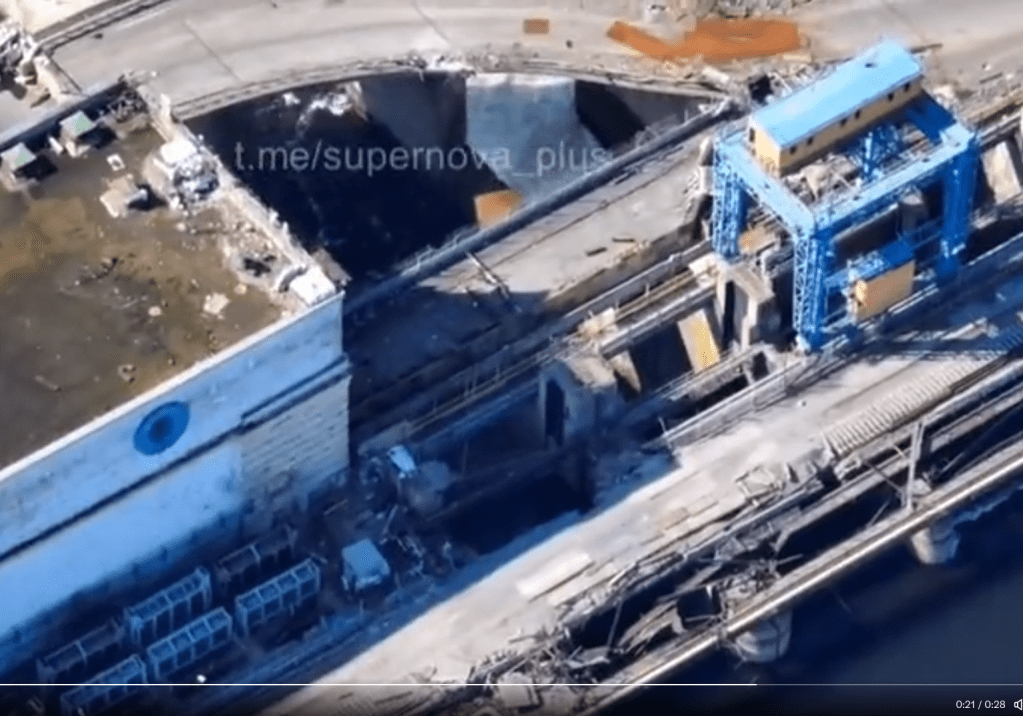
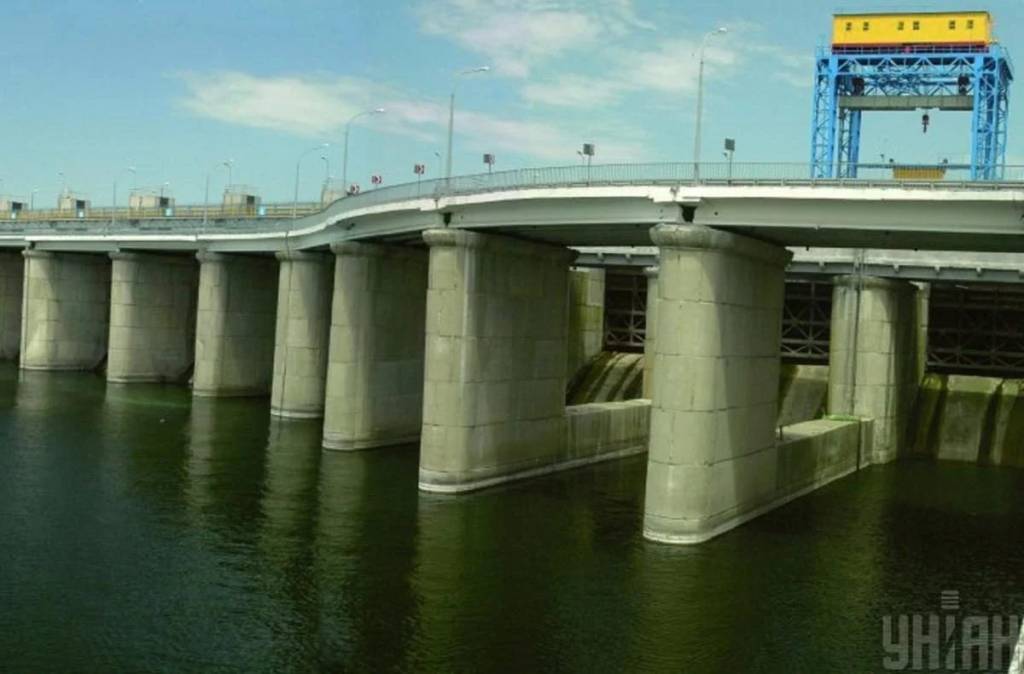
  • Causes of the Nova Kakhovka Dam Disaster: Key takeaways

    Jun 24th, 2023

    Timings indicate no use of explosives to blow the dam:

    • The reported seismic event said to indicate a large explosion occurred at 2:54am local time, but footage revealed the dam had already been breached by 2.46am. This indicates that the seismic signal was most probably produced by the further collapse of the dam structures – like the Hydroelectric Power Plant (HPP) building giving way – rather than the use of explosives.
    • An earlier weak signal at 2.35am subsequently reported by NORSAR, is then likely to be the first breaching event. NORSAR later removed text from the web page.

    The facility had been hit repeatedly by Ukraining shelling:

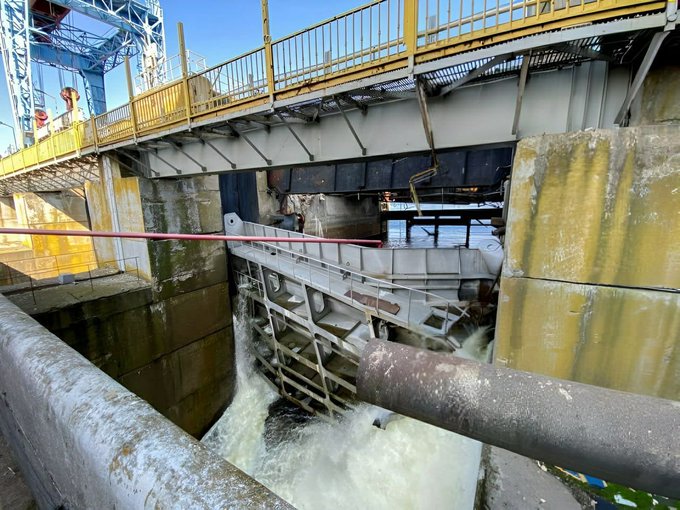
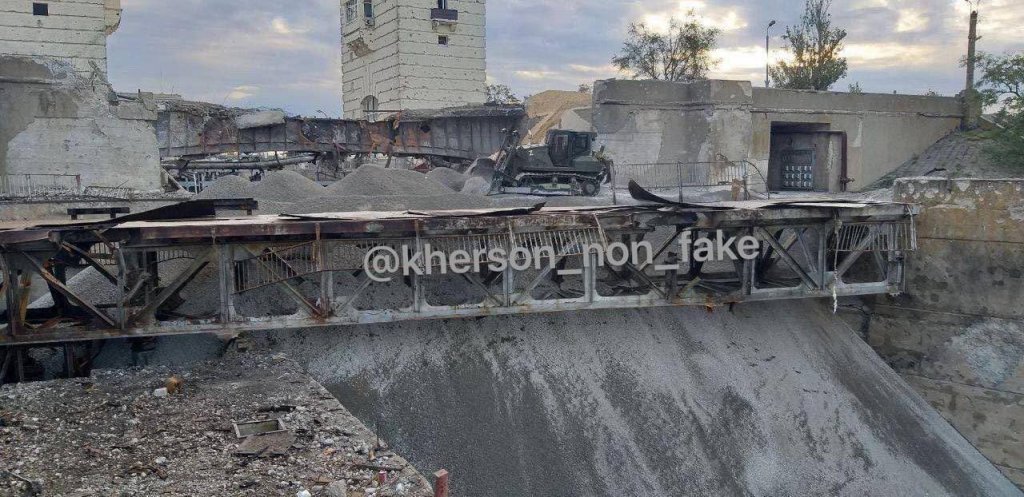
    • The dam was on the frontline, with Russian forces present. Ukrainian shelling of the roadway caused marked damage to the dam close to the HPP.

    Supporting columns for a road section over the barrage had collapsed five days earlier:

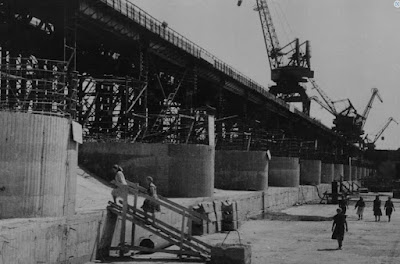
    • Two thick concrete columns – supporting a previously shelled section of roadway close to the HPP – collapsed and were washed away between 1-2 June, according to satellite photos from the dates. Those supports formed part of the spillways for sluice gates 2,3,4, close to the HPP. The initial breach occurred on that side of the central barrage section.

    Two sluice gates were damaged months earlier:

    • Sluice gate 1, closest to the HPP had sustained significant damage from Ukrainian shelling months earlier. Resulting in more turbulent flows from that section.
    • The damage likely dates from November 6, 2022 when a HIMARS strike was reported.
    • This would match with later comments in the Washington Post: ”The Ukrainians… even conducted a test strike with a HIMARS launcher on one of the floodgates at the Nova Kakhovka dam, making three holes in the metal to see if the Dnieper’s water could be raised enough to stymie Russian crossings but not flood nearby villages. The test was a success…” – said Ukrainian Maj. Gen. Andriy Kovalchuk.
    • “The threat from Ukrainian forces including snipers was reported, by the local Mayor in March, 2023 as preventing repair and maintenance operations.
    • Update July 2023: Photos of prior damage to sluice gate 3 have also emerged

    Canal blocked up:

    • The lock canal was filled-in during September ’22 by the Russians to build a new road crossing, after Ukrainian HIMARS strike had destroyed the road bridge. This would then prevent the canal being used as a slipflow around the dam in the event of high water levels.

    Unusually high water levels in the reservoir:

    • The high levels appear to be due to heavy rain and some amount of excess discharge from the Ukrainian controlled dams upstream the Dnieper. The Kakhovka dam did still release a lot of water downstream in the weeks prior, although this was only through a few gates close to the HPP. Normal rotations and maintenance could not be carried out.

    The above presents a few key takeaways from analysing the sources I collated on the ACLOS page for the Kakhovka Dam Collapse. You can find a more detailed treatment, with references and source attributions for the above there.
    I particularly recommend Adam Larson’s analysis, and also this early technical overview from Mike Mihajlovic.

    Update: Why did those columns collapse?

    Adam Larson surmises that the concrete ‘apron’ underlying the spillways had sustained damaged from HIMARS strikes landing underwater. The high water level in the reservoir and its release through just a few (damaged) gates, generated intense flows – which would be sucked into and around any cavities and damage of this concrete shelf.

    Scouring erosion of this base, underlying the thick columns supporting the roadway, then most likely accounts for their collapse. With an integral part of the structure washed away, the further main collapse event was pretty much inevitable.

  • ‘Russian chemical weapons’ – English drug users: The work of British Intelligence

    Mar 26th, 2023

    The ‘Public Inquiry’ in to the death of Dawn Sturgess resumed on March 24. After preliminaries its timeline has again been set back substantially. Press commentary acknowledges this is ‘exceptional‘. The need for further delay is said to arise from the risk of ‘top secret’ information posing a threat to ‘national security’ being inadvertently disclosed in the many relevant documents.

    The process clearly isn’t independent, nor is it public, nor is there much inquiry. Let’s examine some facts pertinent to the case to see why that would be.

    According to reports, on the morning of Saturday 30th June 2018 around 10.15am emergency services were called to a flat in Muggleton Road, Amesbury. A 44 year-old woman named Dawn Sturgess was taken to hospital. Later that afternoon emergency services attended once again, in greater numbers. A man was taken to hospital. According to later reports, it was her partner Charlie Rowley whose flat it was.

    That evening a reporter for Salisbury based local radio station SpireFM reported on its website, that emergency services had been called to deal with a drug related incident with one person being taken to hospital.

    Emergency vehicles attended a drug related medical incident on Saturday evening (June 30) – Faye Tryhorn, Spire FM, June 30, 2018 – Updated July 2 (Page grabbed here)

    “Police have told us they are ‘certain there’s no risk to the public’ following the drug-related incident.“

    After the high profile events surrounding the hospitalisation of Sergei and Yulia Skripal in March, there had seemingly been some concern about dangerous materials. A unit from Swindon Fire attended the second incident at the flat with their decontamination equipment. Locals saw personnel in green Hazmat suits. The next morning on their twitter account Swindon Fire stated, “thankfully the incident wasn’t serious and our decontamination shower wasn’t required.”

    (Source)

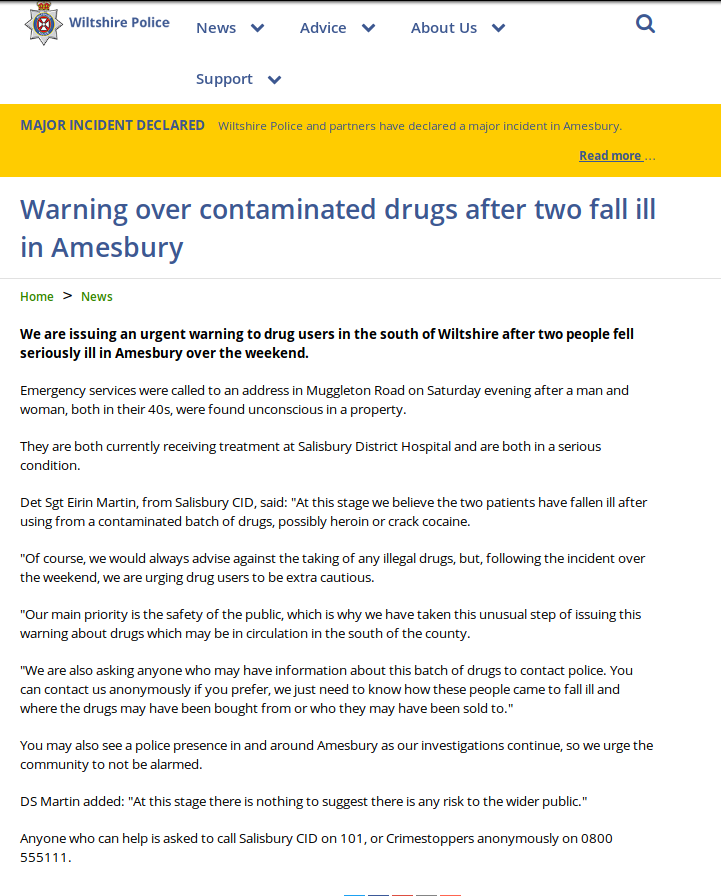
    Two days later (2nd July) Wiltshire Police issued an urgent warning to local drug users about a batch of contaminated drugs in circulation in South Wiltshire. It said two people had been found unconscious at the flat over the weekend after using from the batch. The statement asked for information from anybody who might know anything about how the batch came into circulation. But it also assured that there was nothing to suggest any wider risk to the public.

    Evidence from Police records indicated that Dawn Sturgess suffered a cardiac arrest after taking contaminated heroin. The local Criminal Investigations Department (CID) had investigated and found that the flat had been taken over (or ‘cuckoo’d’) by a group of local drug users and dealers. There had apparently been a party of sorts on the Friday night before. Conceivably, Charlie Rowley may have used from the batch later on Saturday, without fully realising the danger.

    On 3rd July Wiltshire Police issued a further warning about ‘cuckooing’ of vulnerable people’s accommodation by drug dealers.

    That such information pertaining to the incident not enter the wider public domain is, it seems, now considered a matter of the ‘utmost importance’ for “national security”.

    How did these tragic, but not altogether uncommon, details of a vulnerable person apparently succumbing to the ill effects of drug consumption, become something the British establishment views as ‘extremely sensitive’ and a threat to the country’s “standing” with international partners?

    On the morning of the 4thJuly London media announced that the pair had been poisoned by a ‘novichok nerve agent’. The case was now being linked, in the media worldwide, with the Government’s claims about the poisoning of Sergei and Yulia Skripal in March. This time the story ran against the backdrop of the Football World Cup being hosted in Russia and a summit between the Russian and US Presidents.

    By the evening, ‘Counter Terrorism Police’ from the MET (Metropolitan Police) had taken over control of the incident’s management from Wiltshire Police. ‘ Counter Terrorism’ (previously ‘Special Branch’) fall under political and security agency control. Statements from the local council, Fire, and WIltshire Police referred obscurely to coordinating with ‘multi-partner agencies’. These agencies being left unnamed. Later the Defence Science and Technology Laboratory at nearby Porton Down was reported as confirming the pair had been exposed to Novichok.

    On the 7th of July the Daily Mail reported:

    EXCLUSIVE: Mother of Novichok victim says her ‘lost soul’ daughter is being deprived the care given to the Skripals because she’s a ‘nobody alcoholic’ who turned to drink battling post-natal depression Daily Mail, July 7, 2018 (Archived)

    ..She also slammed the police for ‘keeping the family in the dark’ by saying that Dawn had suffered a heart attack for several days before the truth came out.

    The article also said family members were accustomed to her being treated in hospital as a result of her substance use issues. The family member interviewed also said that she “trusted people too easily”.

    On 8th July Dawn Sturgess’s life support machine was turned off. Some comments in the media from the period indicated that the family believed she had effectively died in the flat. Normally a postmortem would take place on the day following the death, but officials in London intervened to delay it and put another coroner in charge.

    The motive for the opportunistic hijacking of these unfortunate events and Dawn’s medical status clearly seems to have been to bolster the government’s faltering Novichok narrative. Which had been weaponized against Russia in the international arena after the hospitalisation of the Skripals in March. Claims that a highly lethal Russian nerve agent was used in Salisbury to attack Sergei and Yulia, resulted in some perplexity and derision after none of those said to be affected died.

    The delayed postmortem took place on the 17th when a visiting team from the OPCW was allowed to attend. Strangely, its findings were not signed off until four months after the procedure.

    …cause of death “Ia post cardiac arrest hypoxic brain injury and intracerebral haemorrhage; Ib Novichok toxicity”.

    These findings became public during a previous sitting of the Coroner’s Inquest in London. Medical experts were approached for comment by John Helmer. They..

    ..believe the record of cardiac arrest leading to brain death is proof that Novichok toxicity was not (repeat not) the cause of Sturgess’s death. According to one of these experts, sumarising his colleagues’ assessments, “Novichok leads to low acetylcholine esterase levels, and the victim essentially drowns, i.e. lungs fill with fluid. Lung fluid would have been detected in the first PM, unless the experts at Salisbury drained the lungs as part of their treatment.” Another expert on organophosphate poisoning, who works in hospital emergency wards, says that nerve agents cause paralysis of the lungs, so asphyxia is the usually given as the cause of death. He too expresses surprise at the report of cardiac arrest.

    Opioid overdoses can lead to cardiac arrest with such brain injuries, according to medical texts.

    In the days after the relaunched ‘Novichok’ story went out on the wires, Police “working with with partner agencies” were said to be looking for the source of the poisoning. On Friday, July 13th the MET announced that on July 11th they had found the ‘Novichok container’. This was 12 days after Wiltshire Police had first attended the flat.

    The narrative for public consumption would be that: assassins from Russian Military Intelligence had, after smearing Sergei Skripal’s front door with the military grade nerve agent, discarded the container, a Nina Ricci ‘Premier Jour’ perfume bottle, in a charity bin. Somehow Charlie Rowley found it, nearly four months later, whilst rummaging through. Three days later when Dawn tried the perfume on, she unwittingly sprayed a highly deadly Russian chemical weapon on herself. Many months later, official sources acknowledged that finding such a bottle in a regularly emptied charity bin was implausible. But this is what was depicted in the BBC’s drama “The Salisbury Poisonings”.

    The Police information management procedure running ahead of the ‘public inquiry’ is coordinated by the MET’s SO15 and Thames Valley Police and is called ‘Operation Verbasco.’ Wiltshire Police play a subordinate role in adhering to its process. According to Verbasco’s submissions to the inquiry:

    The nature and extent of the national security concerns which arise in the context of this Inquiry necessitate extensive and carefully developed security arrangements. These arrangements come at a significant time-cost and expense, and maintaining the security of sensitive material which is required in the environs of the OPEN hearings will not be without its challenges…

    The forces have needed to recruit staff specifically to filter documents about the incident to “avoid any inadvertent disclosure of sensitive material.” A Police submission to the inquiry mentions that apparently innocuous materials may when placed together pose national security concerns. The preparation of documents for the enquiry requires:

    “…liaison with each of the “equity holders” within policing, so as to ensure that the scope of the application accurately reflects the underlying sensitivities. This is necessarily a time-consuming process, requiring extensive and detailed input from senior officers across various forces and commands.”

    As Helmer reported, “court papers also reveal that the official records now under review of the Novichok investigations have “emanated from the Home Office; the Cabinet Office; the Foreign, Commonwealth and Development Office, the Ministry of Defence, the Department for Environment, Food, and Rural Affairs, Public Health England, the Department of Health and Social Care and the Government Office for Science.“

    The legally required coroner’s proceedings; have been repeatedly delayed, had their legal format changed to enable secrecy, only to be delayed again. Aside from the considerable public expense and waste of man hours, the British State appears to have:

    • Rail-roaded the work of Wiltshire Police, placing its officers and other emergency service personnel, who dealt with the initial incidents and their investigation, in an invidious position.
    • Deceived Sturgess’ family and manipulated their emotions, whilst coaching them on the official story for media appearances.
    • Betrayed the trust of the British public and world at large with the aim of traducing the international standing of a foreign government. The ‘Novichok’ media sensation was used to instigate a round of diplomatic measures against Russia by Western and European governments.
    • Caused both alarm and inconvenience to local residents. The building on Muggleton Rd was gratuitously demolished, on the pretext it was contaminated. No one else who went in there ever required medical treatment.
    • Pressured media outlets to scrub from the web earlier reports on the incident that did not fit the official narrative.

    Details of a drug related incident and death clearly do not pose any threat to ‘national security’. Rather the threat to the authorities is of shame, embarrassment and loss of credibility, in the event of this rather sinister and yet poorly conceived psychological operation being widely exposed.

    I don’t think the implications for the tenability of the UK’s and NATO’s accounts of other “Novichok poisonings” need be spelt out here.

    More sources and details can found at the pages on A Closer Look on Syria

    UPDATE – October 20, 2024

    One of the documents submitted to the enquiry by Wiltshire Police; a witness statement taken two days after the incident from one of Charlie Rowley’s friends who was with them that weekend, indicates that Dawn’s collapse may have been due to her taking prescribed Zopiclone tablets (sedatives used to aid sleep).

    Overdose of Z-drugs will result in depression of the central nervous system. The effects of any misuse will likely be exacerbated by alcohol consumption. In any event the combination of Zopiclone and opioids is strongly advised against.

    The witness statements also suggest, although sketchily, that Dawn may have been taking the antipsychotic quietiapine – as she had recently been diagnosed as ‘bipolar’. Quietiapine also has sedative effects. Moreover its use is strongly correlated with adverse cardiac events.

    Dawn was found by the paramedic not breathing and without a pulse. Recent media reports that Dawn Sturgess was blue when found by the paramedic are likely due to her applying blue hair dye when she collapsed – as described in the witness statement.

    The statements emphasised that Dawn was not an active heroin user, although was an ‘alcoholic’.

    But the witness statements do say that Charlie Rowley did subsequently take heroin that day after Dawn was taken to hospital. Unusual symptoms that Charlie Rowley is reported as presenting with later on, were I suspect, rapid withdrawal symptoms. Which as I outlined here significantly overlap with typical symptoms indicating nerve agent exposure.

  • Death on the Tracks: Did the ‘Kraken’ carry out this massacre of fleeing families?

    Nov 3rd, 2022

    On October 1st reports about a ‘cruel’ massacre of civilians and children appeared in the western media. In all 26 people, including 13 children, fleeing in a small convoy of five cars and a truck, are now reported as killed in this atrocity. In photos and video footage of the scene, bullet holes could be seen in vehicles, with the dead inside. One man lain on the ground alongside a car. At the rear of the convoy the truck and its wagon had burnt out along with the corpses of their occupants. Ahead a small car had also burnt out. The victims bodies had been at the scene for a few days before the incident came to light. Video footage showed victims with flies buzzing around their bodies in the cars.

    The date the attack took place has not been independently confirmed. Ukrainian sources reported the massacre took place on the morning of September 25th. It is not stated how this detail was known. Nor is it explained, consequently, why the incident wasn’t reported for five days. The dead had apparently been left unattended at the scene during that period. The savagery was attributed to a Russian ‘reconnaissance and sabotage group’. No supporting evidence for that claim was provided at the time.

    The convoy was heading east away from the East Kupiansk area, recently recaptured by the Ukranians, and towards Svatove in LPR/Russian controlled territory. A Ukrainian TV channel later produced some dubious testimony. The purported survivors were at pains to explain why the convoy were headed to Russian controlled Svatove, implausibly claiming that it was the only route they could take to Dnipro. Which is well to the south-west. The most natural explanation is that they were Russian speakers who felt safer fleeing away from Ukrainian forces conducting “mop-up” operations.

    Here, examining the location and context of the attack, I present the case that the atrocity was the work of a Ukrainian ‘Kraken’ unit. Kraken is a Kharkov based affiliate of the extremist Azov Battalion. According to the Washington Post, it “operates somewhat in a gray zone — a force that answers to the Defense Ministry but is not part of Ukraine’s armed forces.” The group’s conduct has raised human rights concerns.

    A Kraken unit is documented to have been active in the locale in late September. Ukrainian media had announced the group taking control in East-Kupiansk on Sept 16 and then in Kupiansk-Vuzlovyi on Sept 27. Graphic photos and video the Kraken group had taken in that locale in late September, were shared on their telegram account.

    Their faces are obscured in the published photos, except for one; the group’s deputy leader, Sergey Vilichenko aka ‘Chile’, an infamous criminal who had like other Kraken members been released from prison to fight. In March, he was responsible for the shooting in the knees of surrendered Russian PoWs. The perpetrators had filmed their own crimes. Vilichenko is wanted by the Russian authorities who put up a reward for his capture.

    Posing in front of a captured Russian APC, likely a BTR-80A

    The BTR-80A is fitted with a 30mm 2A72 automatic gun and 7.62mm PKT coaxial machine gun….The 30mm gun has a maximum firing rate of 330 rounds a minute and can fire AP-T (armour piercing – tracer), HEF-I (high-explosive fragmentation – incendiary) and HE-T (high-explosive – tracer) rounds.

    Returning to the convoy, it was heading out eastwards along the railway line just beyond the far end of Kurylivka (a stretched out settlement east of Kupiansk-Uzlozovyia). The line then curves round to the south-east towards Svatove. The old cars were packed with heavy travel bags. This was not any day excursion.

    See Googlemaps location of the scene.

    When the convoy passed the farthest point of Kurylivka it would, presumably, leave the road (‘vulytsia Lozova’) using a cut-through to join the track that runs alongside the railway (Satellite view). They would only be some 250-300 metres further on from that point when they were killed. Had the convoy made it further to the next settlement of Pischane, some 2km on from the scene, it would have passed into the then LPR/Russian front lines.

    According to quotes from French investigators working under the auspices of the local prosecutor, 30mm and 45mm high explosive rounds, that come from heavy military vehicles were used. In addition, fragments of Vog17 and Vog25 grenades – which can be used with under barrel grenade launchers – were also reported. Both Vog17 and Vog25 grenades are used by the Ukrainian military.

    A compound the unit were using. The captured APC’s ‘Z’ markings had been painted over.

    It seems likely that the unit attacked with their heavy vehicles, probably including the captured BTR-80A (pictured). The unit had boasted of two captured APC’s. The use of a captured Russian fighting vehicle could allow that forensic findings falsely point towards Russian forces. Their photos also show they had a Canadian made Roshel Senator (Infantry Mobility Vehicle) and a pick-up.

    A matching compound to that shown above, close to the scene of the atrocity. To the front (north side) of the compound the road vulytsia Lozova. The rear (south side) backs on to the tracks with cut-throughs to the railway embankment. (Geolocation)

    1km before the scene of the attack, the convoy would have passed, towards the end of the village, a small compound backing on to the the railway. The photo above suggests it was used by the Kraken unit. Operating from the compound, it would have been easy for them to see the convoy passing – on one side or the other – perhaps without alerting the civilians to any threat. Once the convoy had passed, the sadistic men could easily drive their vehicles onto the track, pursue the convoy and open fire using the heavy automatic guns on their vehicles. Then used their automatic rifles, some fitted with under-barrel grenade launchers.

    Looking back towards Kurylivka. Photos suggest that the rear of the convoy was passed on its left side by the Kraken vehicles – as shown by bullet holes on their left (driver) sides. Whilst the front cars of the convoy went (or were shunted) off the embankment to the left, with the attackers passing and firing from behind and the right of the cars. A pick-up and quad bike may also have been used to hunt down anybody trying to run. Ukrainian sources subsequently reported, that two other bodies were found nearby.

    I believe the scenario I have just outlined accounts quite simply for the basic ‘logistics’ of this attack. The answers to ‘who’, ‘how’ and ‘from where’ are all supported by the evidence provided. ‘Means’, ‘method’, ‘opportunity’ and ‘motive’ are accounted for:

    • Means – fighting vehicles, including captured Russian fighting vehicle
    • Method – let the civilians pass, then pursue, attack with the vehicles’ guns, and then semi-automatic rifles with under-barrel grenades.
    • Opportunity – provided by the location of the compound between the road and the tracks where the civilians would just have passed.
    • Motive – fanatical hatred of Russian identifying Ukrainians, by those with a known record of extreme violence.

    Different explanations or attributions will likely produce a more complicated scenario or leave rather more unexplained.

    Footage of the scene was uploaded to Telegram on the 30th, probably by a different Ukrainian unit. Which may, conceivably, have been unaware of who carried the massacre out. The incident could and would, though, be used to bolster the narrative of Russians wantonly killing civilians that was featuring in the media that day.

    On the southern front a convoy of civilian cars looking to leave Ukrainian held Zaporozhzhia and cross into Russian controlled territory, were killed by an explosion, whilst waiting at a transit point that morning on the edge of town. This time there would be no delay in media reports circulating and blaming the Russians. That the civilians were attempting to leave Ukrainian control was explained away. Officials claimed that they were on a ‘humanitarian mission’ and planning to deliver aid, before returning. Pictures of the aftermath revealed families travelling with pets and their vehicles jammed full of personal belongings. But such insults to the intelligence of western news consumers often seem to go unregistered.

    *The working out of this account was done openly on the research wiki A Closer Look on Syria. The sources, reports and geolocations referenced above were compiled here.

    Update: November 30, 2022

    Kraken’s official YouTube channel published on November 6, this video of their claimed exploits in Kupiansk area in late September. With sections focusing on Kupiansk-Vozlovi and Kurylivka.

    The British tabloid The Sun published shortly after a shortened version of the video. There are many supportive comments of these “heroes”. The Kraken youtube account commented back to The Sun:

    We are very grateful for the support of all our friends and allies from other states. All Ukrainians and fighters of the Kraken unit see this support, your kind words and appreciate it very much, this is important for us, do not doubt. For our and your freedom, on guard of Europe and the whole world! Together we will win!

    I don’t know if the people at the Sun know they are supporting the very same criminals who carried out this attack. Which they had called ‘cruel’ and ‘evil‘. Either way, I don’t expect they will ever acknowledge the fact.

  • An Octopus in the Gate of Tears? – Israel and the Yemen conflict

    Aug 5th, 2022

    Israel’s role in wider conflict in the middle east is often overlooked. Recently, it attacked Damascus airport, a part of Syria’s civilian infrastructure. This was not an isolated incident, as the Jerusalem Post explains:

    Over the years, Israel has carried out thousands of strikes in Syria and beyond its borders by land, sea and air – and also used cyberkinetic attacks, according to foreign reports – to prevent Iran from achieving regional hegemony and becoming a nuclear state. Over the 13 years of Mabam, Israel’s targets have included weapons convoys and shipments and military infrastructure, including advanced weaponry and personnel. The campaign was not limited to Syria but extended to Iraq and Yemen, according to foreign reports.

    A newly announced strategy in its conflict with Iran, and what it deems as Iranian proxies, talks of attacking the head of the Iranian ‘octopus’ rather than its tentacles. The new ‘Octopus strategy’ seems to be really a continuation of the – war between the wars – ‘Mabam strategy’, intervening in conflicts in Syria, Iraq and Yemen to strike what it identifies as Iranian aligned forces or assets. In this article, I sketch out what we might call tentacles of an ‘Israeli octopus’, largely in relation to the role it has been playing in the international struggle for control and influence over strategically located Yemen.

    Yemen, of course, has resources such as oil to exploit and competition for access to those resources has obviously been a factor driving the war there (for example, France and the United Arab Emirates (UAE) stand to profit from Total’s Balhaf oil installations). More importantly though, its proximity to major world shipping routes means world powers vie to gain a hand there. After the construction of the Suez canal, the Bab-al-Mandeb (Gate of Tears) straits at the southern entrance to the Red Sea gained in geostrategic significance. It had become a potential choke point on world trade, as the Israelis were to learn in the wars with the Arabs. In 1973 Yemen closed the straits, blocking shipping through the Red Sea to Israel.
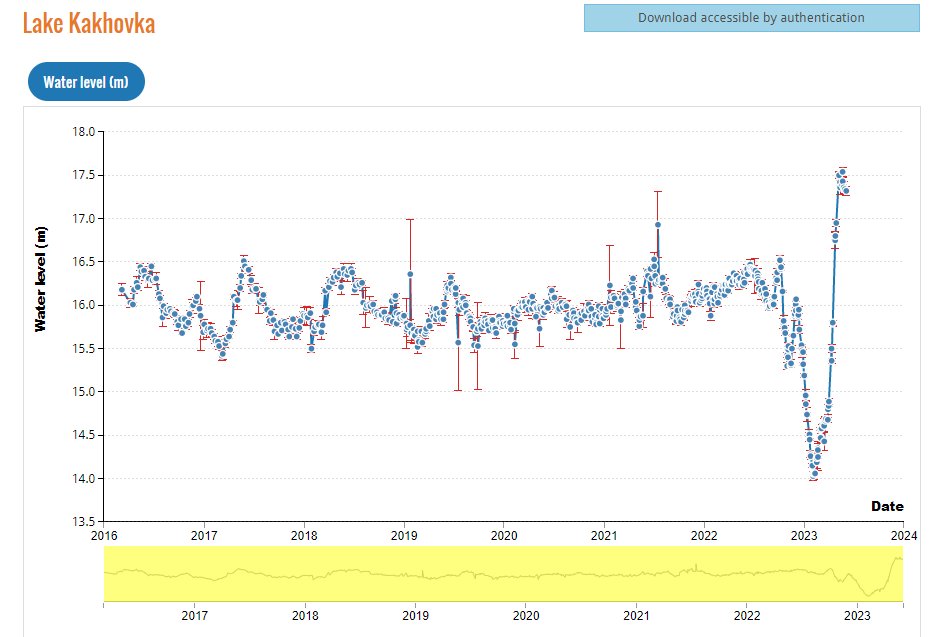
    Having direct maritime access to the Red Sea from its southern port of Eilat on the Gulf of Aqaba and much economic interest in trade with the east, Israel’s strategic interest in the Red Sea is clear. It is known to use an Eritrean island in the Red Sea for electronic monitoring in the region. Its navy now patrol those waters south of Suez, including its most potent missile subs. Long concerned that its enemies should not control the Bab-al-Mandeb, it has pledged to join military action if the straits are closed again. The Israeli Defence Force makes no secret that it considers Yemen a threat and it deploys its military intel capabilities to monitor ‘the houthis’.

    The Israeli enemy sees Yemen as a threat to it, explained the National Salvation Government Information Minister Dhaifalla Al-Shami, “especially in its strategic location, so it has worked to find a foothold in Yemen through the UAE’s role.(Middle East Monitor)

    When reports of the previously planned installation by the Emiratis of a runway and military infrastructure on Yemen’s Mayyun (or Perim) island in the straits became public, pro-Iranian media sources were quick to suggest the likely involvement of Israel alongside the US and UAE. By 2019 the Red Sea had become a theatre of conflict in the shadow war between Israel and Iran, involving seizures and attacks on commercial shipping interests. A pretext Israel cites for its involvement in the area is the threat of Iranian drones or missiles being fired from Yemen. That the Yemeni armed forces have their own technical capabilities independently of Iran often seems to be condescendingly overlooked in western commentaries.

    Of course, Washington, London and Paris have their own geostrategic interests in the region, working closely with their allies in Riyadh, Abu Dhabi and Tel Aviv they don’t wish to see forces in control the Yemeni coast, that maintain their independence of the centres of global capital. The Chinese also have a presence in the contested region with a base on the other side of the straits, in Djibouti.

    Naval bases in the region according to Debka file

    During the cold war the Port of Aden in the south of Yemen was an important centre of global commerce. After gaining independence from the British in 1967 South Yemen became loosely aligned with the Soviet bloc. The two separate states of the Islamic North (governed from Sana’a) and the Marxist South (Aden) unified to become the Republic of Yemen only in 1990. Access to the southern coast is strategically desirable, as oil from the Arabian peninsula can be shipped on routes that avoid vulnerable passage through the straits of Hormuz or the Bab-al-Mandeb. As an expansionist regional player the UAE, now advances its interests in the south, caring little for the integrity of the Yemeni state. It has been a major player in the coalition attacking Yemen from 2015.

    Despite announcing a pull-out in 2019, the Emirati regime backs the Southern Transitional Council (STC) a coalition which seeks independence from the north. The STC leadership has apparently signalled their openness to future friendly relations with Tel Aviv. Some commentators see such relations as having parallels with Israeli support for the Kurds in Syria and its previous recognition of Somaliland, aspects of a wider strategy to fracture and weaken Arab states unfriendly to it.

    Many undersea fibre optic cables run past Socotra (Source)

    That Israel and the UAE cooperate closely on ‘security’ is in no doubt, especially since the so called ‘normalization agreement’. This can be seen in a few interesting developments:

    • 2015: Reports of Colombian mercenaries fighting against the ‘houthis’ and funded by the UAE. With later reports of their involvement in the coalition’s 2018 advance on Hodeidah, after receiving Israeli training in the Negev desert. The cooperation between the security states of Israel and Colombia is long standing. Israel has shaped the training and brutal tactics used against the FARC leftist rebels over decades.
    • Since 2020 allegations, based on local reports, have circulated that UAE and Israel are developing signals intelligence bases and other military infrastructure on the seized Yemeni islands of Socotra and on Perim in middle of the Bab-al-Mandeb straits.
      • Although these local reports are hard to verify, they have strong circumstantial corroboration and were accepted by Israeli open source analysts. Israel’s signals intelligence capability is known to be highly developed and aggressive. Israeli tourists now fly to see spectacular Socotra via the UAE, the only commercial aviation route that now reaches the island. The UAE had essentially seized control of Yemen’s Socotra archipelago of islands that lie off the Horn of Africa between the Gulf of Aden and the Indian Ocean. With their proxies the STC taking over control from the governor of the ‘internationally recognised’ (Western & Saudi backed) regime in June 2020. A world heritage site for its unique ecology, Socotra was historically a strategically valuable position for monitoring communications. The Soviets had a listening base there when friendly relations existed between Marxist South Yemen and the USSR.
    • 2022: After Yemeni missile forces hit the UAE with drone strikes Israel offered its ‘Iron Dome’ air defence system to the Emirati princes. It is now reported that Israel has already installed radar systems in the UAE and that its air defence systems in friendly Gulf Arab states are now active.

    Having traced out some traces of the game Israel has been playing in relation to conflict in Yemen, I must point out that an other state has undeniably played a far more extensive part in the war. The state-corporate interests of this country can be seen to overlap with Israeli ones. To take one example, Elbit Systems, an Israeli arms manufacturer has contracts with the British military and has set up factories in the UK to better fulfil its orders. According to the Canary:

    The UK government has been working with Israel on UAV technology since 2005 in a deal worth at least £1bn. The Ministry of Defence (MoD) signed a contract with UAV Tactical Systems Ltd (U-TacS). This is a “joint venture” between UK-based Thales and Israeli arms company Elbit Systems. 

    The companies are reported as promoting a British version of an Elbit Hermes UAV to Saudi Arabia. Perhaps more significantly, one of Britain’s largest and politically influential industrial concerns, BAE Systems provides service personnel to maintain the Saudi’s Eurofighter Typhoon fleet for their bombing missions over Yemen. Whilst, the Saudi ‘Operations Room’ commanding their missions has included British officers, said to provide “training, supervision and evaluation”. Additionally, the Royal Navy has supported the blockade of Yemen. The blockade has resulted in ongoing starvation, epidemics and fuel shortages. It has become apparent that not only do British companies and their investors profit through the war, but even that British forces are active participants in the conflict.

    Commonly acknowledged as the poorest country in the middle east and suffering the world’s worst humanitarian situation, Yemen is being held back from peace and independence not only by the House of Saud, but also in Washington, London, Paris, Abu Dhabi and Tel Aviv.