On October 17, 6.59pm local time an explosive strike hit the courtyard of the Anglican Al-Ahli Hospital, in the Gaza strip. Reports suggest many people were crowded in the courtyard outside at the time. This video from the morning after gives some impression.

After reports began to circulate Hannanya Naftali an advisor to the Israel PM tweeted:
“BREAKING: Israel Air Force struck a Hamas terrorist base inside a hospital in Gaza. A multiple number of terrorists are dead.”
Soon after he deleted the tweet.
In the days after there has been much focus on video evidence from CCTV cameras with different views of events in the skies over Gaza, with claims from the Israel Defence Forces that an intercepted rocket fired by Palestinian combatants had fallen on the hospital grounds, and hence the IDF was not responsible.
Major Western media outlets would swing round to amplify this claim. An informational barrage, seemingly intended to obscure the facts and distract audiences from the wider context. The IDF also released a doctored audio purportedly of Palestinian Islamic Jihad fighters acknowledging the explosion was due to one of their downed rockets. Both these claims have now been debunked.
My analysis here does not focus on the released CCTV footage and speculation about what the lights in the sky might show. Instead I focus on the strike itself, the scene, and the best inferences that can be made about the weapon deployed, based on a wider background of relevant sources.
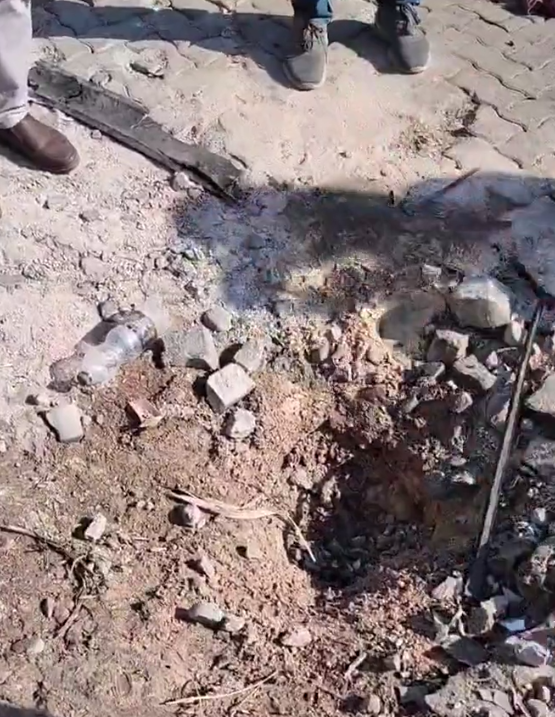
There are number of unusual aspects to the strike and the nature of the blast and impact that seem confounding. Here, I mean to show how they are reconciled. Analysis of the scene and the crater – some of which is compiled on the ACLOS research wiki – is consistent with the following:
- A small crater
- Westerly or WNW direction of origin
- Steep angle of impact
- A sizeable blast
- Some indication of downward pressure, suggesting possible above ground detonation (air burst)
- Lack of major damage to the buildings
- High casualties
- Sound signature characteristic of a guided bomb, immediately before detonation, but with no sound of a jet overhead
- Reportedly, a lack of fragments from the munition found at the scene
That Palestinian resistance groups have such a weapon in their inventory is not sustainable.
By examining the range of weapons the IDF uses for strikes in densely packed urban environments – and accepting the logical necessity than that an attribution to any particular weapon system must show properties consistent with all of the above – one can narrow down the options. This looks to me to be a more logical approach than pouring over CCTV footage. Which is likely to be of limited relevance. There is no reason why such footage would necessarily give any indication of the nature of this particular strike. The IDF was conducting multiple operations at the time, as it had been since the beginning of its retribution on Gaza.
In the days after Hamas’ raids into the south of Israel, Boeing accelerated the shipping of 1000 smart bombs. These were GBU-39 Small Diameter Bombs (SDB) which Israel had purchased in 2021 for $735 million, according to Defense Post. A plane with such a shipment arrived in Israel on October 11.

This ‘small diameter bomb’ has a relatively small warhead compared with other bombs. A glide bomb with fold-out wings, it can be deployed as a stand-off weapon from up to 60 miles away, according to the manufacturers. The Israeli Air Force routinely conducts air strikes in the region – including against targets in Syria – while operating over the Mediterranean. An engagement like this would be consistent with crater analysis implying the bomb came from the West or WNW.

Analysis of the scene indicated a steep trajectory rather than a shallow one. These ”sky-riders” can come into the target not at vertical, but at a steep trajectory (as shown here). They can be fused to detonate on impact or just above (in an air burst).


The GBU 39 is specifically designed to minimise collateral damage in close environments. One variant in particular the GBU-39A/B FLM (Focused Lethality Munition) comes with a carbon composite case rather than a steel one, for the purposes of minimising fragmentation – as opposed to optimising penetration. These cases simply disintegrate in the explosion. It also uses a multiphase blast explosive with enhanced explosive effects/lethality (See here on ACLOS for more).
As I understand it a multiphase blast comprises first a ‘gas phase’ with build up of pressure and then a ‘particulate phase’ that imparts momentum. If the detonation was with a proximity fuze, then this looks consistent with both the signs of downward pressure and the direction implied by the spray pattern around the impact crater.
In my view, the characteristics of the GBU-39 FLM fit with the takeaway features from analysis of the scene of impact.
- Small crater
- Steep angle of impact
- A sizeable blast
- Some indication of downward pressure effects, suggesting possible above ground detonation (air burst)
- Lack of major damage to the buildings
- High casualties
They also, I believe, account for the characteristic sound signature heard on the footage immediately before the explosion. In addition a FLM bomb with a disintegrating carbon composite case would explain the inability of Palestinian authorities to produce fragments/ shrapnel from the weapon itself. It also fits with the original claim from Hannanya Naftali that it was their Air Force who struck at the hospital.
Update 26/10/23
This screenshot from video of the scene clearly shows two parts matching those of the GBU-39’s fold-out wing assembly. It is surprising the Palestinian authorities have not produced them. They may have been discarded, and their significance overlooked. But now we have concrete supporting evidence.
Some have suggested Hellfire missiles fired from UAV’s or helicopters may account for the carnage. I believe this is inconsistent with the incoming sound signature, and the explosive force. And such missiles do not have parts like we see here.
——–
For the time being I do not speculate on the motivation for the targeting. Scott Ritter has suggested that the IDF could have received intel of a high profile target at the location. In any case it appears that the courtyard was crowded with Palestinians seeking safety and medical aid.
To the best of my knowledge the death toll and causality figures produced by Palestinian authorities still lack independent verification.
Update 28/10/23
This close up from a photo of the scene (lead image above) also shows an object which also looks to match with the GBU-39’s wing parts.

Another investigator, with greater technical background and forensic skills than me, thinks apparently that the level of fragmentation is not consistent with a carbon case – as with the FLM variant. The Defense Post article stated the 1000 bomb (2021) contract with Boeing was for the 39B – a “multipurpose” version with a more conventional casing.
However, at this stage, the question of which particular GBU-39 sub-type was used seems largely academic.
(Read my follow up Al Ahli: Post script – The view from London )
(See ACLOS for more there)
Edited to remove a muddled reference to a motor on the GBU-39. There is a ground launched adaptation with a rocket motor attached. But that is not relevant here.
Edited to adjust implied direction of origin from others’ spray pattern analysis from WSW to WNW. Due to my initial off hand orientation of scene photos.
Noted that my work here and on A Closer Look on Syria has been used without crediting.