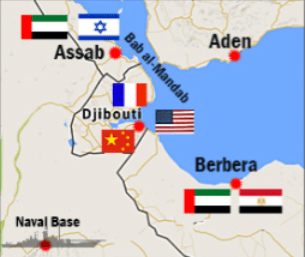
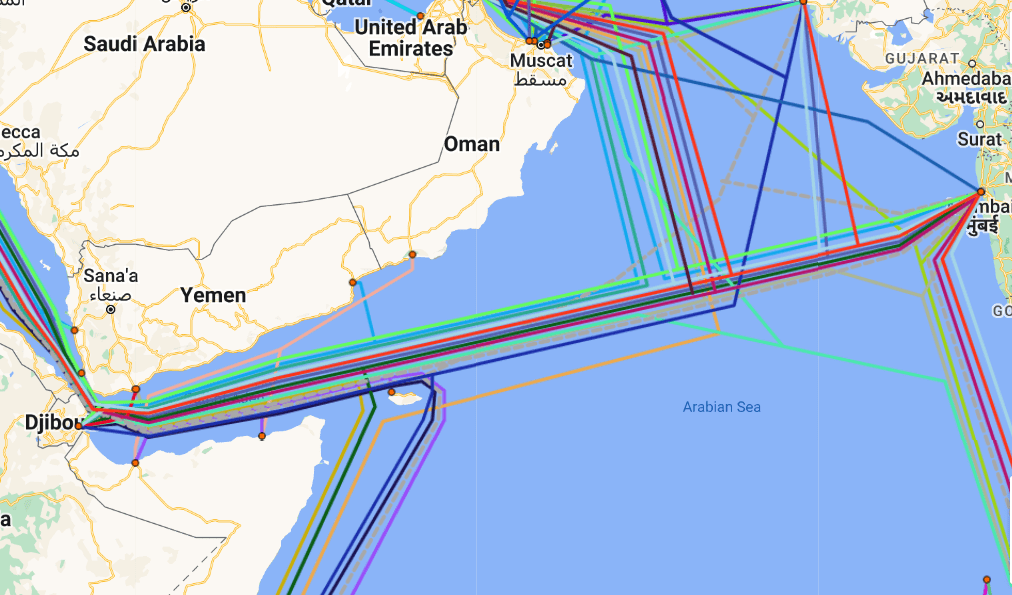
The recent collapse of the Baathist state in Syria has brought into sharp focus the nature of the jihadi, mercenary groups that waged war on it. And moreover, the question of who funded and supplied them with logistical, intelligence, PR, propaganda and other support.
As the British government welcomes the assumption of power in Syria by a group they had officially designated a ‘proscribed terrorist organisation’. It once again faces public pressure to prevent jihadis entering (or reentering) the UK.
As MI6 head Alex Younger had noted publicly, such jihadists may be very capable.
“They are likely to have acquired both the skills and connections that make them potentially very dangerous and also experienced extreme radicalisation…”
He could say this with confidence, because MI6 had itself been active in facilitating and equipping such men. Now, the prospect is raised that those chickens will come home to roost, as they did once before in the foyer of Manchester Arena, in May 2017.
I try here to connect some dots between the deals and arrangements – shrouded in official secrecy – Her Majesty’s Government (HMG) came to, in respect of its longstanding strategic partnership with the Kingdom of Saudi Arabia, and international Islamist militancy in Libya and Syria.

Seven years ago the BBC reported that the some of the funding
for a government contractor in Syria, developing the ‘Free Syrian Police Force’ had flowed into the hands of members of Al-Nusra (the main branch of al Qaeda in Syria) and a proscribed terrorist organisation. The Panorama episode around Adam Smith International’s activity on behalf of HMG caused a stir. But the story really represented just the tip of the iceberg.
My previous article, outlined briefly the international coalition for regime change, which brought together Saudi, Qatari and Turkish backers of the Muslim brotherhood and al-Qaeda, with the US & UK, and Israel – against Iranian, Shi’ite and Arab Nationalist powers; in an extensively planned and orchestrated Machiavellian campaign.
There is evidence such plans for proxy warfare may have been conceived, on behalf of an expansionist Israel, as far back as 1996. There were two other significant parts of the axis I should have mentioned; countries that played key roles; one as core part of Nato, France; and the other as the home of al-Qaeda’s leadership, Pakistan.
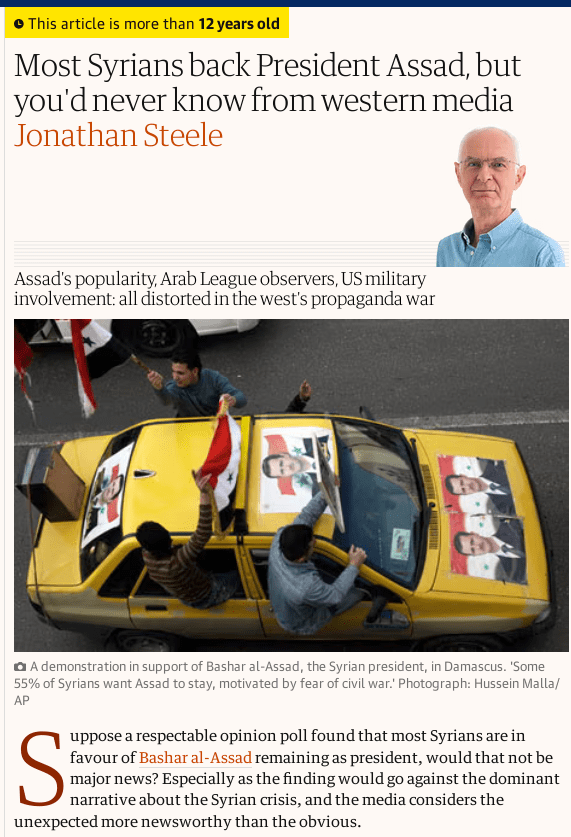
The scheme involved ‘off the books’ procurement of weapons. As well as recruitment of Islamist extremists from not just the Gulf, Libya and Pakistan, but also regions of the Balkans, the Caucuses and central Asia. All to take part in the “Syrian Revolution” – a project of former colonial powers and some of the world’s most reactionary autocracies. In a country whose President’s actual popularity ratings compared quite favourably with those of western leaders.
First stop, Libya
It’s hard to know where to start in attempting to outline all the machinations, but the Elysee Palace seems as good a place as any.
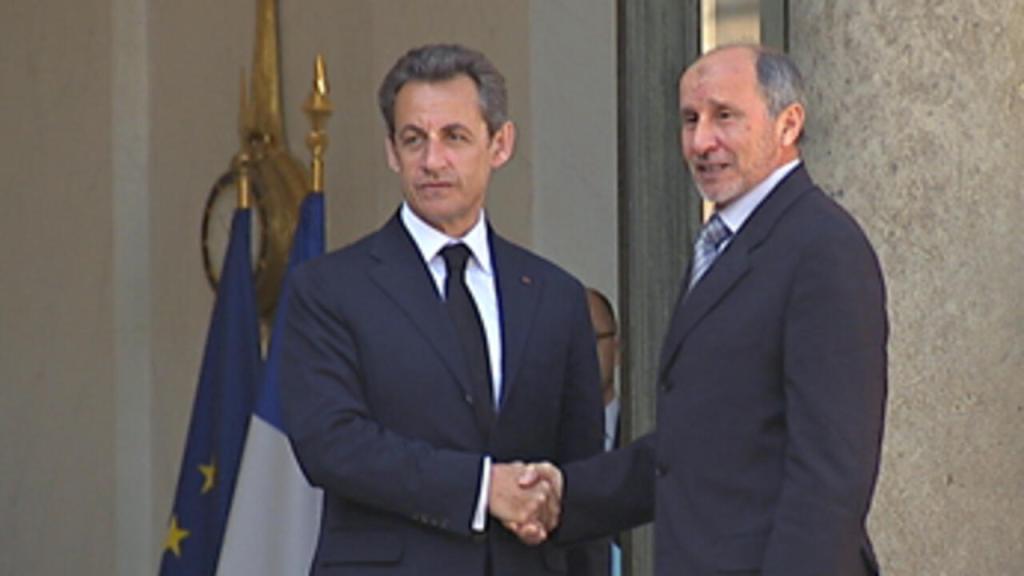
April 20, 2011 The head of the Libyan ‘National Transition Council’ seen with the French President
After the overthrow of the Libyan Arab Jamahiriya and Gaddafi’s horrific murder. The British would recount the work of their special services. A report in Reuters explained about the work of one their assets (Mlegta) in encouraging Libyan security officials to betray Gaddafi. According to him:
Rebel leaders discussed their idea with French President Nicolas Sarkozy at a meeting at the Elysee Palace on April 20.
That meeting was one of five in Paris in April and May, according to Mlegta. Most were attended by the chiefs of staff of NATO countries involved in the bombing campaign, which had begun in March, as well as military officials from Qatar and the United Arab Emirates.
After presenting the rebels’ plan “from A to Z”, Mlegta handed NATO officials three memory cards: the one packed with information about regime strongholds in Tripoli; another with updated information on regime sites as well as details of 65 Gaddafi officers sympathetic to the rebels who had been secretly supplied with NATO radiophones; and a third which contained the plot to take Tripoli.
That the rebels were largely constituted by Islamic extremists would, undoubtedly, have been well known to western security agencies. Indeed, the top rebel military commander Abdel Hakim Belhaj appointed to run operations in Tripoli had previously been renditioned by the CIA for his role in running al-Qaeda training camps in Afghanistan.
Before that Belhaj had been active in the Libyan Islamic Fighting Group (LIFG), which had previously cooperated with the British in trying to assassinate Gaddafi in 1995 and 1996. He certainly has an ‘interesting’ resume.

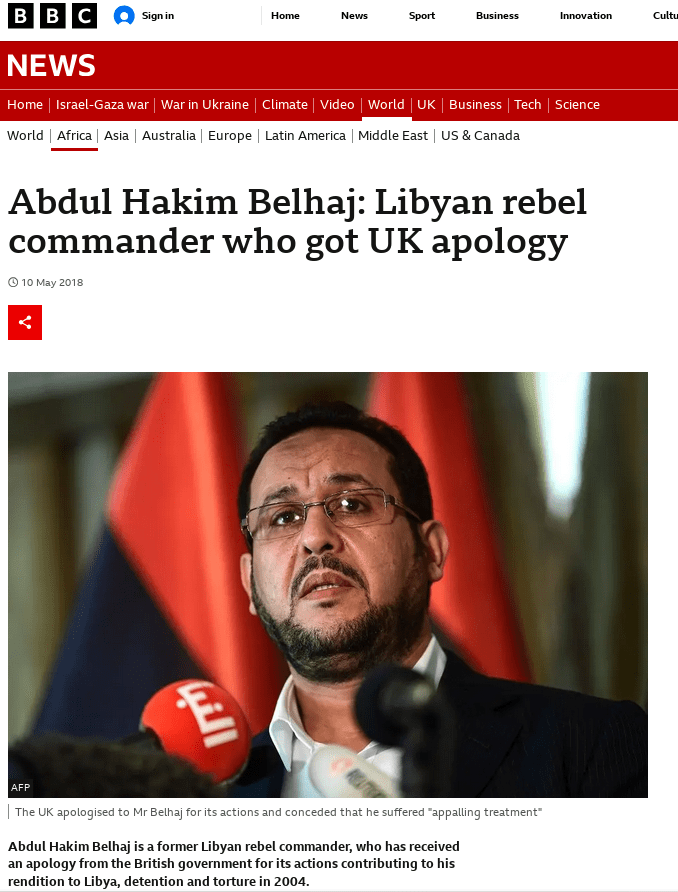
When Qaddafi protested to the world’s media that the violence in his country earlier in 2011 was due to al-Qaeda, the western press and media simply mocked and insulted him.
Why was Libya a target ?
For many reasons, but among them:
- It was an Arab Nationalist ally to Syria
- Resource nationalist – refusing to do deals with western oil companies on their terms
- Useful staging post for funneling fighters into Syria. It had long been home to a proportionately high number of al-Qaeda fighters
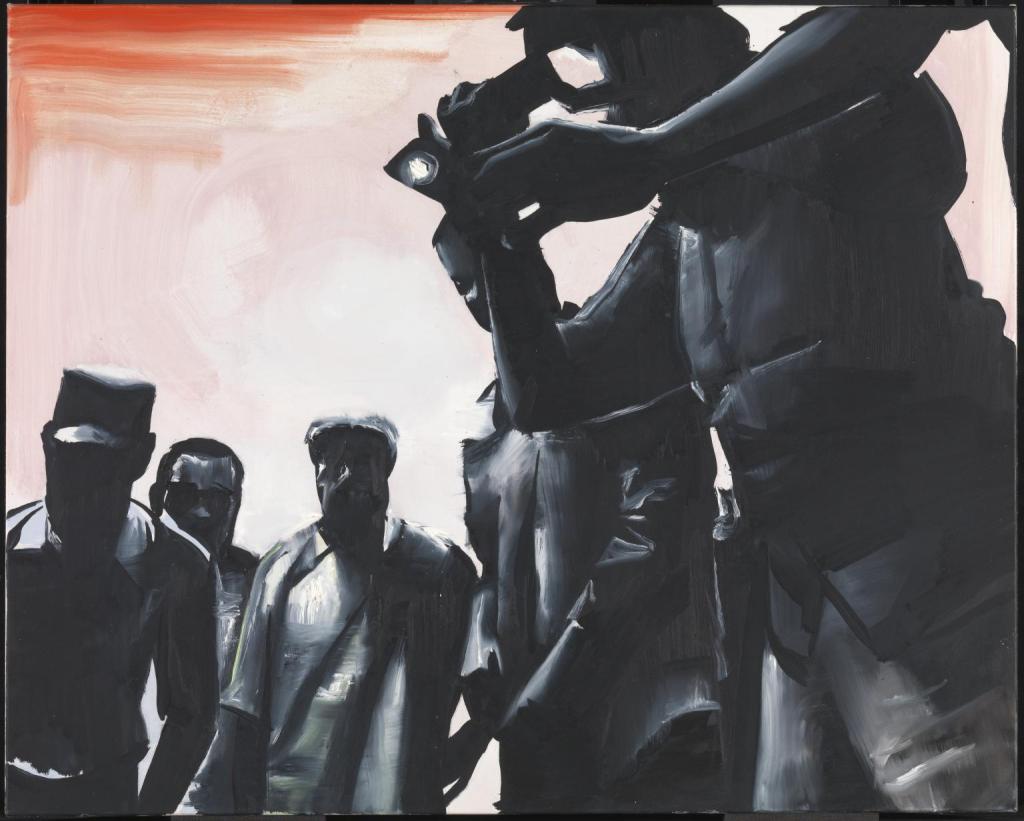
‘Gaddafi 2’ (2011) by Polish artist Wilhelm Sasnal
Covert Operations and The Ratline
After Gaddafi fell, Libya would, as noted by a 2012 Library of Congress research report, “become the centre of a network designed to send jihadists to Syria.” Bases in Libya would, under the watchful eyes of NATO, serve as training and logistics hubs for militants focused on taking down the Baathist state.
Indeed, elements of the LIFG were active in Syria from the outset of the insurgency there. Belhaj himself travelled to Turkey’s border with Syria in November 2011 to meet with the leadership of the ‘Free Syrian Army’ – discussing arrangements for sending weapons and a stream of foreign fighters to the ‘rebels’ in Syria.
As former CIA analyst Phil Giraldi informed in late 2011:
Unmarked NATO warplanes are arriving at Turkish military bases close to Iskenderum on the Syrian border, delivering weapons from the late Muammar Gaddafi’s arsenals as well as volunteers from the Libyan Transitional National Council who are experienced in pitting local volunteers against trained soldiers, a skill they acquired confronting Gaddafi’s army. Iskenderum is also the seat of the Free Syrian Army, the armed wing of the Syrian National Council. French and British special forces trainers are on the ground, assisting the Syrian rebels while the CIA and U.S. Spec Ops are providing communications equipment and intelligence to assist the rebel cause, enabling the fighters to avoid concentrations of Syrian soldiers.
MI6 were reported in 2012 to be covertly supplying with satellite phones, with the SAS active ‘in country’ training the “rebels”.
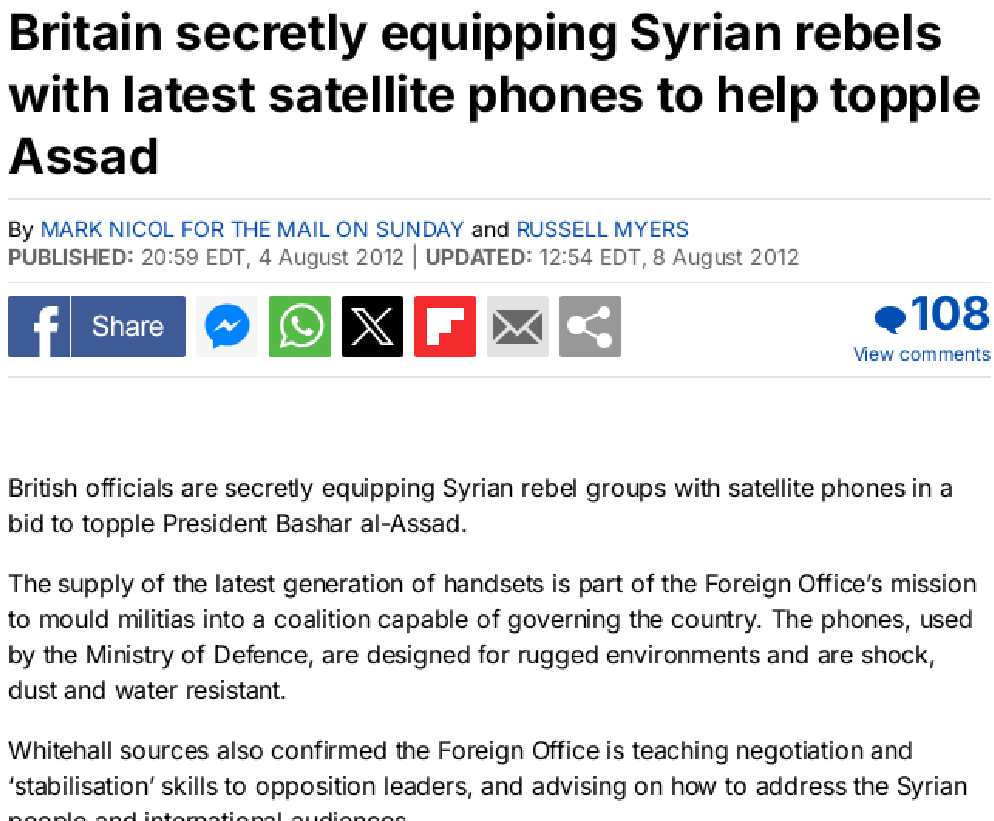
Useful overviews of Britain’s covert operations in Syria has been provided by Mark Curtis. I won’t attempt to catalogue things here, but suffice it to say that HMG’s investment in the regime change project was longstanding, deep and extensive, and deployed both hard-power and soft-power capabilities.
Funding for the proxy military campaign in Syria, though, largely came from Qatar and Saudi Arabia. Whilst operations were largely directed from Turkey. Training of the militants also took place in Jordan – where much of the CIA rebel training programme money was spent. It hosts dedicated special ops training camps.
In 2012 Turkey established an ‘operations room’ for the ‘rebels’ military campaign. This was after a request to establish such a “nerve centre” was made by one of the Saudi King Abdullah’s four sons, Prince Abdulaziz- who had a longstanding career in the Saudi Arabian National Guard (SANG). This ‘nerve centre’ was set up near Turkey’s border with Syria at Adana. Nato’s Incirlik airbase is also situated in Adana. The Reuters report mentioned that the Turks were keen to get more technical support for running operations, especially around drones.
In my last article, I found that the head of the Saudi Ministry of the Interior Mohammed bin Nayef (MBN) and his right hand man Saad al Jabri had, using MBN’s personal counter-terrorism account, set up front companies. Given the somewhat surprising nature of those expenditures, these ‘vehicles in the private sector’ appear to have been used to provide logistical support to ‘rehabilitated’ al Qaeda militants sent on to fight in Yemen, Libya and Syria.
Circumstantial evidence strongly points to the SANG as being one channel used by the west to arm the ‘rebels’ at arms-length. SANG – the troops of the Interior Ministry – purchased, among other US made systems, a large supply of TOW anti-tank missiles in the years 2012-15. A weapons system that then happened to turn up in the hands of takfiri militants across Syria.
The Memorandum and the ‘fast ball’
By late 2013, the British were seeing their scheme, to funnel Sunni militants into insurgency operations, start to get out of hand. A report in the Telegraph said British and European jihadis in Syria were being encouraged and prepared to wage Jihad in their home countries.
This was then, the backdrop to a Memorandum of Understanding then British Home Secretary Theresa May signed in Riyadh in March 2014. The MoU was not publicised at the time and only vague details were reported a year later; with the Government refusing to disclose further details. A Freedom of Information request for more details about the agreement was rejected:
‘The public interest falls in favour of applying these exemptions as the memorandum of understanding (MoU) contains information relating to the UKs security co-operation with Saudi Arabia, the release of which would damage the UKs bilateral relationship.’
But from snippets and developments at the time, I think it is possible to get a sense of what was agreed. The deal was said to concern British ‘help’ with the ‘modernisation’ of the Saudi Interior Ministry.
Theresa May must have met MBN and al Jabri, when agreeing the MoU in March 2014.

It seems likely that the British side’s assistance to the Saudis consisted of technology, training and supplies for the SANG; the latter including supplies of CS gas and upgrades to crowd control vehicles.
There happens to be a long standing British military mission to the SANG. As Declassified UK reported in 2019:
The British embassy in Riyadh admitted in 2012 that the UK military officers involved in the mission “take their orders directly from His Royal Highness, Prince Miteb bin Abdullah bin Abdulaziz, Cabinet Minister and Head of the Saudi Arabian National Guard”.
In return for ‘technical support’, MBN likely offered the British help on counter-terrorism, as the two monarchies struggled to keep their ‘useful idiot’ jihadis in check.
As was noted on gov.uk:
On 31 January, the Saudi Arabian government published the full text of its new counter-terrorism and terrorism financing legislation, outlining the procedures and punishments to be applied. Later, on 7 March, the Ministry of Interior issued a decree creating Saudi Arabia’s first list of proscribed organisations. Amongst the groups included were Al Qaeda and its affiliates (including the Al Nusra Front, Al Qaeda-Iraq, and Al Qaeda in the Arabian Peninsula), Saudi Hezbollah, certain Houthi groups in Yemen and the Muslim Brotherhood.
Shortly after the MoU was signed a civil servant at the Ministry of Defense (MoD) related in an email that he had receieved a ‘fast ball’ from the Saudis. It was from Prince Mutaib (or ‘Miteb’) and at the MoD in relation to its longstanding SANGCOM programme (providing communications systems for the SANG). It appears they were made an offer they couldn’t refuse. MoD officials judged the proposal as effectively impossible to turn down.
Snatching up the contract would though, following Prince Miteb’s instruction, mean making special payments to a private company owned by Salah Fustok ( or ‘Fustuq’) – a Saudi-Lebanese arms dealer with close family ties to the Saudi Royals. Such payments were apparently routine in relation to SANGCOM and would be denoted in MoD records only as ‘bought in services’.
The contract would be with a British company called GPT Special Project Management. What the contract was for, HMG prefers to keep secret; despite court proceedings about the corrupt payments and kickbacks.
According to 2017 research for Corruption Watch, GPT was set up to provide services only to the UK MoD, and only for the SANGCOM programme.
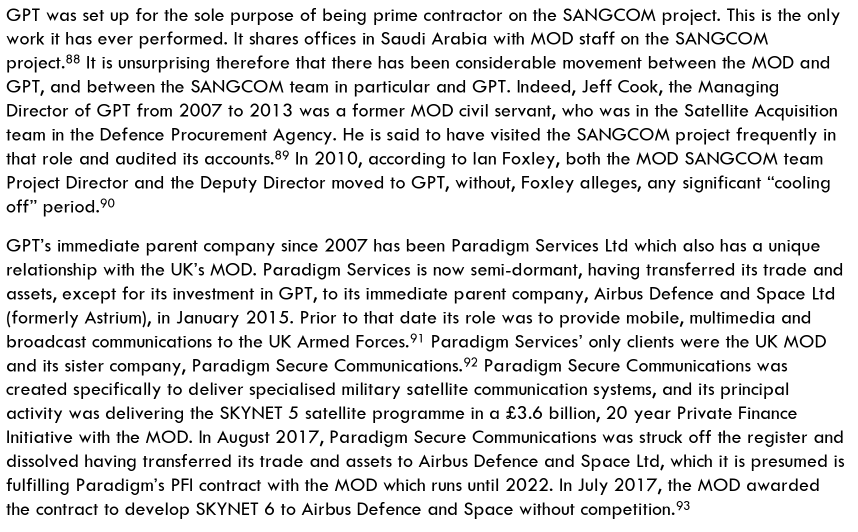
GPT has, though, been owned by a plethora of defence sector providers. GPT provided ‘space services’, through its parent company Paradigm Services Ltd and the latter’s sister company ‘Paradigm Secure Communications’ – that provided ‘MilSatCom’ equipment and services, using the British military’s ‘Skynet 5’ communications satellites, first launched in 2003.
A MoD civil servant and board member with both GPT SPM and Paradigm described their capabilities in a 2013 feature in MilSat Magazine:
..The Skynet 5 fleet of four satellites are the most powerful, commercially controlled, military X-band satellites launched to date…The satellites were specifically designed to mission critical, sensitive command and control communications systems, where loss of communications is not an option… This makes the satellites ideal for supporting smaller, low powered tactical terminals that are deployed across multiple theaters of operation.
The Skynet 5 satellites are also used to control military drone flights, according to the website Drone Wars.
After it was struck off the Companies register, Paradigm Secure Communications’ assets were transferred to Airbus Defence and Space Ltd. Which also provides satellite communications and imagery services.
The ‘fast-balled’ GPT SPM contract was, according to emails released under and FOI request, to work in a “very sensitive environment”.
Salah Fustok was a key middle-man for arms sales to the SANG and said to be linked with western private military and intelligence contracters, like Vinnell Corp; who happen also to be longstanding providers of training for the SANG. Turkey is another of Vinnell’s clients.
Putting this together, suggests that Syrian rebels (eg al-Nusra militants) were using satellite phones and other comms equipment that depended on the same satellites the UK military uses.
And that, possibly, real time satellite imagery or connectivity for drone reconnaissance was provided to the ‘nerve centres’ directing those proxy operations. And what’s more, that corrupt payments to arms dealers and Saudi royals were signed off by British civil servants in order to make that happen.
Rehabilitation
Perhaps Prince Miteb’s ‘fast ball’ took advantage of the British need for cooperation on counter-terrorism; given the situation British security agencies had created for themselves, with their policy – extant since 2006, according to former army and police intelligence officer Charles Shoebridge – of enabling travel for persons that could otherwise be under terror control-orders at home.
However, given the nature of the UK-Saudi relationship there would probably have been a few ways for MBN’s Ministry and the SANG to exert a bit of ‘sharp power’. As Mark Curtis has noted:
It is hard to pinpoint whether Saudi Arabia is a client of the UK or the other way round: probably both, since both sets of elites have been happily joined at the hip.
While keeping up tough talk about prosecuting jihadis for domestic consumption, the Home Office, in consequence of the double game they were playing, had to develop a softer, rehabilitation focused approach to returnees. Senior defence figures deemed it inappropriate to treat harshly, men that had been encouraged to take up the fight, and allowed to travel on a nod and a wink.
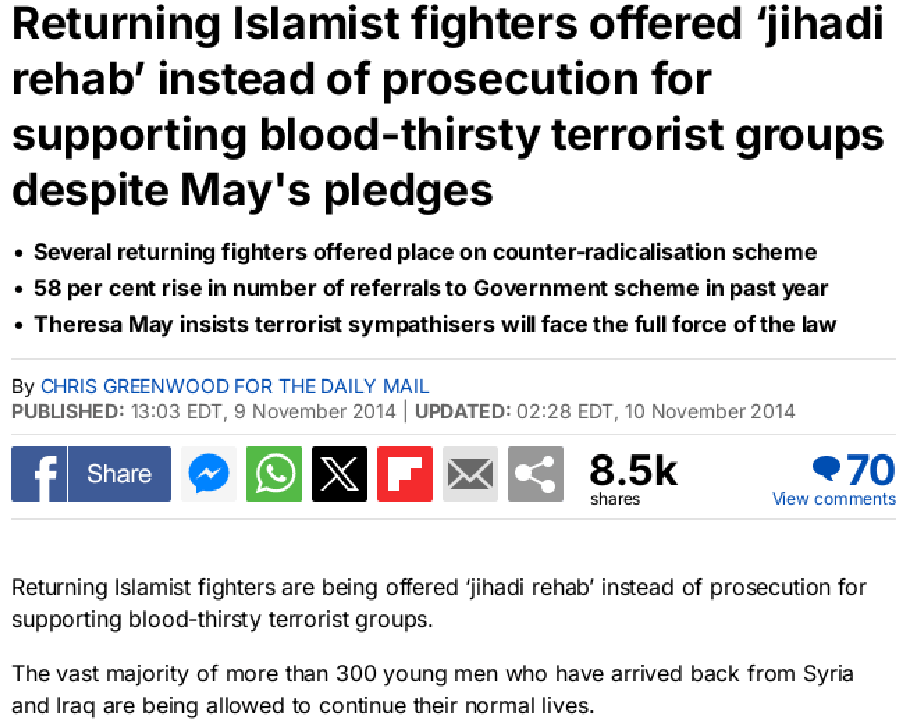
A 2019 report in the Guardian states that 119 convicted or suspected terrorists were living out in the community. A Danish rehabilitation programme had earlier been seen as a pilot to monitor. Perhaps both drew inspiration from the approach MBN had pioneered a decade earlier.
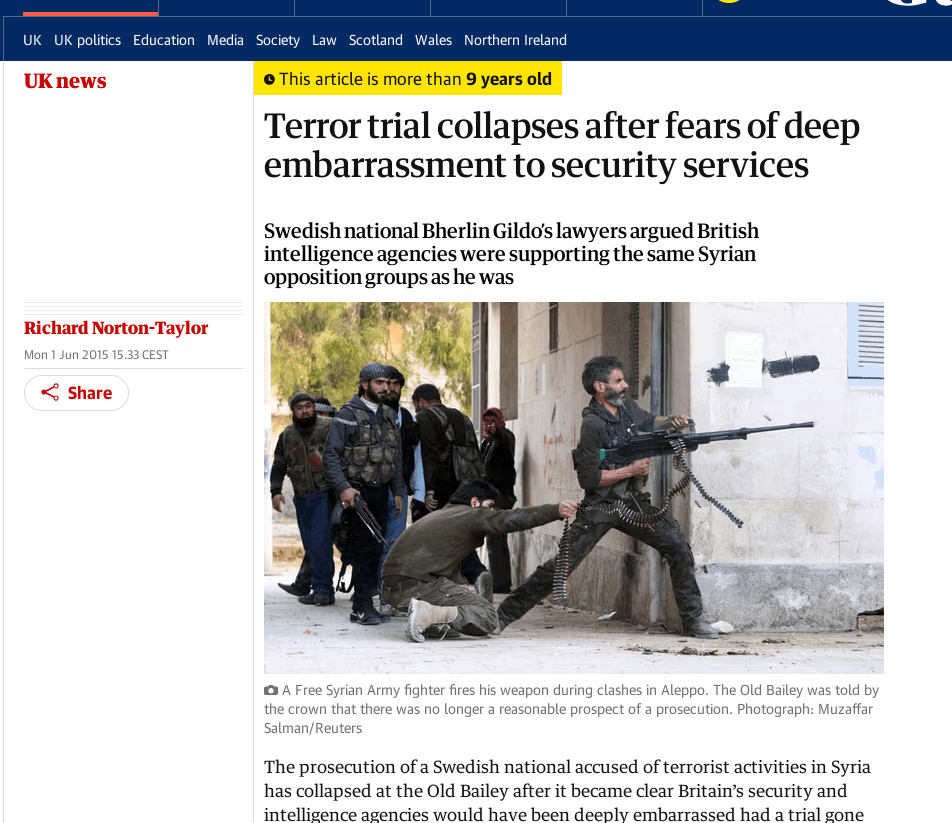
In any case, it was not practical to prosecute the men. As court hearings would inevitably incriminate the security agencies. Who had, to all intents and purposes, been supplying the same terrorist outfits that prosecutors were accusing defendants of participating in.
Manchester
The British government’s official enquiry into the Manchester arena bombing had to hold secret ‘closed sessions’. No doubt to avoid even more significant ’embarrassment’ to the security services.
The subject deserves more detailed treatment, but I’ll make a few observations that seem pertinent.
It seems likely that the need to avoid risking damaging disclosures of MI6’s extensive collaborations with al-Qaeda linked militants, was one reason why Salman Abedi was not picked up upon returning to the country, despite multiple warnings about him.
Salman’s father Ramadan Abedi had a history of cooperation with MI6. Whilst among his associates were figures linked to al-Qaeda senior leadership, including:
- Abdel Hakim Belhaj – former head of LIFG
- Abu Anis al Libi – who had been instructed to develop AQ network in Libya by al Azawari.
- Abdul Basset al Azzouz – an expert bomb-maker, who had lived close to the Abedis in Manchester
Given Ramadan’s background, he could potentially cause headaches for the British security state, if he was so minded.
Subsequently, Ramadan’s oldest son Ismael was allowed to leave the country despite being due to appear at the Arena enquiry. Ramadan and his wife were said to be keeping a low profile in Libya.
Attempting to account for their inaction before the bombing, British officialdom has intimated that Salman Abedi was not picked up because Libya was not at that time on their counter-terrorism radar.; with the policies for returning foreign fighters being focused on Syria.
This is not a plausible line. Not when knowledge of an extensive terror network in Libya was in the public domain. For instance:
- 2012: reports of a jihadist safehaven in Derna the north-east of Libya under leadership of Basset al Azzouz: “The threat to Western security posed by al Qaeda in eastern Libya was mainly “over-the-horizon” according to the official – but had the potential to become significant because of Libya’s proximity to Europe.”
- 2014: mainstream reports of ISIS being in control around Derna
Salman Abedi, it was reported after the attack, had met in Libya with members of, “Katibat al-Battar al-Libi, a core Islamic State unit that was headquartered in Syria before some of its members dispersed to Libya.” Many of its members were reported to have returned from Syria to Derna.
It is likely that through such contacts, Salman and his brother Hashem acquired the wherewithawal to put the explosive device together – with its sophisticated detonator. The al-Battar group was linked to the perpetrators of the 2015 Paris attacks. Which included the Stade de France suicide bombing attempt. Security sources said that that bomb had the same fingerprints as the Manchester attack.
Sharp Power
I concluded my previous article on MBN’s ‘savvy’ approach to counter-terrorism, discussing his demise as Crown Prince at the hands of his cousin Mohammed bin Salman (MBS). This took place within a couple of weeks of the Manchester bombing. As the Palace coup played out, the Saudis enacted measures against Qatar.
As MBS consolidated his powerbase, purges would also remove Prince Miteb from his position of influence. Payments made to MBN’s and Miteb’s front companies and personal accounts provided a pretext of ‘fighting corruption’ for their arrests. Like Saad al Jabri, Salah Fustok is now also said to be a wanted man in Riyadh.
But MBS’s agenda to replace MBN had been in the offing for couple of years, with some encouragement from the UAE’s Crown Prince MBZ . There are indications, from Canadian court filings made by al Jabri that MBS had, by summer 2015, turned against the Kingdom’s involvement in the Syrian conflict. And this was again under the influence of MBZ, who was pursuing an anti-Muslim Brotherhood agenda.
Mohammed bin Salman has been considered the driver of Saudi Arabia’s war on Yemen. But in leaked emails where the UAE’s ambassador in Washington and pro-Israeli (and anti-Qatar) thinktankers intrigued against MBN, it was said that by spring 2017, MBS already wanted out of the war.
However, these influencers felt that there was some leverage over him that could be exploited, so as to keep the war running. Suggesting that the military campaign against Yemen, may have been a convenient enactment of the interests of other powers. Powers that can be found among those who had before comprised the ‘Friends of Yemen’.
One can only speculate about the nature of any leverage held over bin-Salman. It would, though, be just one more example of a double-ended ‘sharp power’ game playing out between the Gulf monarchies and their longstanding western sponsors. A Machiavellian game often tending to revolve around accommodating the strategic concerns of Israel.