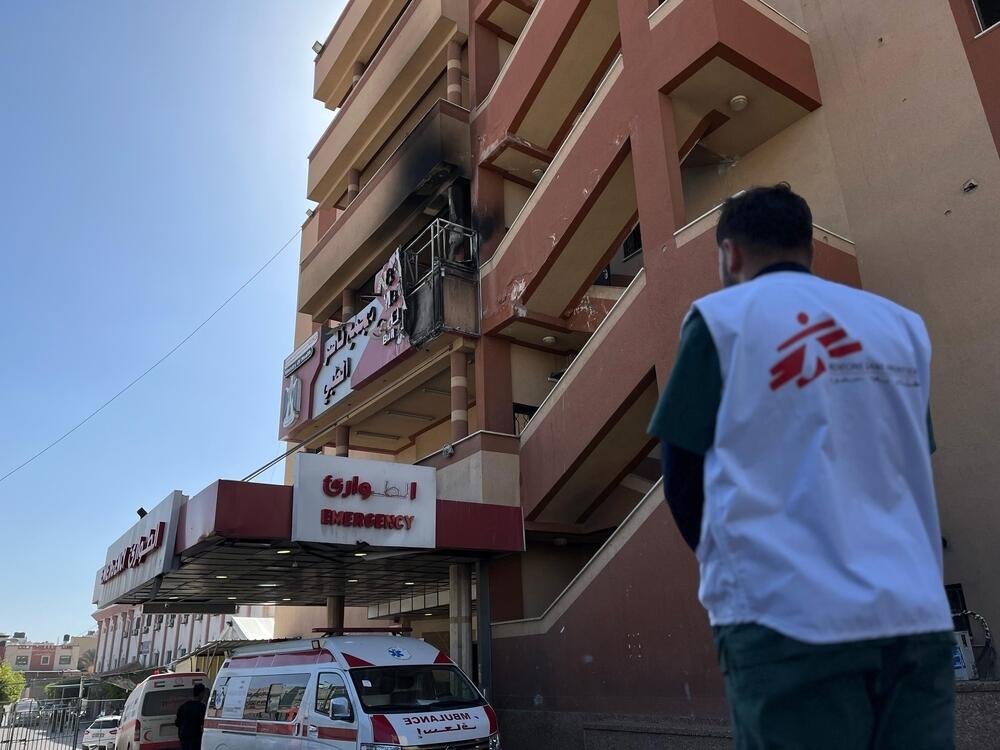
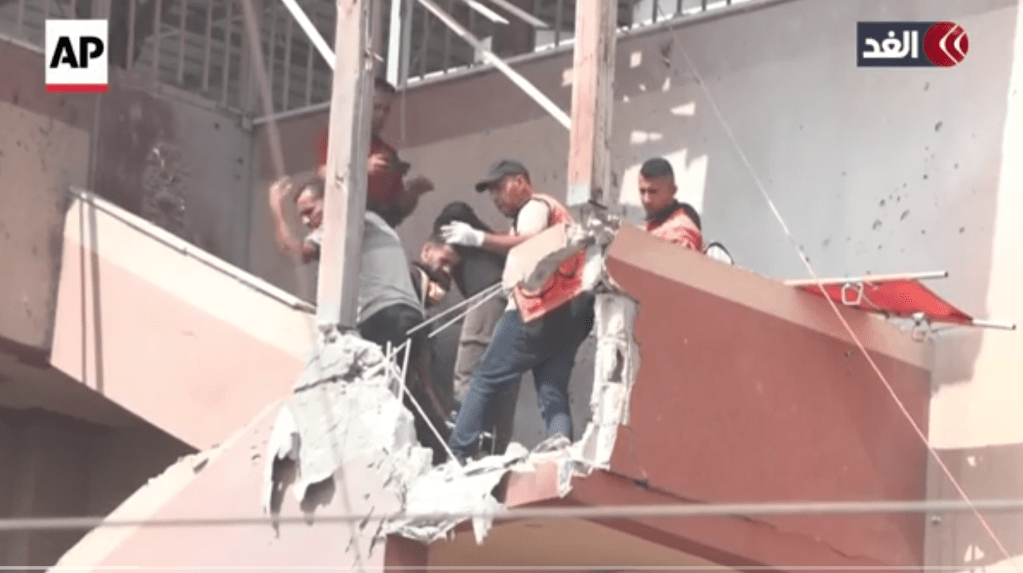
Here, I offer a brief overview of the August 25, 2025 attack on the external stairwell of Al Nasser hospital in Khan Yunis, where Reuters cameraman Hussam al Masri manned a live feed.
“Hussam has done this gruelling task day in and day out for months, mainly from Nasser Hospital but also from Rafah when the story merited it,” said Labib Nasir, Reuters‘ visual editor for the Middle East and North Africa.
I refer here to Osint analysis produced by media organisations at the time. Without time pressure and with the benefit of hindsight, it’s easier to pick up on oversights and misinterpretations of details in reporting and anlysis, in what was a confusing incident.
The attack was characterised in international media as a ‘double tap’. That was probably a fair characterisation. But we should consider Israel accounts before we are definitive.
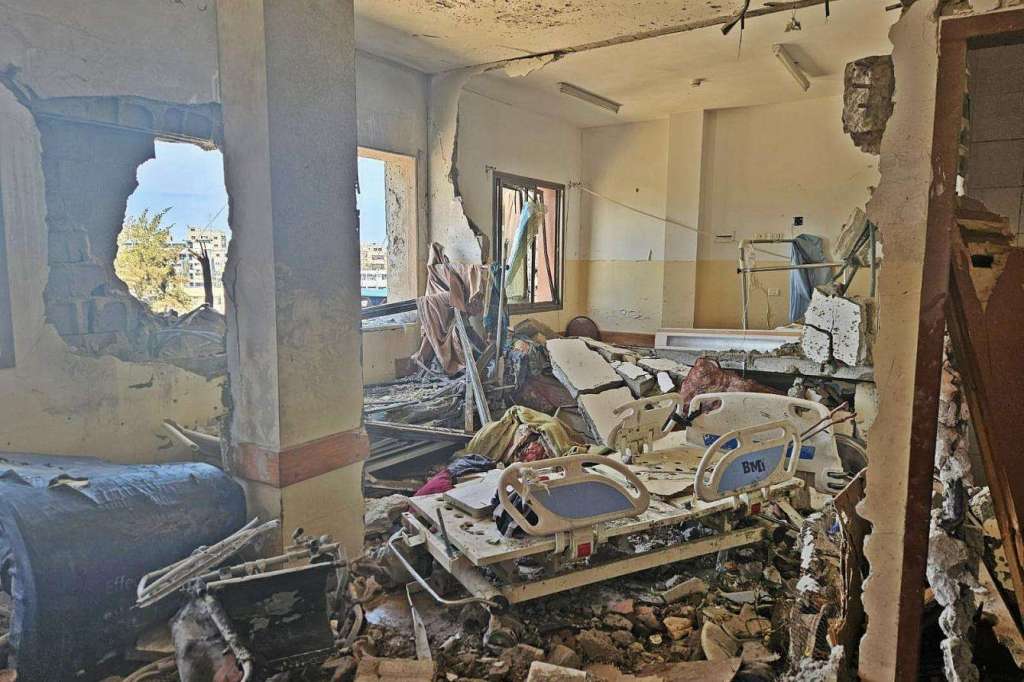
The hospital had been struck by shelling in February 13 – 15 in 2024, after a long running ‘siege’ on the hospital, leaving extensive damage. It was hit again in March 2025. The front side of the hospital, where the entrance to the Emergency department is found, faces east/south-east.
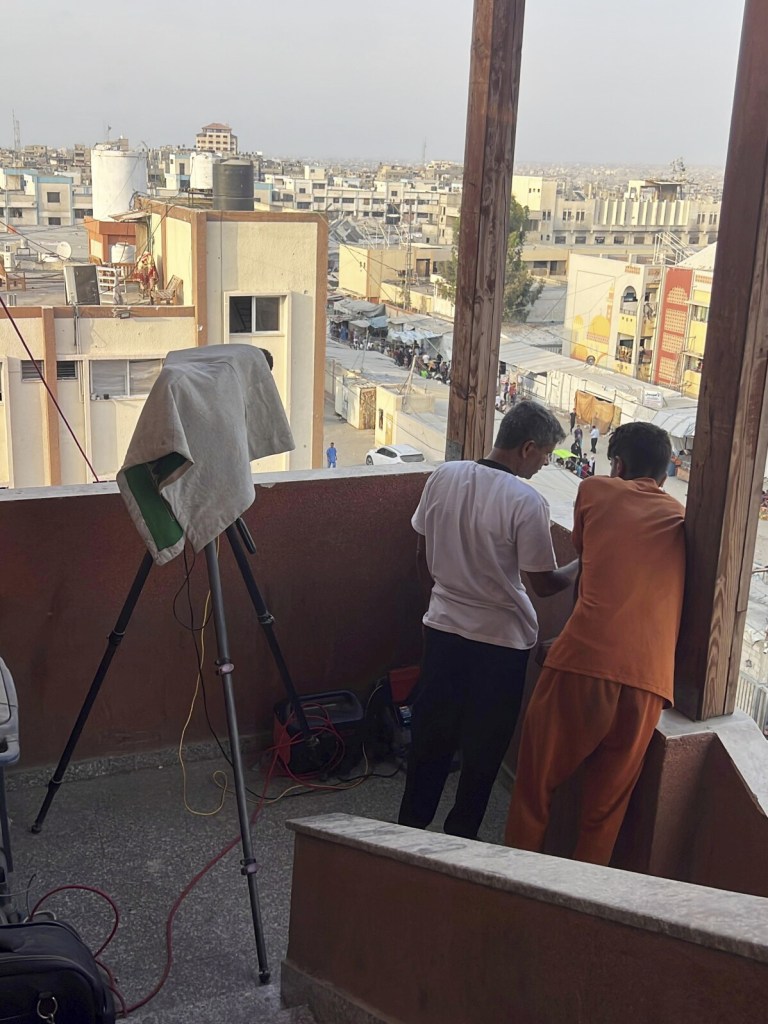
It was the external stairwell on this face of the building where al Masri and his camera was situated. Where it protrudes close to the corner with the north/north-east facing side of the building. With that orientation in mind, for simplicity, I will refer to the east and north facing sides of the building.
The top-floor front right corner of the hospital (centre) was struck
The corner of the 4th floor stairwell was struck at 10.08am, killing al Masri. The munition appears to have struck the front wall of the corner ‘balcony’ on the stairwell. The north facing wall of the balcony was still intact after the first hit, which tends to imply the munition was fired from the east or south east. The imagery of the damage left by the initial strike on the stairwell suggests that it was a fairly direct (front-on) blow to the ESE face.
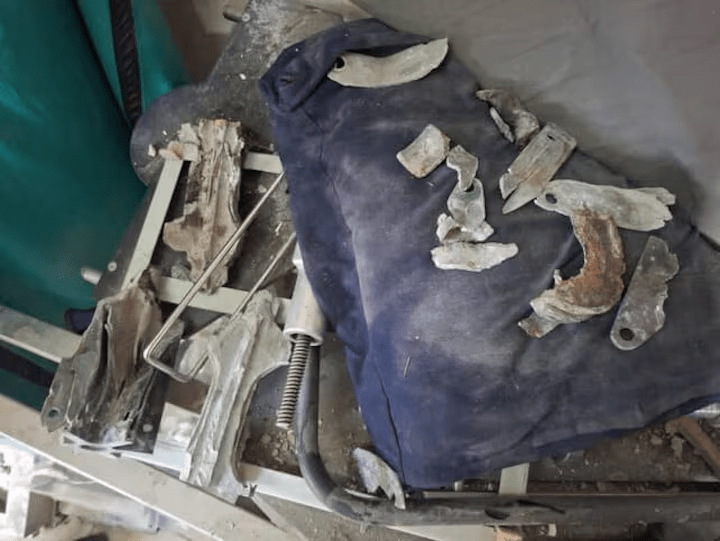
Some munition fragments collected from the scene and photographed were identified as from 120mm tank shells – standard calibre for Israeli tanks. This must’ve been from the first hit (10.08am). Which looks to have been an accurate single shot. Reviewing images there is no obvious sign of damage from more than one shell, from the first ‘tap’. However, subsequent Israeli reporting mentioned two shells. And the photo of remnants collected that day implies two shells. But we don’t know if the doctor had collected shell fragments from previous strikes.
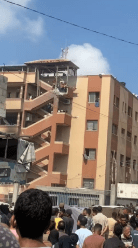
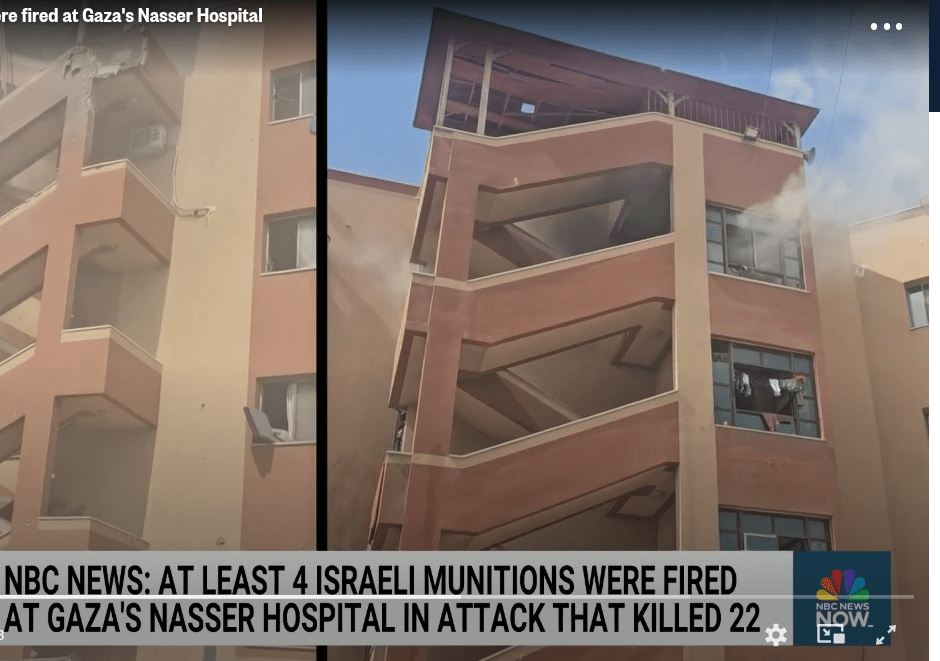
BBC Verify subsequently pointed to evidence that the north side of the building, where there is another external stairwell was also struck. This seems to have been confused. Reviewing the evidence, the ‘hit’ seems only to be smoke coming out of a fourth floor window. With no sign of damage in that part of the building – see this screen shot from NBC coverage.
It seems likely that after the first munition hit the balcony, smoke blew along a corridor and out of the window. Or quite possibly, the impact and ensuing chaos resulted in a relatively minor secondary fire inside. Whatever the origin of the smoke, there is no obvious damage to the north side of the building to suggest it was also hit then. Nor, to my knowledge, is there any witness testimony concerning a strike to this part of the building that morning.
Nine minutes after the initial shell fire, as rescuers attended to al Masri’s body, another strike happened; resulting in 19 additional fatalities, four of whom were also journalists.
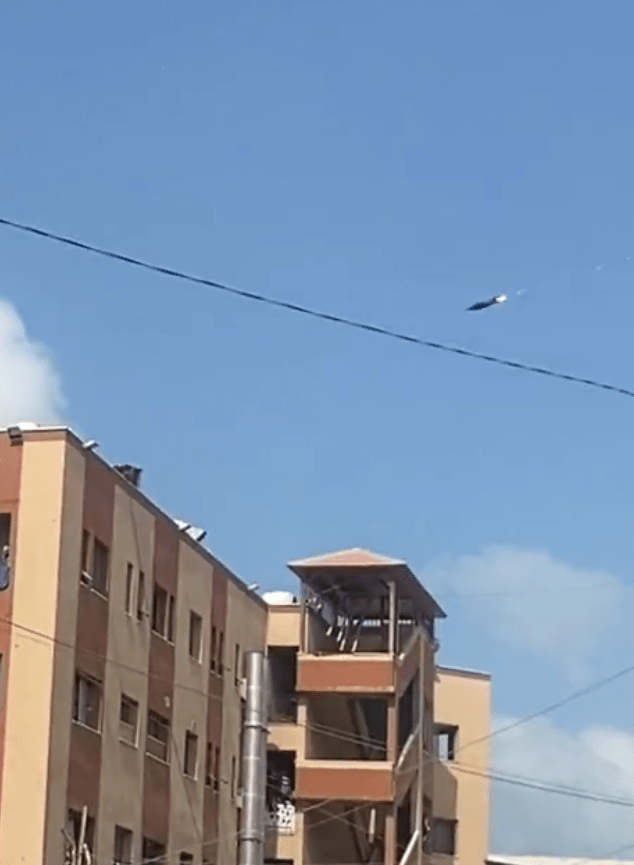
It was captured on mobile phone footage, which revealed two munitions hitting the NNE facing corner of the stairwell, almost instantaneously. This footage indicates a firing position from approximately the north/north-east; distinct from where the tank fire came from.
This video of the follow-up strike indicates use of missiles, rather than tank shells. Available evidence points to short-range Spike missiles. That the pair hit near instantaneously, on close trajectories strongly suggests they were fired simultaneously, and from a single platform.
Some experts, commenting at the time, suggested tracer tank rounds. However, not only would that imply two tanks firing from the same position simultaneously, and both accurately. It also does not sit with the observation that tank shell projectiles fly too fast to be discernible to the eye. A shell fired from a tank travelling at approx Mach 2.5 could not be discerned by the naked eye, or at a normal video recording rate. Technical forensic video analysis would be able to give an appoximate speed for the projectiles. Spike missiles are said to reach Mach 0.45.
The day following the attack, a report in Israeli media claimed a drone strike on the position had first been intended. According to the account, Golani Brigade troops spotted a ‘Hamas surveillance camera’. They requested a drone strike on the position, which was approved by Southern command. Shortly after, the troops identified an ‘apparent rifle scope’ at the position. Classing it as an “immediate threat”, they made an urgent request for tank fire, which was also approved. However, IDF statements subsequently disavowed that tank fire was approved by Southern Command.
The earlier reporting did not suggest that once tank fire had hit the camera position, the drone mission was aborted. Which rather suggests that an armed drone still fired.
A remote piloted drone (probably a Hermes) firing two Spike missiles from the north/north-east seems to be the most plausible fit for what is seen in the footage. Dheifallah Al-Dabboubi, a weapons analyst, noted that the destruction pattern at the site was unusually precise, consistent with a guided strike. And pointed to the use of ‘fire and forget’ Spike missiles. This is consistent with the short range Spike missiles carried by Israeli Hermes drones.
A trace of the rocket stream is visible behind the burner
For some reason BBC Verify analysts seem to have believed ground launched LAHAT missiles were implied; probably as tank fire was implicated in the incident. I think LAHAT missiles can be ruled out here. Two tank fired LAHAT missiles fired simultaneously is implausible. Nor has there been been any documented use of LAHAT missiles (which are longer stand-off range weapons) from aerial platforms over Gaza since October 2023.
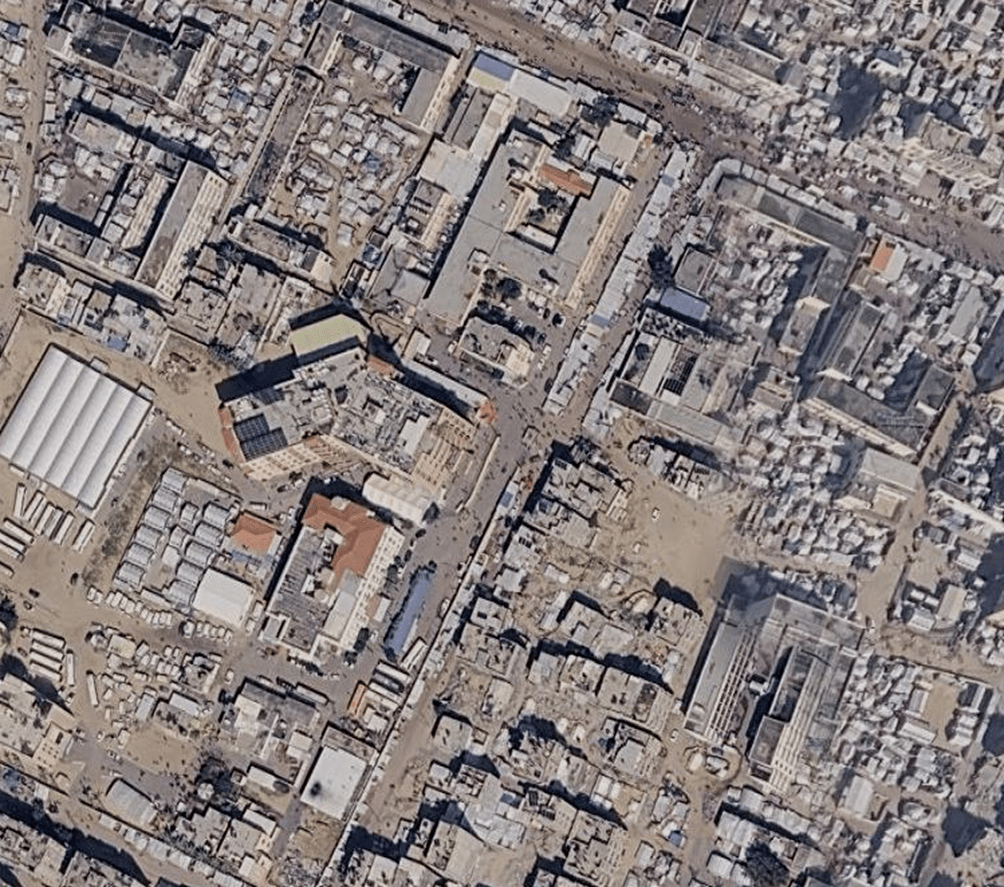
Satellite imagery from Planet Labs had apparently shown tanks positioned to the north-east. The position was said by BBC Verify and CNN to be 1.5 miles (2.5km) While I can’t rule out that tank shells were fired from there. Some difficulties with this should be noted:
The Planet Labs imagery shown in different outlets doesn’t obiously match up. Associated Press and Times of Israel had a different image of a position, said to 4km to the north-east.
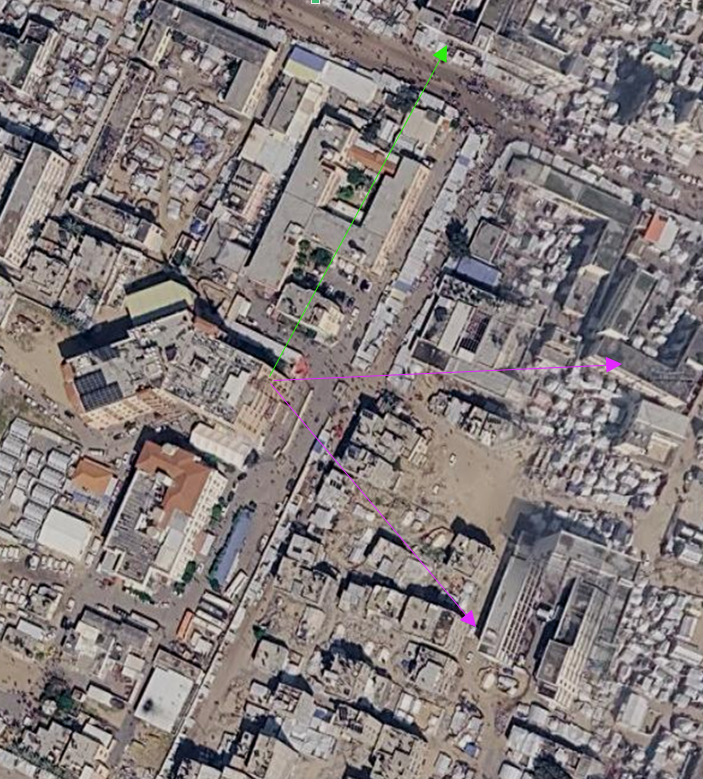
Below is a recently prior view from the balcony – looking to the north-east. It strikes me as questionable that a single, accurate line-of-sight shot could be attained at such range across the urban terrain of Gaza. So, I doubt that the initial tank shell was fired from either of those positions.
Consistent with the above, the first impact that morning was with a tank shell (perhaps more than one). While there is no video available of that strike, the initial damage appears consistent with a relatively straight-on hit, and from an east/south-east sector.
The missiles arrived from the north/north-east. A Hermes drone firing two Spike missiles together is the most plausible attribution for the deadly second strike.
Green indicates direction from wich Spike missiles came. Magenta lines indicates likely range of directions from whcih tank fire came.
Israeli accounts sought to refute that the secondary strike was a ‘double tap’ as such, and due to a mishap, or failed communication. According to their account, a drone strike had been ordered before the tank fire was carried out. However, the IDF did not acknowledge that a drone did in fact still fire; falsely putting all hits down to tank fire.
A surveillance quadcopter was filmed over the scene four minutes after the first tank shell hit, and this obviously raises the question of why the drone strike mission was not then aborted. Given the obvious presence of rescuers and journalists on the stairwell, the evidence weighs against any Israeli claim that the second strike was simply an oversight.
Article amended August 25, 2026 – to reflect that the tank postion(s) identified from Planet Labs satellite imagery are said to be to the north-east (not the north-west). And to note apparent inconsistencies around this imagery evidence in reporting.
If you value this content, please share it or support me atBuy me a coffee
The recent collapse of the Baathist state in Syria has brought into sharp focus the nature of the jihadi, mercenary groups that waged war on it. And moreover, the question of who funded and supplied them with logistical, intelligence, PR, propaganda and other support.
As the British government welcomes the assumption of power in Syria by a group they had officially designated a ‘proscribed terrorist organisation’. It once again faces public pressure to prevent jihadis entering (or reentering) the UK.
As MI6 head Alex Younger had noted publicly, such jihadists may be very capable.
“They are likely to have acquired both the skills and connections that make them potentially very dangerous and also experienced extreme radicalisation…”
He could say this with confidence, because MI6 had itself been active in facilitating and equipping such men. Now, the prospect is raised that those chickens will come home to roost, as they did once before in the foyer of Manchester Arena, in May 2017.
I try here to connect some dots between the deals and arrangements – shrouded in official secrecy – Her Majesty’s Government (HMG) came to, in respect of its longstanding strategic partnership with the Kingdom of Saudi Arabia, and international Islamist militancy in Libya and Syria.
Seven years ago the BBC reported that the some of the funding for a government contractor in Syria, developing the ‘Free Syrian Police Force’ had flowed into the hands of members of Al-Nusra (the main branch of al Qaeda in Syria) and a proscribed terrorist organisation. The Panorama episode around Adam Smith International’s activity on behalf of HMG caused a stir. But the story really represented just the tip of the iceberg.
My previous article, outlined briefly the international coalition for regime change, which brought together Saudi, Qatari and Turkish backers of the Muslim brotherhood and al-Qaeda, with the US & UK, and Israel – against Iranian, Shi’ite and Arab Nationalist powers; in an extensively planned and orchestrated Machiavellian campaign.
There is evidence such plans for proxy warfare may have been conceived, on behalf of an expansionist Israel, as far back as 1996. There were two other significant parts of the axis I should have mentioned; countries that played key roles; one as core part of Nato, France; and the other as the home of al-Qaeda’s leadership, Pakistan.
The scheme involved ‘off the books’ procurement of weapons. As well as recruitment of Islamist extremists from not just the Gulf, Libya and Pakistan, but also regions of the Balkans, the Caucuses and central Asia. All to take part in the “Syrian Revolution” – a project of former colonial powers and some of the world’s most reactionary autocracies. In a country whose President’s actual popularity ratings compared quite favourably with those of western leaders.
First stop, Libya
It’s hard to know where to start in attempting to outline all the machinations, but the Elysee Palace seems as good a place as any.
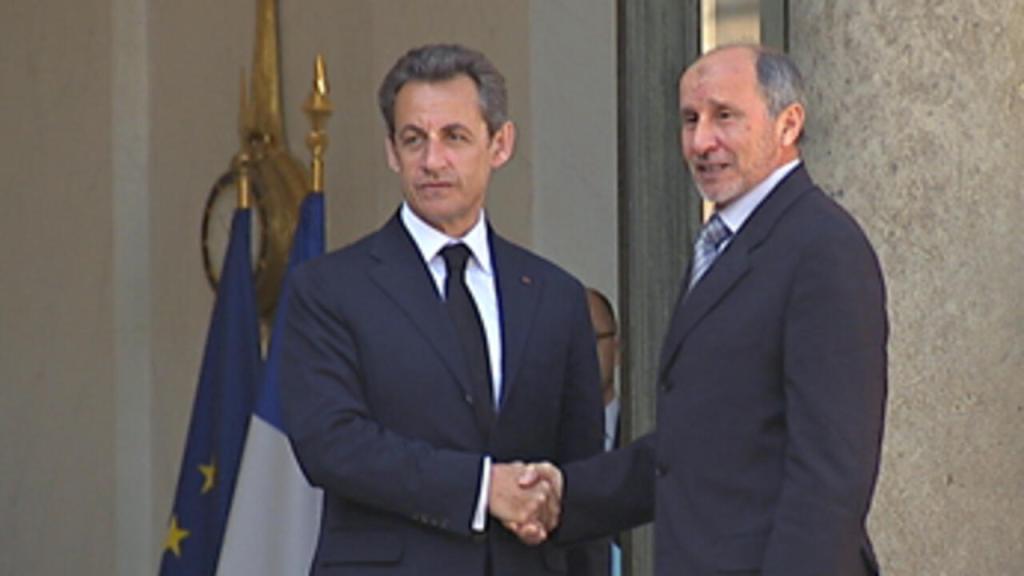
April 20, 2011 The head of the Libyan ‘National Transition Council’ seen with the French President
After the overthrow of the Libyan Arab Jamahiriya and Gaddafi’s horrific murder. The British would recount the work of their special services. A report in Reuters explained about the work of one their assets (Mlegta) in encouraging Libyan security officials to betray Gaddafi. According to him:
Rebel leaders discussed their idea with French President Nicolas Sarkozy at a meeting at the Elysee Palace on April 20.
That meeting was one of five in Paris in April and May, according to Mlegta. Most were attended by the chiefs of staff of NATO countries involved in the bombing campaign, which had begun in March, as well as military officials from Qatar and the United Arab Emirates.
After presenting the rebels’ plan “from A to Z”, Mlegta handed NATO officials three memory cards: the one packed with information about regime strongholds in Tripoli; another with updated information on regime sites as well as details of 65 Gaddafi officers sympathetic to the rebels who had been secretly supplied with NATO radiophones; and a third which contained the plot to take Tripoli.
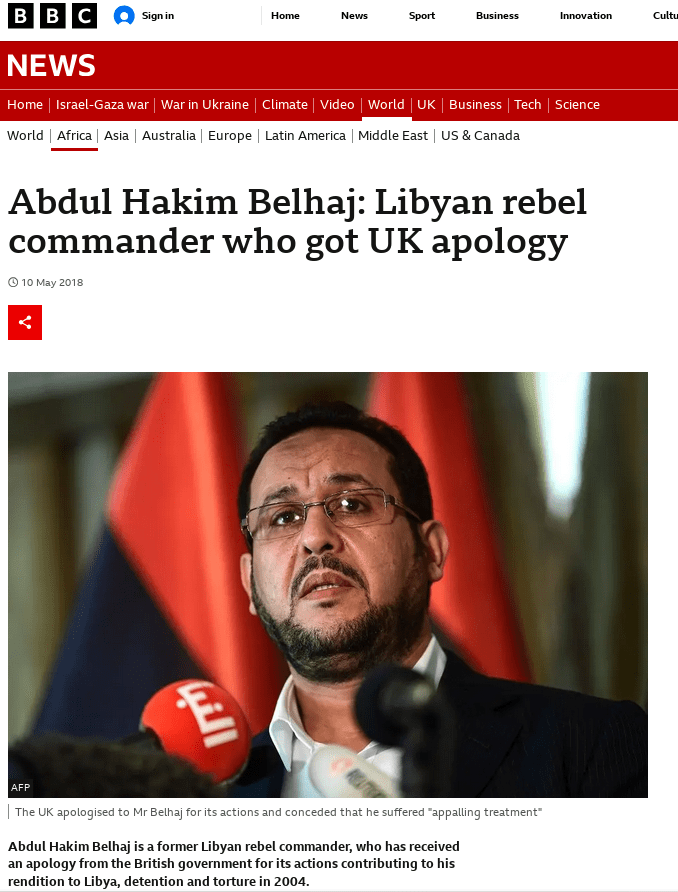
That the rebels were largely constituted by Islamic extremists would, undoubtedly, have been well known to western security agencies. Indeed, the top rebel military commander Abdel Hakim Belhaj appointed to run operations in Tripoli had previously been renditioned by the CIA for his role in running al-Qaeda training camps in Afghanistan.
Before that Belhaj had been active in the Libyan Islamic Fighting Group (LIFG), which had previously cooperated with the British in trying to assassinate Gaddafi in 1995 and 1996. He certainly has an ‘interesting’ resume.
When Qaddafi protested to the world’s media that the violence in his country earlier in 2011 was due to al-Qaeda, the western press and media simply mocked and insulted him.
Why was Libya a target ?
For many reasons, but among them:
It was an Arab Nationalist ally to Syria
Resource nationalist – refusing to do deals with western oil companies on their terms
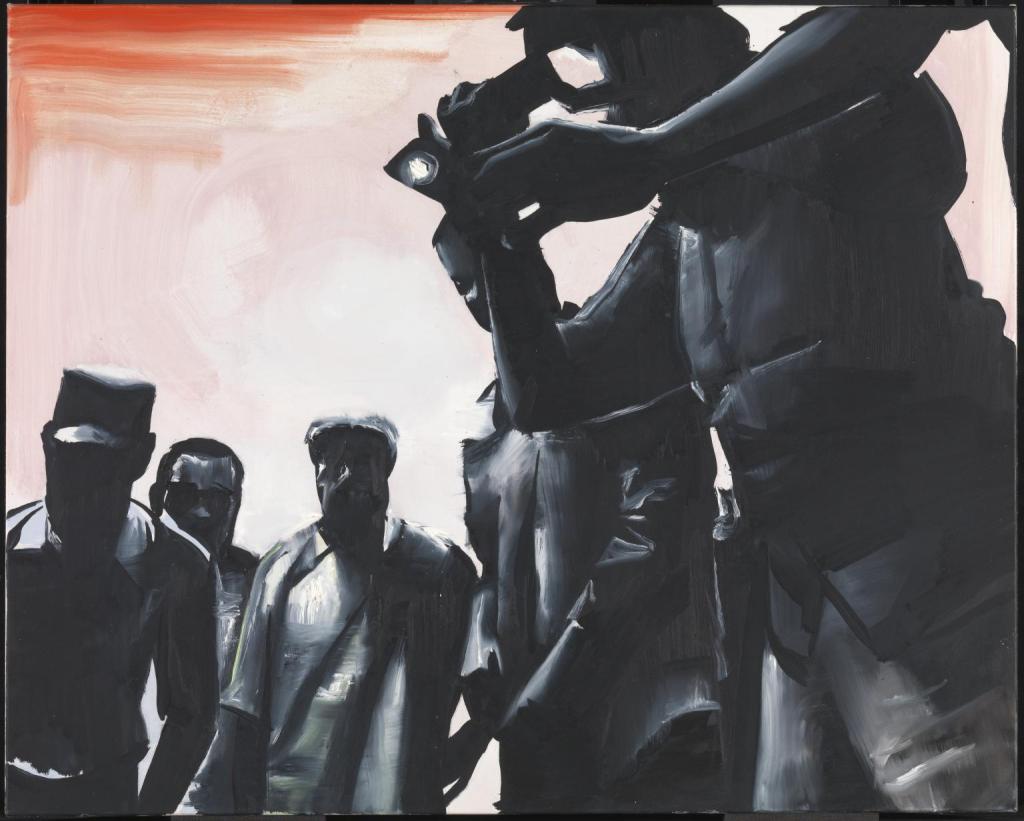
‘Gaddafi 2’ (2011) by Polish artist Wilhelm Sasnal
Covert Operations and The Ratline
After Gaddafi fell, Libya would, as noted by a 2012 Library of Congress research report, “become the centre of a network designed to send jihadists to Syria.” Bases in Libya would, under the watchful eyes of NATO, serve as training and logistics hubs for militants focused on taking down the Baathist state.
Indeed, elements of the LIFG were active in Syria from the outset of the insurgency there. Belhaj himself travelled to Turkey’s border with Syria in November 2011 to meet with the leadership of the ‘Free Syrian Army’ – discussing arrangements for sending weapons and a stream of foreign fighters to the ‘rebels’ in Syria.
Unmarked NATO warplanes are arriving at Turkish military bases close to Iskenderum on the Syrian border, delivering weapons from the late Muammar Gaddafi’s arsenals as well as volunteers from the Libyan Transitional National Council who are experienced in pitting local volunteers against trained soldiers, a skill they acquired confronting Gaddafi’s army. Iskenderum is also the seat of the Free Syrian Army, the armed wing of the Syrian National Council. French and British special forces trainers are on the ground, assisting the Syrian rebels while the CIA and U.S. Spec Ops are providing communications equipment and intelligence to assist the rebel cause, enabling the fighters to avoid concentrations of Syrian soldiers.
Useful overviews of Britain’s covert operations in Syria has been provided by Mark Curtis. I won’t attempt to catalogue things here, but suffice it to say that HMG’s investment in the regime change project was longstanding, deep and extensive, and deployed both hard-power and soft-power capabilities.
Funding for the proxy military campaign in Syria, though, largely came from Qatar and Saudi Arabia. Whilst operations were largely directed from Turkey. Training of the militants also took place in Jordan – where much of the CIA rebel training programme money was spent. It hosts dedicated special ops training camps.
In 2012 Turkey established an ‘operations room’ for the ‘rebels’ military campaign. This was after a request to establish such a “nerve centre” was made by one of the Saudi King Abdullah’s four sons, Prince Abdulaziz- who had a longstanding career in the Saudi Arabian National Guard (SANG). This ‘nerve centre’ was set up near Turkey’s border with Syria at Adana. Nato’s Incirlik airbase is also situated in Adana. The Reuters report mentioned that the Turks were keen to get more technical support for running operations, especially around drones.
In my last article, I found that the head of the Saudi Ministry of the Interior Mohammed bin Nayef (MBN) and his right hand man Saad al Jabri had, using MBN’s personal counter-terrorism account, set up front companies. Given the somewhat surprising nature of those expenditures, these ‘vehicles in the private sector’ appear to have been used to provide logistical support to ‘rehabilitated’ al Qaeda militants sent on to fight in Yemen, Libya and Syria.
Circumstantial evidence strongly points to the SANG as being one channel used by the west to arm the ‘rebels’ at arms-length. SANG – the troops of the Interior Ministry – purchased, among other US made systems, a large supply of TOW anti-tank missiles in the years 2012-15. A weapons system that then happened to turn up in the hands of takfiri militants across Syria.
The Memorandum and the ‘fast ball’
By late 2013, the British were seeing their scheme, to funnel Sunni militants into insurgency operations, start to get out of hand. A report in the Telegraph said British and European jihadis in Syria were being encouraged and prepared to wage Jihad in their home countries.
This was then, the backdrop to a Memorandum of Understanding then British Home Secretary Theresa May signed in Riyadh in March 2014. The MoU was not publicised at the time and only vague details were reported a year later; with the Government refusing to disclose further details. A Freedom of Information request for more details about the agreement was rejected:
‘The public interest falls in favour of applying these exemptions as the memorandum of understanding (MoU) contains information relating to the UKs security co-operation with Saudi Arabia, the release of which would damage the UKs bilateral relationship.’
But from snippets and developments at the time, I think it is possible to get a sense of what was agreed. The deal was said to concern British ‘help’ with the ‘modernisation’ of the Saudi Interior Ministry.
Theresa May must have met MBN and al Jabri, when agreeing the MoU in March 2014.
It seems likely that the British side’s assistance to the Saudis consisted of technology, training and supplies for the SANG; the latter including supplies of CS gas and upgrades to crowd control vehicles.
The British embassy in Riyadh admitted in 2012 that the UK military officers involved in the mission “take their orders directly from His Royal Highness, Prince Miteb bin Abdullah bin Abdulaziz, Cabinet Minister and Head of the Saudi Arabian National Guard”.
In return for ‘technical support’, MBN likely offered the British help on counter-terrorism, as the two monarchies struggled to keep their ‘useful idiot’ jihadis in check.
On 31 January, the Saudi Arabian government published the full text of its new counter-terrorism and terrorism financing legislation, outlining the procedures and punishments to be applied. Later, on 7 March, the Ministry of Interior issued a decree creating Saudi Arabia’s first list of proscribed organisations. Amongst the groups included were Al Qaeda and its affiliates (including the Al Nusra Front, Al Qaeda-Iraq, and Al Qaeda in the Arabian Peninsula), Saudi Hezbollah, certain Houthi groups in Yemen and the Muslim Brotherhood.
Shortly after the MoU was signed a civil servant at the Ministry of Defense (MoD) related in an email that he had receieved a ‘fast ball’ from the Saudis. It was from Prince Mutaib (or ‘Miteb’) and at the MoD in relation to its longstanding SANGCOM programme (providing communications systems for the SANG). It appears they were made an offer they couldn’t refuse. MoD officials judged the proposal as effectively impossible to turn down.
Snatching up the contract would though, following Prince Miteb’s instruction, mean making special payments to a private company owned by Salah Fustok ( or ‘Fustuq’) – a Saudi-Lebanese arms dealer with close family ties to the Saudi Royals. Such payments were apparently routine in relation to SANGCOM and would be denoted in MoD records only as ‘bought in services’.
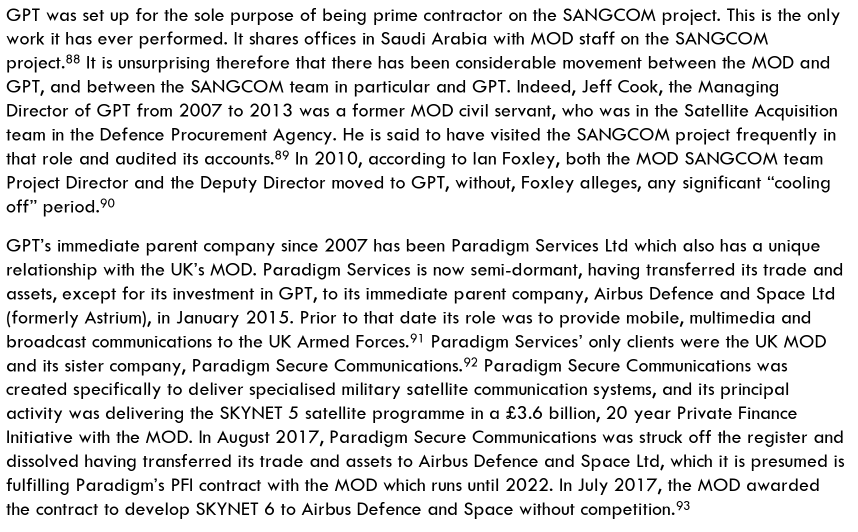
The contract would be with a British company called GPT Special Project Management. What the contract was for, HMG prefers to keep secret; despite court proceedings about the corrupt payments and kickbacks.
According to 2017 research for Corruption Watch, GPT was set up to provide services only to the UK MoD, and only for the SANGCOM programme.
GPT has, though, been owned by a plethora of defence sector providers. GPT provided ‘space services’, through its parent company Paradigm Services Ltd and the latter’s sister company ‘Paradigm Secure Communications’ – that provided ‘MilSatCom’ equipment and services, using the British military’s ‘Skynet 5’ communications satellites, first launched in 2003.
A MoD civil servant and board member with both GPT SPM and Paradigm described their capabilities in a 2013 feature in MilSat Magazine:
..The Skynet 5 fleet of four satellites are the most powerful, commercially controlled, military X-band satellites launched to date…The satellites were specifically designed to mission critical, sensitive command and control communications systems, where loss of communications is not an option… This makes the satellites ideal for supporting smaller, low powered tactical terminals that are deployed across multiple theaters of operation.
The Skynet 5 satellites are also used to control military drone flights, according to the website Drone Wars.
After it was struck off the Companies register, Paradigm Secure Communications’ assets were transferred to Airbus Defence and Space Ltd. Which also provides satellite communications and imagery services.
The ‘fast-balled’ GPT SPM contract was, according to emails released under and FOI request, to work in a “very sensitive environment”.
Salah Fustok was a key middle-man for arms sales to the SANG and said to be linked with western private military and intelligence contracters, like Vinnell Corp; who happen also to be longstanding providers of training for the SANG. Turkey is another of Vinnell’s clients.
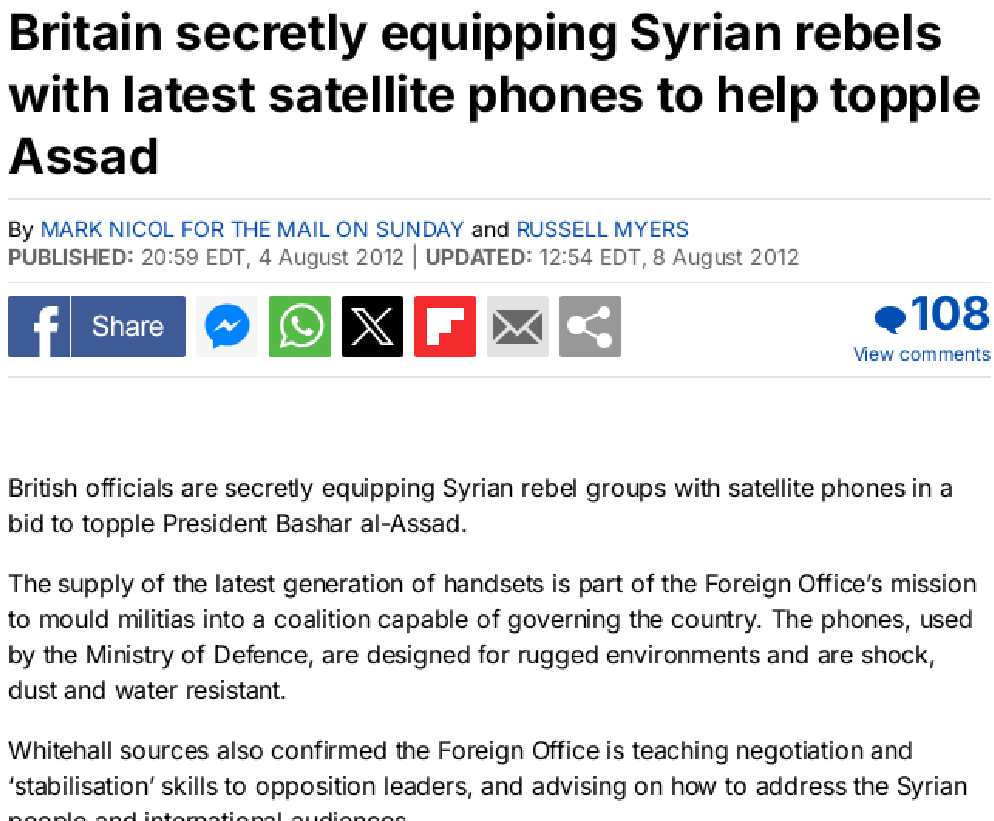
Putting this together, suggests that Syrian rebels (eg al-Nusra militants) were using satellite phones and other comms equipment that depended on the same satellites the UK military uses.
And that, possibly, real time satellite imagery or connectivity for drone reconnaissance was provided to the ‘nerve centres’ directing those proxy operations. And what’s more, that corrupt payments to arms dealers and Saudi royals were signed off by British civil servants in order to make that happen.
Rehabilitation
Perhaps Prince Miteb’s ‘fast ball’ took advantage of the British need for cooperation on counter-terrorism; given the situation British security agencies had created for themselves, with their policy – extant since 2006, according to former army and police intelligence officer Charles Shoebridge – of enabling travel for persons that could otherwise be under terror control-orders at home.
However, given the nature of the UK-Saudi relationship there would probably have been a few ways for MBN’s Ministry and the SANG to exert a bit of ‘sharp power’. As Mark Curtis has noted:
It is hard to pinpoint whether Saudi Arabia is a client of the UK or the other way round: probably both, since both sets of elites have been happily joined at the hip.
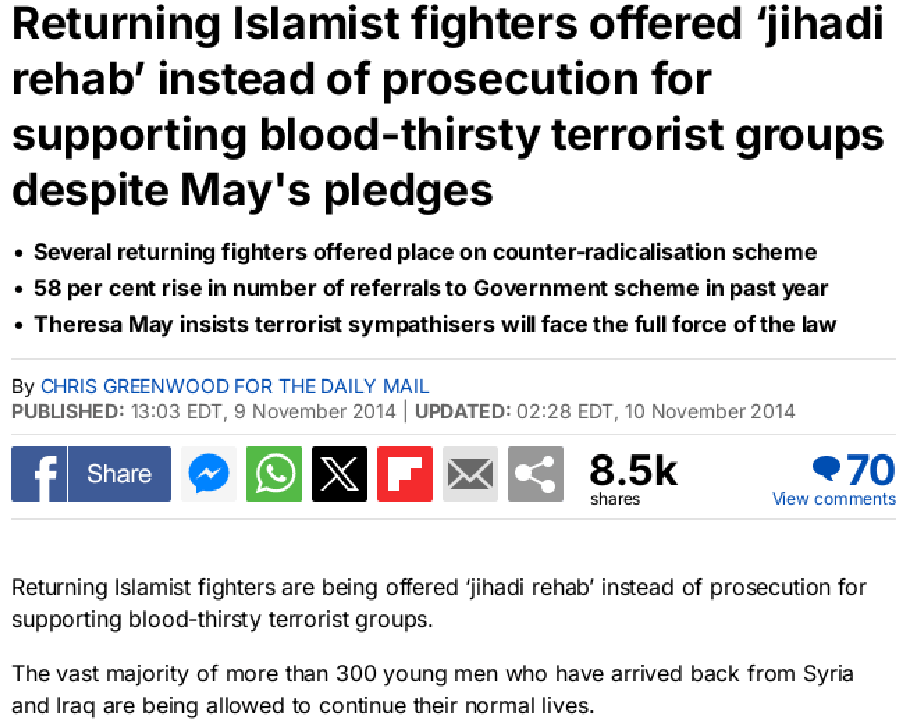
While keeping up tough talk about prosecuting jihadis for domestic consumption, the Home Office, in consequence of the double game they were playing, had to develop a softer, rehabilitation focused approach to returnees. Senior defence figures deemed it inappropriate to treat harshly, men that had been encouraged to take up the fight, and allowed to travel on a nod and a wink.
A 2019 report in the Guardian states that 119 convicted or suspected terrorists were living out in the community. A Danish rehabilitation programme had earlier been seen as a pilot to monitor. Perhaps both drew inspiration from the approach MBN had pioneered a decade earlier.
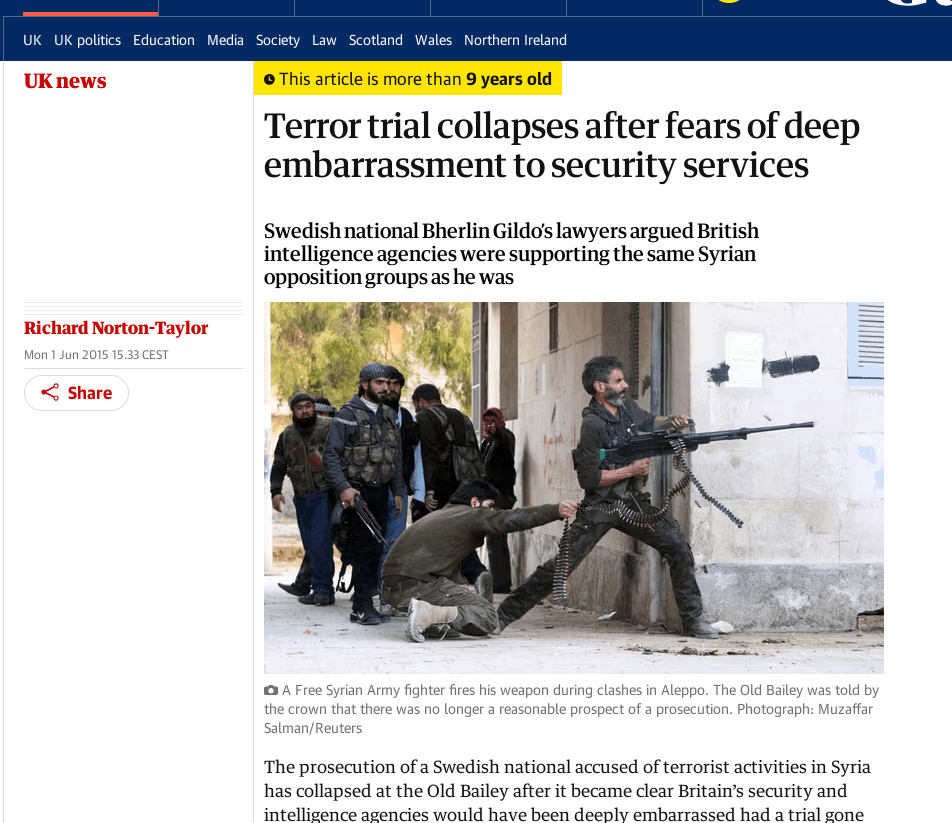
In any case, it was not practical to prosecute the men. As court hearings would inevitably incriminate the security agencies. Who had, to all intents and purposes, been supplying the same terrorist outfits that prosecutors were accusing defendants of participating in.
The British government’s official enquiry into the Manchester arena bombing had to hold secret ‘closed sessions’. No doubt to avoid even more significant ’embarrassment’ to the security services.
The subject deserves more detailed treatment, but I’ll make a few observations that seem pertinent.
It seems likely that the need to avoid risking damaging disclosures of MI6’s extensive collaborations with al-Qaeda linked militants, was one reason why Salman Abedi was not picked up upon returning to the country, despite multiple warnings about him.
Salman’s father Ramadan Abedi had a history of cooperation with MI6. Whilst among his associates were figures linked to al-Qaeda senior leadership, including:
Abdel Hakim Belhaj – former head of LIFG
Abu Anis al Libi – who had been instructed to develop AQ network in Libya by al Azawari.
Abdul Basset al Azzouz – an expert bomb-maker, who had lived close to the Abedis in Manchester
Given Ramadan’s background, he could potentially cause headaches for the British security state, if he was so minded.
Subsequently, Ramadan’s oldest son Ismael was allowed to leave the country despite being due to appear at the Arena enquiry. Ramadan and his wife were said to be keeping a low profile in Libya.
Attempting to account for their inaction before the bombing, British officialdom has intimated that Salman Abedi was not picked up because Libya was not at that time on their counter-terrorism radar.; with the policies for returning foreign fighters being focused on Syria.
This is not a plausible line. Not when knowledge of an extensive terror network in Libya was in the public domain. For instance:
2012: reports of a jihadist safehaven in Derna the north-east of Libya under leadership of Basset al Azzouz: “The threat to Western security posed by al Qaeda in eastern Libya was mainly “over-the-horizon” according to the official – but had the potential to become significant because of Libya’s proximity to Europe.”
Salman Abedi, it was reported after the attack, had met in Libya with members of, “Katibat al-Battar al-Libi, a core Islamic State unit that was headquartered in Syria before some of its members dispersed to Libya.” Many of its members were reported to have returned from Syria to Derna.
It is likely that through such contacts, Salman and his brother Hashem acquired the wherewithawal to put the explosive device together – with its sophisticated detonator. The al-Battar group was linked to the perpetrators of the 2015 Paris attacks. Which included the Stade de France suicide bombing attempt. Security sources said that that bomb had the same fingerprints as the Manchester attack.
Sharp Power
I concluded my previous article on MBN’s ‘savvy’ approach to counter-terrorism, discussing his demise as Crown Prince at the hands of his cousin Mohammed bin Salman (MBS). This took place within a couple of weeks of the Manchester bombing. As the Palace coup played out, the Saudis enacted measures against Qatar.
As MBS consolidated his powerbase, purges would also remove Prince Miteb from his position of influence. Payments made to MBN’s and Miteb’s front companies and personal accounts provided a pretext of ‘fighting corruption’ for their arrests. Like Saad al Jabri, Salah Fustok is now also said to be a wanted man in Riyadh.
But MBS’s agenda to replace MBN had been in the offing for couple of years, with some encouragement from the UAE’s Crown Prince MBZ . There are indications, from Canadian court filings made by al Jabri that MBS had, by summer 2015, turned against the Kingdom’s involvement in the Syrian conflict. And this was again under the influence of MBZ, who was pursuing an anti-Muslim Brotherhood agenda.
Mohammed bin Salman has been considered the driver of Saudi Arabia’s war on Yemen. But in leaked emails where the UAE’s ambassador in Washington and pro-Israeli (and anti-Qatar) thinktankers intrigued against MBN, it was said that by spring 2017, MBS already wanted out of the war.
However, these influencers felt that there was some leverage over him that could be exploited, so as to keep the war running. Suggesting that the military campaign against Yemen, may have been a convenient enactment of the interests of other powers. Powers that can be found among those who had before comprised the ‘Friends of Yemen’.
One can only speculate about the nature of any leverage held over bin-Salman. It would, though, be just one more example of a double-ended ‘sharp power’ game playing out between the Gulf monarchies and their longstanding western sponsors. A Machiavellian game often tending to revolve around accommodating the strategic concerns of Israel.
…As I indicated last week, we have taken care to look at all the evidence currently available. Mr Speaker, I can now share our assessment with the House. On the basis of the deep knowledge and analysis of our intelligence and weapons experts…the British government judges that the explosion was likely caused by a missile – or part of one – that was launched from within Gaza towards Israel.
The misreporting of this incident had a negative effect in the region – including on a vital US diplomatic effort – and on tensions here at home. We need to learn the lessons and ensure that in future there is no rush to judgment.
This is how the British Prime Minister addressed the House of Commons, about the horrific Al Ahli attack, on October 23, 2023.
You’ll probably have registered the qualifier ‘likely’ used in the statement. It’s curious, because in recent times the official conclusions of British Intel agencies on high profile international incidents such as this, have often been prefaced with ‘highly likely’.
For what it’s worth, my own assessment remains that this was an intentional attack by the Israeli Air Force with a bomb and not a missile. Others with greater investigatory experience and skills than me have also reached this conclusion reviewing both the impact scene and video footage of the night skies. See this comprehensive report by Michael Kobs.
Although the type of bomb used is not 100% confirmed, as I speculated in the week following the attack, it was most probably a variant of the GBU-39 ‘Small Diameter Bomb’. Photos and videos of the scene the next morning reveal pieces of debris that could fit with the ‘Diamond Back’ wing assembly employed on these munitions. (See also the updates on my last post).
A screen grab from mobile phone video footage. The metallic rectangular object (centre, in front of the child’s backpack) looks like the underside of a ‘diamond back’ wing
I suspect the object bottom right in the BBC graphic is a part of a diamond back’s cover.
I wrote before that a variant of this type of smart bomb – the GBU-39 (A/B) Focused Lethality Munition (FLM) – had properties that could fit with the observed general characteristics of the blast.
A museum model of Boeing’s FLM
Michael Kobs’ report is conclusive that the blast was not an air burst. Although there are some unusual features of the impact site indicating it was probably not a regular high explosive munition with a conventional bomb casing. The Boeing FLM with its Dense Inert Metal Explosive looks the most likely candidate. As a Defense Industry Daily article on the FLM informed:
A carbon-fiber bomb body disintegrates instead of fragmenting, which adds explosive force nearby but largely removes shrapnel issues beyond. Inside, metal particles turn the explosive material into short-range projectiles.
This, in my view, accounts best for the unusual features at the impact scene – wide effects, but low amount of fragmentation marks. Videos of the aftermath that evening are truly shocking. Even if the death toll according to authorities in Gaza might be inflated, the courtyard was evidently packed with families.
To me, all this now seems fairly clear. What I do find hard to understand, though, is how the initial sense of media reporting on the night could have seen such a ready volte-face.
A BBC TV reporter who said, as the horrific aftermath was unfolding:
‘It’s hard to see what else this could be really, given the size of the explosion, other than an Israeli airstrike or several airstrikes because when we’ve seen rockets fired out of Gaza, we never see explosions of that scale. ‘We might see half a dozen or maybe a few more people being killed in such rocket attacks but we’ve never seen anything on the scale of this sort of explosion on the video I was watching earlier, which as you say, is still to be verified.’
…was, in the days following, publicly shamed for this quite reasonable and appropriate assessment.
BBC senior management would apologise for ‘speculating’, as the Israelis put out a gish-gash of self-contradictory messaging in their attempts to deflect the blame. Kobs’ report demolishes these claims, along with those of a London based academic ‘research agency.’
But could the analysts of official British agencies have earnestly reached the conclusion that it was a missile from Gaza. And what does their term “likely caused” really imply?
If we assume that an assessment of ‘highly likely’ would be intended to signal a high degree of confidence – as their US counterparts were said to have in the same conclusions. Does ‘likely’ signal just moderate confidence, or less perhaps?
A worthwhile (2017) article from former Canadian Intel analyst Patrick Armstrong – ‘When Intelligence Isn’t‘ – can help us understand what could be going on behind pronouncements like this from officialdom. In these times, national security analysts can have high confidence, most of all, in knowing what their paymasters expect them to say.
It seems likely to me then, that some of the British analysts felt uncomfortable and wanted to signal their distance from the conclusion they inevitably had to draw.
The British establishment hasn’t exactly been coy about showing where its sympathies lie since Hamas’ raids on October 7. A dissenting voice from within its ranks who called for a ceasefire in parliament quickly experienced a ‘fall from grace‘.
10 Downing Street in the days after October 7
Will the increasingly massive civilian death toll in Gaza prompt the illumination of Downing Street with the Palestinian flag in a display of solidarity? It seems unlikely, given that widespread calls for the British Government to demand a ceasefire are dismissed by the leadership of both main parties. That would, they assure the public, only be ‘perfomative’ and ‘symbolism’ and wouldn’t really achieve anything.
On October 17, 6.59pm local time an explosive strike hit the courtyard of the Anglican Al-Ahli Hospital, in the Gaza strip. Reports suggest many people were crowded in the courtyard outside at the time. This video from the morning after gives some impression.
After reports began to circulate Hannanya Naftali an advisor to the Israel PM tweeted:
“BREAKING: Israel Air Force struck a Hamas terrorist base inside a hospital in Gaza. A multiple number of terrorists are dead.”
Soon after he deleted the tweet.
In the days after there has been much focus on video evidence from CCTV cameras with different views of events in the skies over Gaza, with claims from the Israel Defence Forces that an intercepted rocket fired by Palestinian combatants had fallen on the hospital grounds, and hence the IDF was not responsible.
Major Western media outlets would swing round to amplify this claim. An informational barrage, seemingly intended to obscure the facts and distract audiences from the wider context. The IDF also released a doctored audio purportedly of Palestinian Islamic Jihad fighters acknowledging the explosion was due to one of their downed rockets. Both these claims have now been debunked.
My analysis here does not focus on the released CCTV footage and speculation about what the lights in the sky might show. Instead I focus on the strike itself, the scene, and the best inferences that can be made about the weapon deployed, based on a wider background of relevant sources.
There are number of unusual aspects to the strike and the nature of the blast and impact that seem confounding. Here, I mean to show how they are reconciled. Analysis of the scene and the crater – some of which is compiled on the ACLOS research wiki – is consistent with the following:
Some indication of downward pressure, suggesting possible above ground detonation (air burst)
Lack of major damage to the buildings
High casualties
Sound signature characteristic of a guided bomb, immediately before detonation, but with no sound of a jet overhead
Reportedly, a lack of fragments from the munition found at the scene
That Palestinian resistance groups have such a weapon in their inventory is not sustainable.
By examining the range of weapons the IDF uses for strikes in densely packed urban environments – and accepting the logical necessity than that an attribution to any particular weapon system must show properties consistent with all of the above – one can narrow down the options. This looks to me to be a more logical approach than pouring over CCTV footage. Which is likely to be of limited relevance. There is no reason why such footage would necessarily give any indication of the nature of this particular strike. The IDF was conducting multiple operations at the time, as it had been since the beginning of its retribution on Gaza.
In the days after Hamas’ raids into the south of Israel, Boeing accelerated the shipping of 1000 smart bombs. These were GBU-39 Small Diameter Bombs (SDB) which Israel had purchased in 2021 for $735 million, according to Defense Post. A plane with such a shipment arrived in Israel on October 11.
This ‘small diameter bomb’ has a relatively small warhead compared with other bombs. A glide bomb with fold-out wings, it can be deployed as a stand-off weapon from up to 60 miles away, according to the manufacturers. The Israeli Air Force routinely conducts air strikes in the region – including against targets in Syria – while operating over the Mediterranean. An engagement like this would be consistent with crater analysis implying the bomb came from the West or WNW.
Analysis of the scene indicated a steep trajectory rather than a shallow one. These ”sky-riders” can come into the target not at vertical, but at a steep trajectory (as shown here). They can be fused to detonate on impact or just above (in an air burst).
The GBU 39 is specifically designed to minimise collateral damage in close environments. One variant in particular the GBU-39A/B FLM (Focused Lethality Munition) comes with a carbon composite case rather than a steel one, for the purposes of minimising fragmentation – as opposed to optimising penetration. These cases simply disintegrate in the explosion. It also uses a multiphase blast explosive with enhanced explosive effects/lethality (See here on ACLOS for more).
As I understand it a multiphase blast comprises first a ‘gas phase’ with build up of pressure and then a ‘particulate phase’ that imparts momentum. If the detonation was with a proximity fuze, then this looks consistent with both the signs of downward pressure and the direction implied by the spray pattern around the impact crater.
In my view, the characteristics of the GBU-39 FLM fit with the takeaway features from analysis of the scene of impact.
Small crater
Steep angle of impact
A sizeable blast
Some indication of downward pressure effects, suggesting possible above ground detonation (air burst)
Lack of major damage to the buildings
High casualties
They also, I believe, account for the characteristic sound signature heard on the footage immediately before the explosion. In addition a FLM bomb with a disintegrating carbon composite case would explain the inability of Palestinian authorities to produce fragments/ shrapnel from the weapon itself. It also fits with the original claim from Hannanya Naftali that it was their Air Force who struck at the hospital.
Update 26/10/23
This screenshot from video of the scene clearly shows two parts matching those of the GBU-39’s fold-out wing assembly. It is surprising the Palestinian authorities have not produced them. They may have been discarded, and their significance overlooked. But now we have concrete supporting evidence.
Some have suggested Hellfire missiles fired from UAV’s or helicopters may account for the carnage. I believe this is inconsistent with the incoming sound signature, and the explosive force. And such missiles do not have parts like we see here.
——–
For the time being I do not speculate on the motivation for the targeting. Scott Ritter has suggested that the IDF could have received intel of a high profile target at the location. In any case it appears that the courtyard was crowded with Palestinians seeking safety and medical aid.
To the best of my knowledge the death toll and causality figures produced by Palestinian authorities still lack independent verification.
Update 28/10/23
This close up from a photo of the scene (lead image above) also shows an object which also looks to match with the GBU-39’s wing parts.
Another investigator, with greater technical background and forensic skills than me, thinks apparently that the level of fragmentation is not consistent with a carbon case – as with the FLM variant. The Defense Post article stated the 1000 bomb (2021) contract with Boeing was for the 39B – a “multipurpose” version with a more conventional casing.
However, at this stage, the question of which particular GBU-39 sub-type was used seems largely academic.
Edited to remove a muddled reference to a motor on the GBU-39. There is a ground launched adaptation with a rocket motor attached. But that is not relevant here.
Edited to adjust implied direction of origin from others’ spray pattern analysis from WSW to WNW. Due to my initial off hand orientation of scene photos.
Israel’s role in wider conflict in the middle east is often overlooked. Recently, it attacked Damascus airport, a part of Syria’s civilian infrastructure. This was not an isolated incident, as the Jerusalem Post explains:
Over the years, Israel has carried out thousands of strikes in Syria and beyond its borders by land, sea and air – and also used cyberkinetic attacks, according to foreign reports – to prevent Iran from achieving regional hegemony and becoming a nuclear state.Over the 13 years of Mabam, Israel’s targets have included weapons convoys and shipments and military infrastructure, including advanced weaponry and personnel. The campaign was not limited to Syria but extended to Iraq and Yemen, according to foreign reports.
A newly announced strategy in its conflict with Iran, and what it deems as Iranian proxies, talks of attacking the head of the Iranian ‘octopus’ rather than its tentacles. The new ‘Octopus strategy’ seems to be really a continuation of the – war between the wars – ‘Mabam strategy’, intervening in conflicts in Syria, Iraq and Yemen to strike what it identifies as Iranian aligned forces or assets. In this article, I sketch out what we might call tentacles of an ‘Israeli octopus’, largely in relation to the role it has been playing in the international struggle for control and influence over strategically located Yemen.
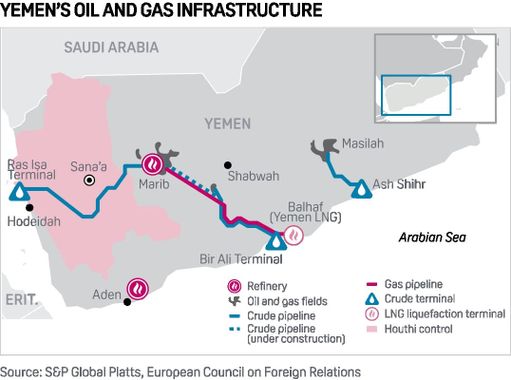
Yemen, of course, has resources such as oil to exploit and competition for access to those resources has obviously been a factor driving the war there (for example, France and the United Arab Emirates (UAE) stand to profit from Total’s Balhaf oil installations). More importantly though, its proximity to major world shipping routes means world powers vie to gain a hand there. After the construction of the Suez canal, the Bab-al-Mandeb (Gate of Tears) straits at the southern entrance to the Red Sea gained in geostrategic significance. It had become a potential choke point on world trade, as the Israelis were to learn in the wars with the Arabs. In 1973 Yemen closed the straits, blocking shipping through the Red Sea to Israel.
Having direct maritime access to the Red Sea from its southern port of Eilat on the Gulf of Aqaba and much economic interest in trade with the east, Israel’s strategic interest in the Red Sea is clear. It is known to use an Eritrean island in the Red Sea for electronic monitoring in the region. Its navy now patrol those waters south of Suez, including its most potent missile subs. Long concerned that its enemies should not control the Bab-al-Mandeb, it has pledged to join military action if the straits are closed again. The Israeli Defence Force makes no secret that it considers Yemen a threat and it deploys its military intel capabilities to monitor ‘the houthis’.
The Israeli enemy sees Yemen as a threat to it, explained the National Salvation Government Information Minister Dhaifalla Al-Shami, “especially in its strategic location, so it has worked to find a foothold in Yemen through the UAE’s role.(Middle East Monitor)
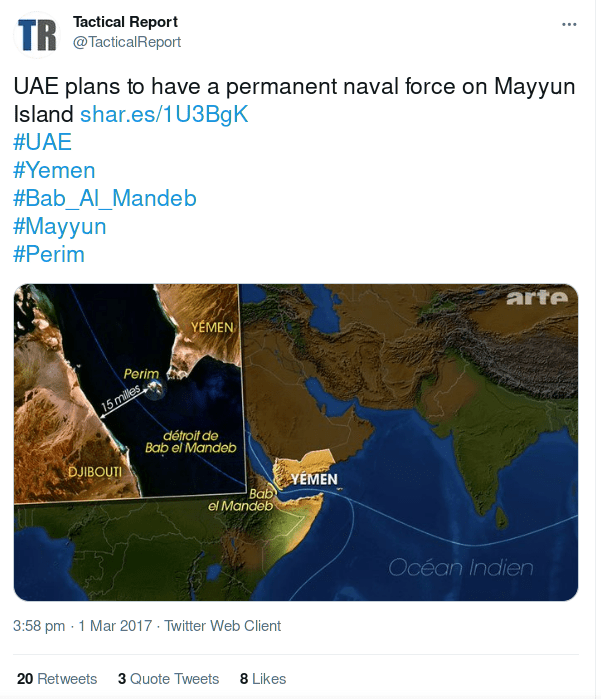
When reports of the previously planned installation by the Emiratis of a runway and military infrastructure on Yemen’s Mayyun (or Perim) island in the straits became public, pro-Iranian media sources were quick to suggest the likely involvement of Israel alongside the US and UAE. By 2019 the Red Sea had become a theatre of conflict in the shadow war between Israel and Iran, involving seizures and attacks on commercial shipping interests. A pretext Israel cites for its involvement in the area is the threat of Iranian drones or missiles being fired from Yemen. That the Yemeni armed forces have their own technical capabilities independently of Iran often seems to be condescendingly overlooked in western commentaries.
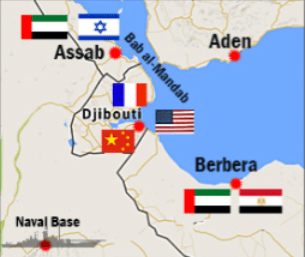
Of course, Washington, London and Paris have their own geostrategic interests in the region, working closely with their allies in Riyadh, Abu Dhabi and Tel Aviv they don’t wish to see forces in control the Yemeni coast, that maintain their independence of the centres of global capital. The Chinese also have a presence in the contested region with a base on the other side of the straits, in Djibouti.
During the cold war the Port of Aden in the south of Yemen was an important centre of global commerce. After gaining independence from the British in 1967 South Yemen became loosely aligned with the Soviet bloc. The two separate states of the Islamic North (governed from Sana’a) and the Marxist South (Aden) unified to become the Republic of Yemen only in 1990. Access to the southern coast is strategically desirable, as oil from the Arabian peninsula can be shipped on routes that avoid vulnerable passage through the straits of Hormuz or the Bab-al-Mandeb. As an expansionist regional player the UAE, now advances its interests in the south, caring little for the integrity of the Yemeni state. It has been a major player in the coalition attacking Yemen from 2015.
Despite announcing a pull-out in 2019, the Emirati regime backs the Southern Transitional Council (STC) a coalition which seeks independence from the north. The STC leadership has apparently signalled their openness to future friendly relations with Tel Aviv. Some commentators see such relations as having parallels with Israeli support for the Kurds in Syria and its previous recognition of Somaliland, aspects of a wider strategy to fracture and weaken Arab states unfriendly to it.
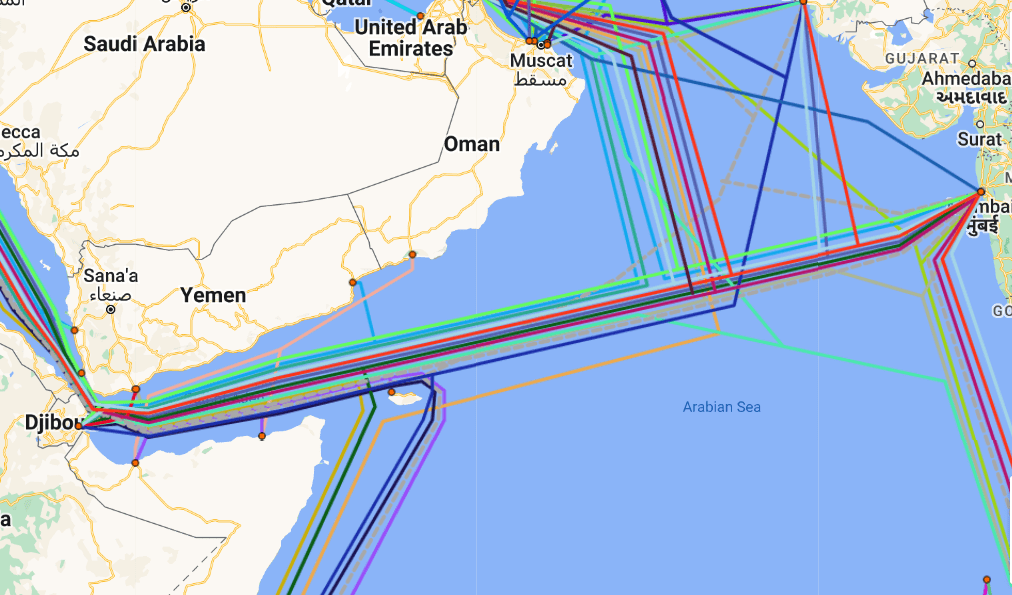
Many undersea fibre optic cables run past Socotra (Source)
That Israel and the UAE cooperate closely on ‘security’ is in no doubt, especially since the so called ‘normalization agreement’. This can be seen in a few interesting developments:
2015: Reports of Colombian mercenaries fighting against the ‘houthis’ and funded by the UAE. With later reports of their involvement in the coalition’s 2018 advance on Hodeidah, after receiving Israeli training in the Negev desert. The cooperation between the security states of Israel and Colombia is long standing. Israel has shaped the training and brutal tactics used against the FARC leftist rebels over decades.
Since 2020 allegations, based on local reports, have circulated that UAE and Israel are developing signals intelligence bases and other military infrastructure on the seized Yemeni islands of Socotra and on Perim in middle of the Bab-al-Mandeb straits.
Although these local reports are hard to verify, they have strong circumstantial corroboration and were accepted by Israeli open source analysts. Israel’s signals intelligence capability is known to be highly developed and aggressive. Israeli tourists now fly to see spectacular Socotra via the UAE, the only commercial aviation route that now reaches the island. The UAE had essentially seized control of Yemen’s Socotra archipelago of islands that lie off the Horn of Africa between the Gulf of Aden and the Indian Ocean. With their proxies the STC taking over control from the governor of the ‘internationally recognised’ (Western & Saudi backed) regime in June 2020. A world heritage site for its unique ecology, Socotra was historically a strategically valuable position for monitoring communications. The Soviets had a listening base there when friendly relations existed between Marxist South Yemen and the USSR.
2022: After Yemeni missile forces hit the UAE with drone strikes Israel offered its ‘Iron Dome’ air defence system to the Emirati princes. It is now reported that Israel has already installed radar systems in the UAE and that its air defence systems in friendly Gulf Arab states are now active.
Having traced out some traces of the game Israel has been playing in relation to conflict in Yemen, I must point out that an other state has undeniably played a far more extensive part in the war. The state-corporate interests of this country can be seen to overlap with Israeli ones. To take one example, Elbit Systems, an Israeli arms manufacturer has contracts with the British military and has set up factories in the UK to better fulfil its orders. According to the Canary:
The UK government has been working with Israel on UAV technology since 2005 in a deal worth at least £1bn. The Ministry of Defence (MoD) signed a contract with UAV Tactical Systems Ltd (U-TacS). This is a “joint venture” between UK-based Thales and Israeli arms company Elbit Systems.
The companies are reported as promoting a British version of an Elbit Hermes UAV to Saudi Arabia. Perhaps more significantly, one of Britain’s largest and politically influential industrial concerns, BAE Systems provides service personnel to maintain the Saudi’s Eurofighter Typhoon fleet for their bombing missions over Yemen. Whilst, the Saudi ‘Operations Room’ commanding their missions has included British officers, said to provide “training, supervision and evaluation”. Additionally, the Royal Navy has supported the blockade of Yemen. The blockade has resulted in ongoing starvation, epidemics and fuel shortages. It has become apparent that not only do British companies and their investors profit through the war, but even that British forces are active participants in the conflict.
Commonly acknowledged as the poorest country in the middle east and suffering the world’s worst humanitarian situation, Yemen is being held back from peace and independence not only by the House of Saud, but also in Washington, London, Paris, Abu Dhabi and Tel Aviv.