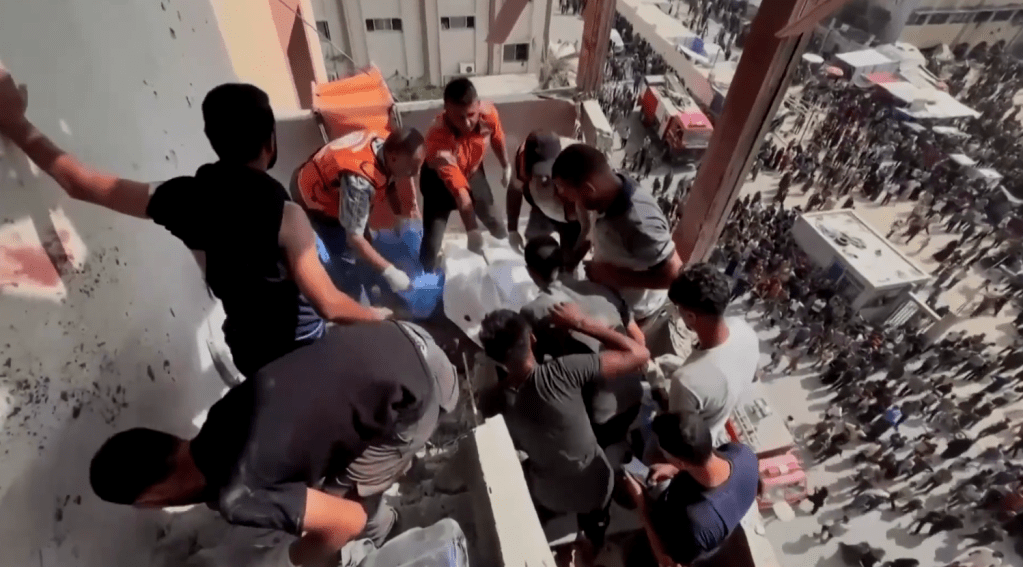
Here, I offer a brief overview of the August 25, 2025 attack on the external stairwell of Al Nasser hospital in Khan Yunis, where Reuters cameraman Hussam al Masri manned a live feed.
“Hussam has done this gruelling task day in and day out for months, mainly from Nasser Hospital but also from Rafah when the story merited it,” said Labib Nasir, Reuters‘ visual editor for the Middle East and North Africa.
I refer here to Osint analysis produced by media organisations at the time. Without time pressure and with the benefit of hindsight, it’s easier to pick up on oversights and misinterpretations of details in reporting and anlysis, in what was a confusing incident.
The attack was characterised in international media as a ‘double tap’. That was probably a fair characterisation. But we should consider Israel accounts before we are definitive.
The hospital had been struck by shelling in February 13 – 15 in 2024, after a long running ‘siege’ on the hospital, leaving extensive damage. It was hit again in March 2025. The front side of the hospital, where the entrance to the Emergency department is found, faces east/south-east.
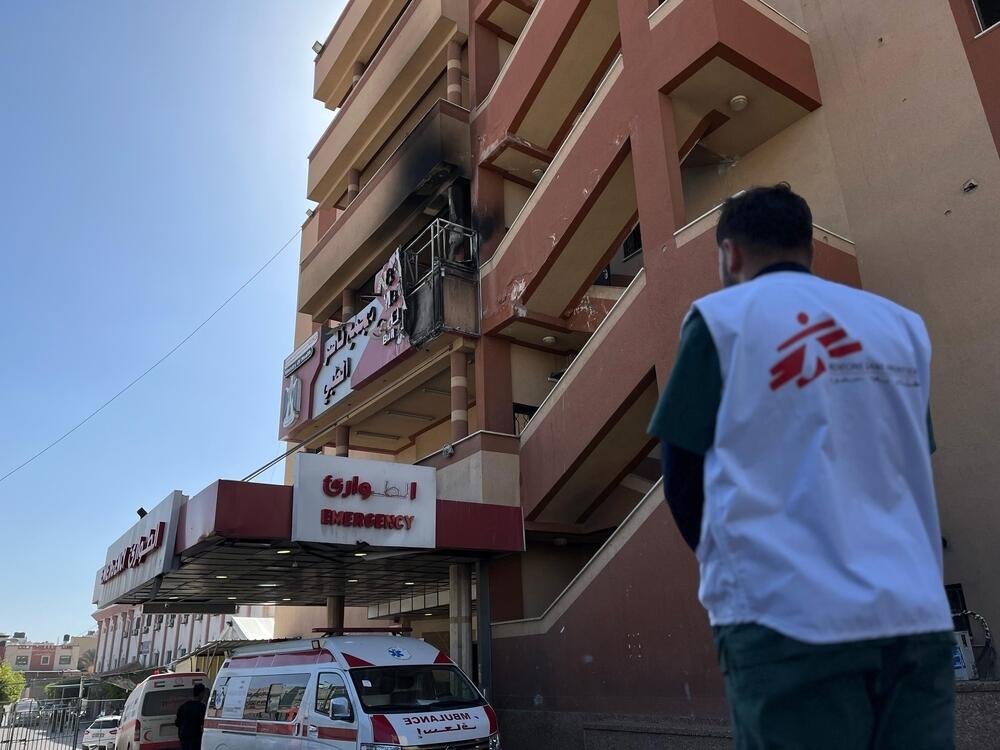
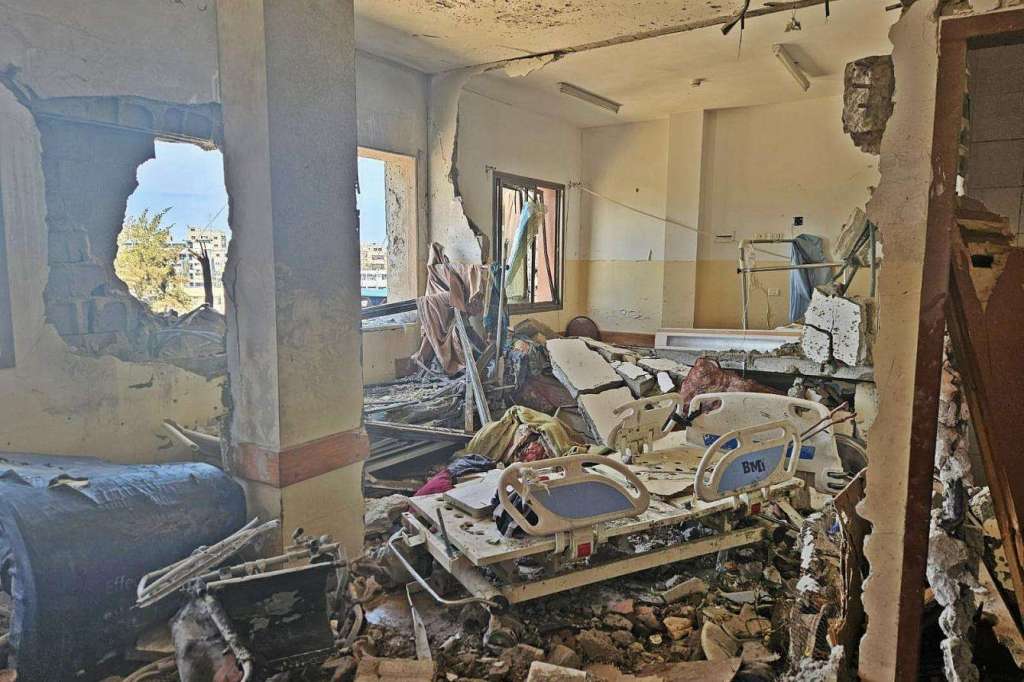
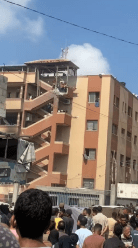
It was the external stairwell on this face of the building where al Masri and his camera was situated. Where it protrudes close to the corner with the north/north-east facing side of the building. With that orientation in mind, for simplicity, I will refer to the east and north facing sides of the building.
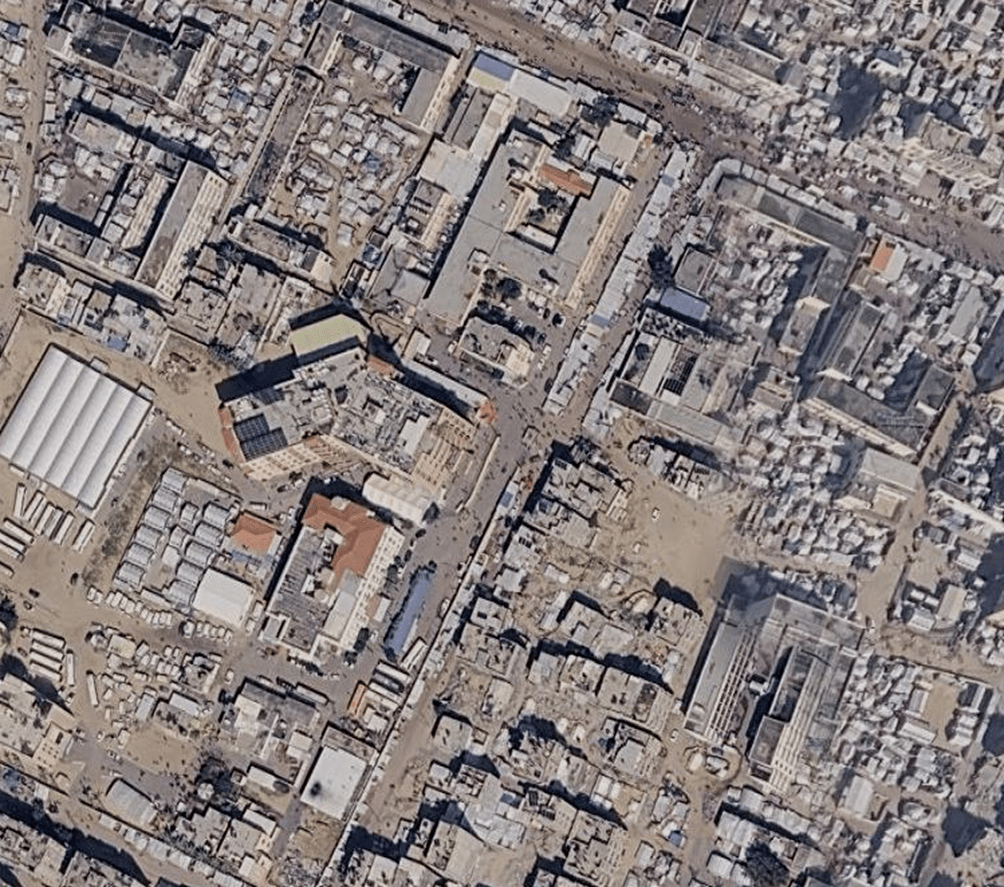
The corner of the 4th floor stairwell was struck at 10.08am, killing al Masri. The munition appears to have struck the front wall of the corner ‘balcony’ on the stairwell. The north facing wall of the balcony was still intact after the first hit, which tends to imply the munition was fired from the east or south east. The imagery of the damage left by the initial strike on the stairwell suggests that it was a fairly direct (front-on) blow to the ESE face.
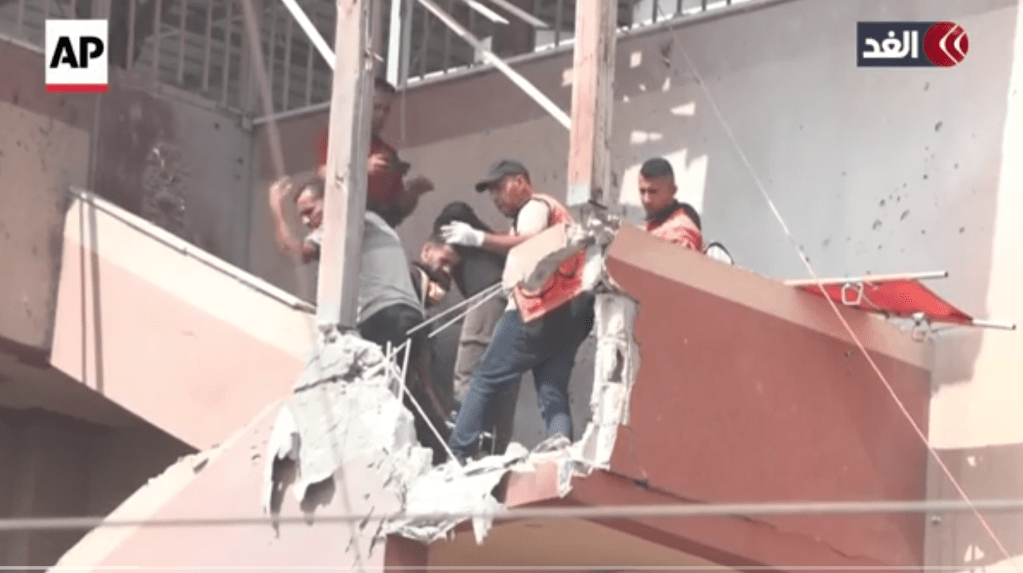
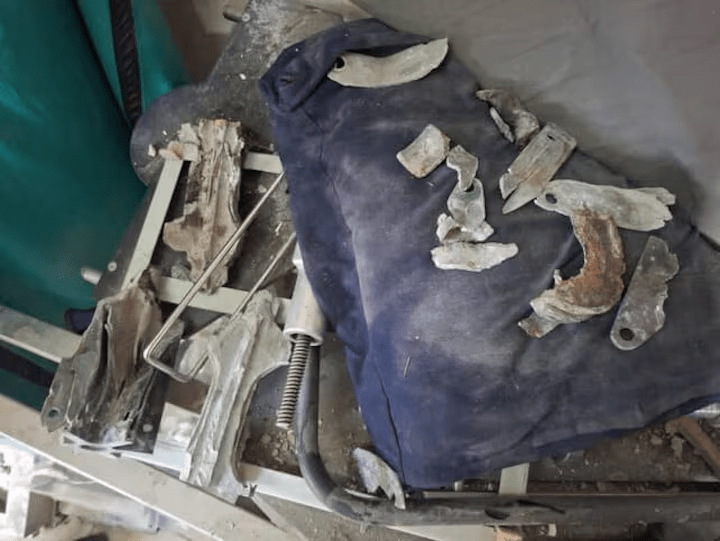
Some munition fragments collected from the scene and photographed were identified as from 120mm tank shells – standard calibre for Israeli tanks. This must’ve been from the first hit (10.08am). Which looks to have been an accurate single shot. Reviewing images there is no obvious sign of damage from more than one shell, from the first ‘tap’. However, subsequent Israeli reporting mentioned two shells. And the photo of remnants collected that day implies two shells. But we don’t know if the doctor had collected shell fragments from previous strikes.
BBC Verify subsequently pointed to evidence that the north side of the building, where there is another external stairwell was also struck. This seems to have been confused. Reviewing the evidence, the ‘hit’ seems only to be smoke coming out of a fourth floor window. With no sign of damage in that part of the building – see this screen shot from NBC coverage.
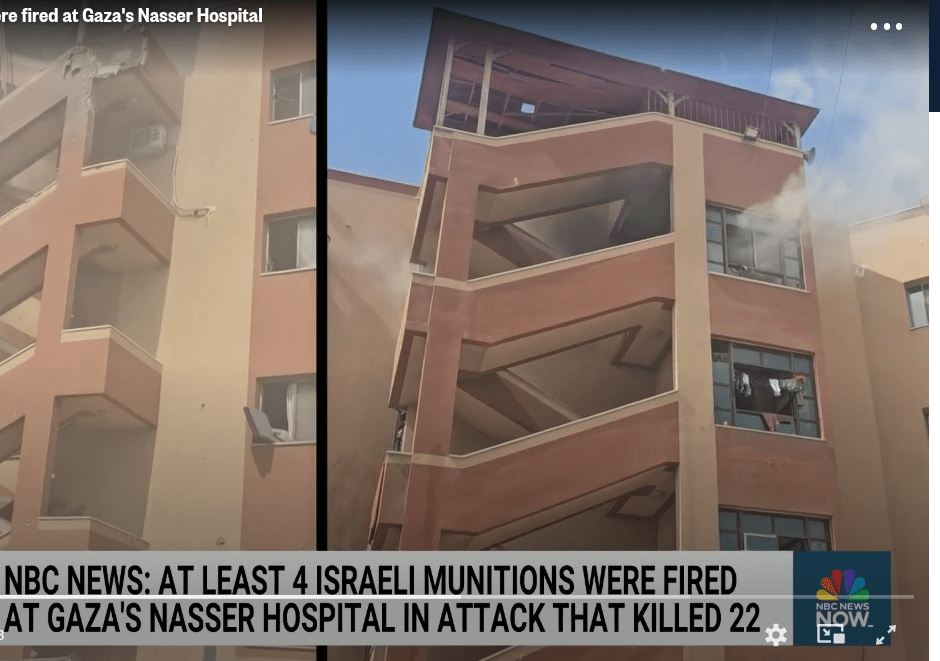
It seems likely that after the first munition hit the balcony, smoke blew along a corridor and out of the window. Or quite possibly, the impact and ensuing chaos resulted in a relatively minor secondary fire inside. Whatever the origin of the smoke, there is no obvious damage to the north side of the building to suggest it was also hit then. Nor, to my knowledge, is there any witness testimony concerning a strike to this part of the building that morning.
Nine minutes after the initial shell fire, as rescuers attended to al Masri’s body, another strike happened; resulting in 19 additional fatalities, four of whom were also journalists.
It was captured on mobile phone footage, which revealed two munitions hitting the NNE facing corner of the stairwell, almost instantaneously. This footage indicates a firing position from approximately the north/north-east; distinct from where the tank fire came from.
This video of the follow-up strike indicates use of missiles, rather than tank shells. Available evidence points to short-range Spike missiles. That the pair hit near instantaneously, on close trajectories strongly suggests they were fired simultaneously, and from a single platform.
Some experts, commenting at the time, suggested tracer tank rounds. However, not only would that imply two tanks firing from the same position simultaneously, and both accurately. It also does not sit with the observation that tank shell projectiles fly too fast to be discernible to the eye. A shell fired from a tank travelling at approx Mach 2.5 could not be discerned by the naked eye, or at a normal video recording rate. Technical forensic video analysis would be able to give an appoximate speed for the projectiles. Spike missiles are said to reach Mach 0.45.
The day following the attack, a report in Israeli media claimed a drone strike on the position had first been intended. According to the account, Golani Brigade troops spotted a ‘Hamas surveillance camera’. They requested a drone strike on the position, which was approved by Southern command. Shortly after, the troops identified an ‘apparent rifle scope’ at the position. Classing it as an “immediate threat”, they made an urgent request for tank fire, which was also approved. However, IDF statements subsequently disavowed that tank fire was approved by Southern Command.
The earlier reporting did not suggest that once tank fire had hit the camera position, the drone mission was aborted. Which rather suggests that an armed drone still fired.
A remote piloted drone (probably a Hermes) firing two Spike missiles from the north/north-east seems to be the most plausible fit for what is seen in the footage. Dheifallah Al-Dabboubi, a weapons analyst, noted that the destruction pattern at the site was unusually precise, consistent with a guided strike. And pointed to the use of ‘fire and forget’ Spike missiles. This is consistent with the short range Spike missiles carried by Israeli Hermes drones.
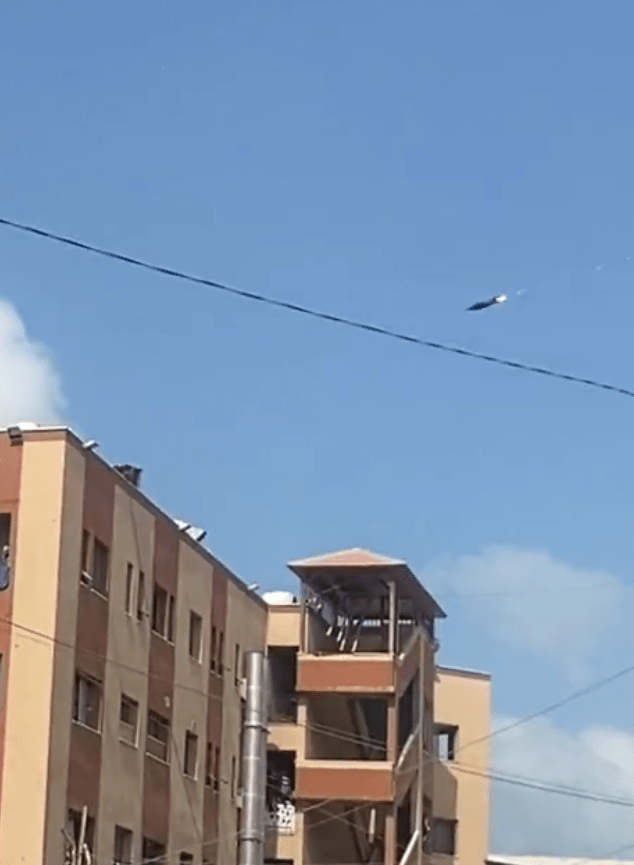
For some reason BBC Verify analysts seem to have believed ground launched LAHAT missiles were implied; probably as tank fire was implicated in the incident. I think LAHAT missiles can be ruled out here. Two tank fired LAHAT missiles fired simultaneously is implausible. Nor has there been been any documented use of LAHAT missiles (which are longer stand-off range weapons) from aerial platforms over Gaza since October 2023.
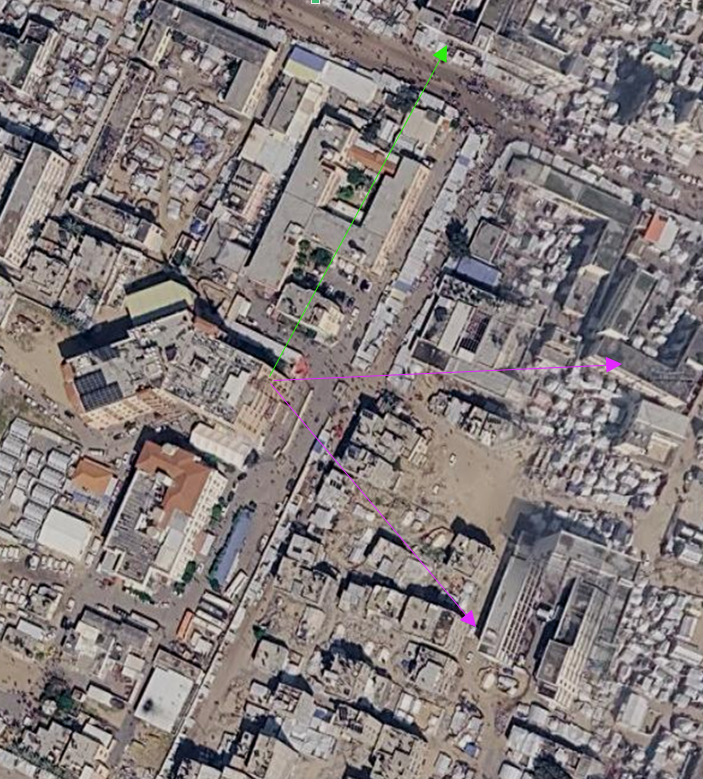
Satellite imagery from Planet Labs had apparently shown tanks positioned to the north-east. The position was said by BBC Verify and CNN to be 1.5 miles (2.5km) While I can’t rule out that tank shells were fired from there. Some difficulties with this should be noted:
The Planet Labs imagery shown in different outlets doesn’t obiously match up. Associated Press and Times of Israel had a different image of a position, said to 4km to the north-east.
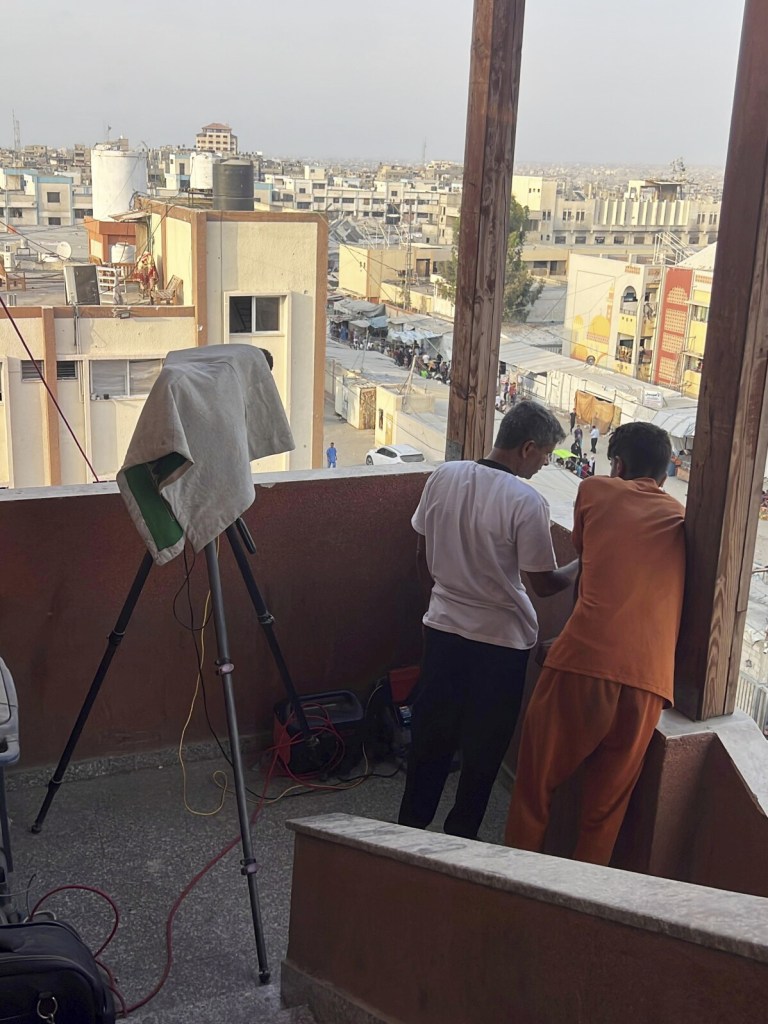
Below is a recently prior view from the balcony – looking to the north-east. It strikes me as questionable that a single, accurate line-of-sight shot could be attained at such range across the urban terrain of Gaza. So, I doubt that the initial tank shell was fired from either of those positions.
Conclusion
Consistent with the above, the first impact that morning was with a tank shell (perhaps more than one). While there is no video available of that strike, the initial damage appears consistent with a relatively straight-on hit, and from an east/south-east sector.
The missiles arrived from the north/north-east. A Hermes drone firing two Spike missiles together is the most plausible attribution for the deadly second strike.
Israeli accounts sought to refute that the secondary strike was a ‘double tap’ as such, and due to a mishap, or failed communication. According to their account, a drone strike had been ordered before the tank fire was carried out. However, the IDF did not acknowledge that a drone did in fact still fire; falsely putting all hits down to tank fire.
A surveillance quadcopter was filmed over the scene four minutes after the first tank shell hit, and this obviously raises the question of why the drone strike mission was not then aborted. Given the obvious presence of rescuers and journalists on the stairwell, the evidence weighs against any Israeli claim that the second strike was simply an oversight.
Article amended August 25, 2026 – to reflect that the tank postion(s) identified from Planet Labs satellite imagery are said to be to the north-east (not the north-west). And to note apparent inconsistencies around this imagery evidence in reporting.
If you value this content, please share it or support me at Buy me a coffee
