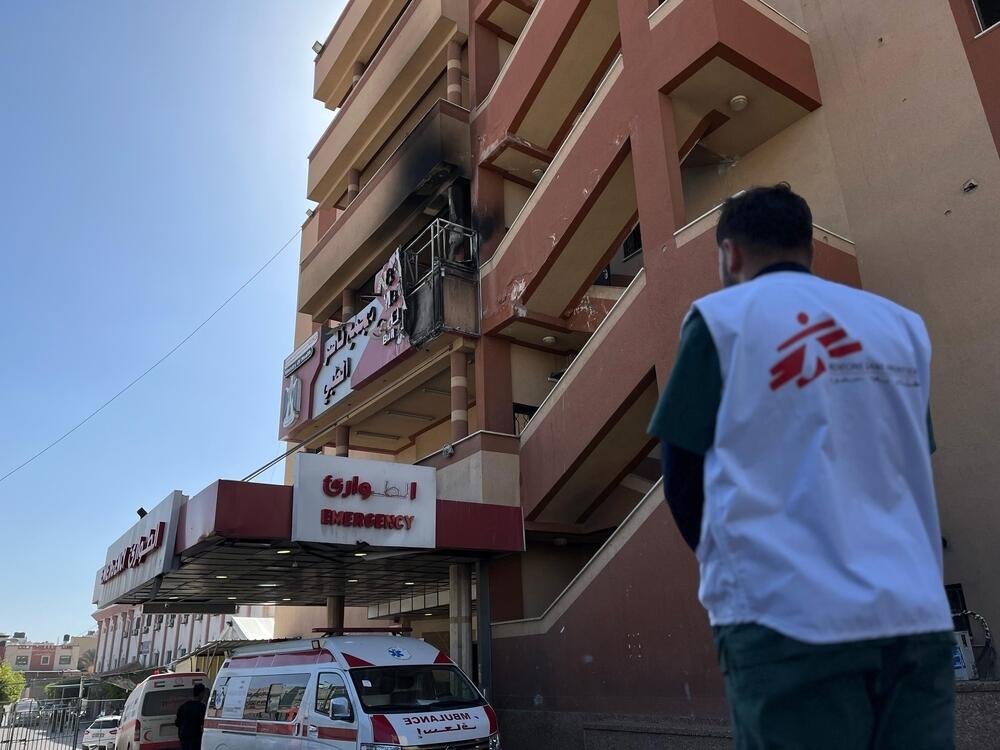
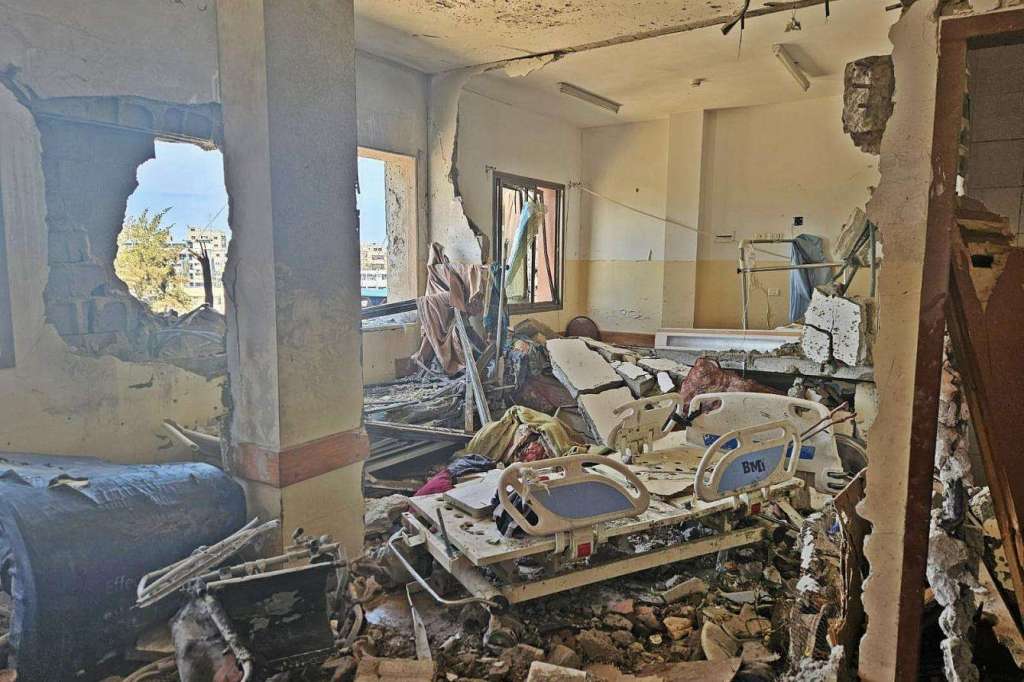
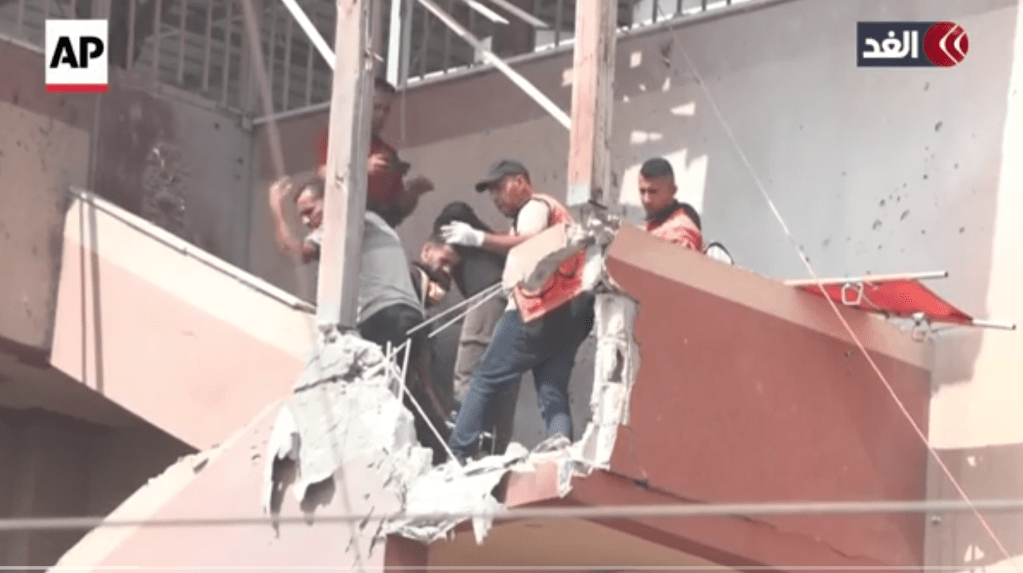
Here, I offer a brief overview of the August 25, 2025 attack on the external stairwell of Al Nasser hospital in Khan Yunis, where Reuters cameraman Hussam al Masri manned a live feed.
“Hussam has done this gruelling task day in and day out for months, mainly from Nasser Hospital but also from Rafah when the story merited it,” said Labib Nasir, Reuters‘ visual editor for the Middle East and North Africa.
I refer here to Osint analysis produced by media organisations at the time. Without time pressure and with the benefit of hindsight, it’s easier to pick up on oversights and misinterpretations of details in reporting and anlysis, in what was a confusing incident.
The attack was characterised in international media as a ‘double tap’. That was probably a fair characterisation. But we should consider Israel accounts before we are definitive.
The hospital had been struck by shelling in February 13 – 15 in 2024, after a long running ‘siege’ on the hospital, leaving extensive damage. It was hit again in March 2025. The front side of the hospital, where the entrance to the Emergency department is found, faces east/south-east.
It was the external stairwell on this face of the building where al Masri and his camera was situated. Where it protrudes close to the corner with the north/north-east facing side of the building. With that orientation in mind, for simplicity, I will refer to the east and north facing sides of the building.
The top-floor front right corner of the hospital (centre) was struck
The corner of the 4th floor stairwell was struck at 10.08am, killing al Masri. The munition appears to have struck the front wall of the corner ‘balcony’ on the stairwell. The north facing wall of the balcony was still intact after the first hit, which tends to imply the munition was fired from the east or south east. The imagery of the damage left by the initial strike on the stairwell suggests that it was a fairly direct (front-on) blow to the ESE face.
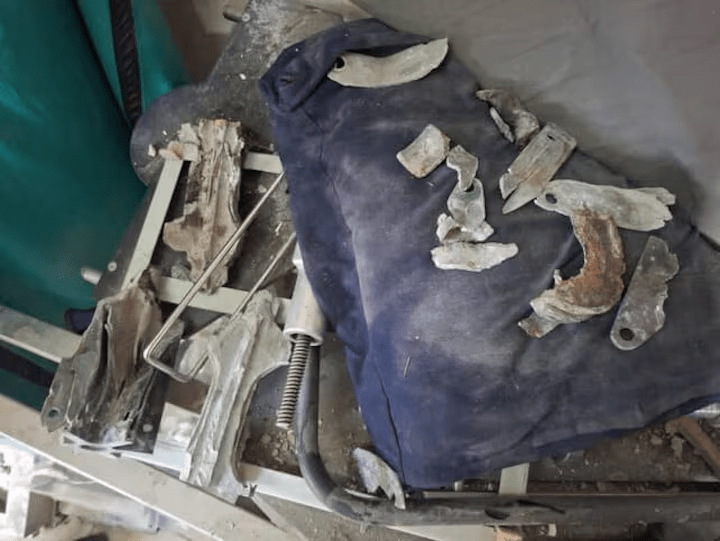
Some munition fragments collected from the scene and photographed were identified as from 120mm tank shells – standard calibre for Israeli tanks. This must’ve been from the first hit (10.08am). Which looks to have been an accurate single shot. Reviewing images there is no obvious sign of damage from more than one shell, from the first ‘tap’. However, subsequent Israeli reporting mentioned two shells. And the photo of remnants collected that day implies two shells. But we don’t know if the doctor had collected shell fragments from previous strikes.
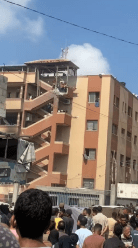
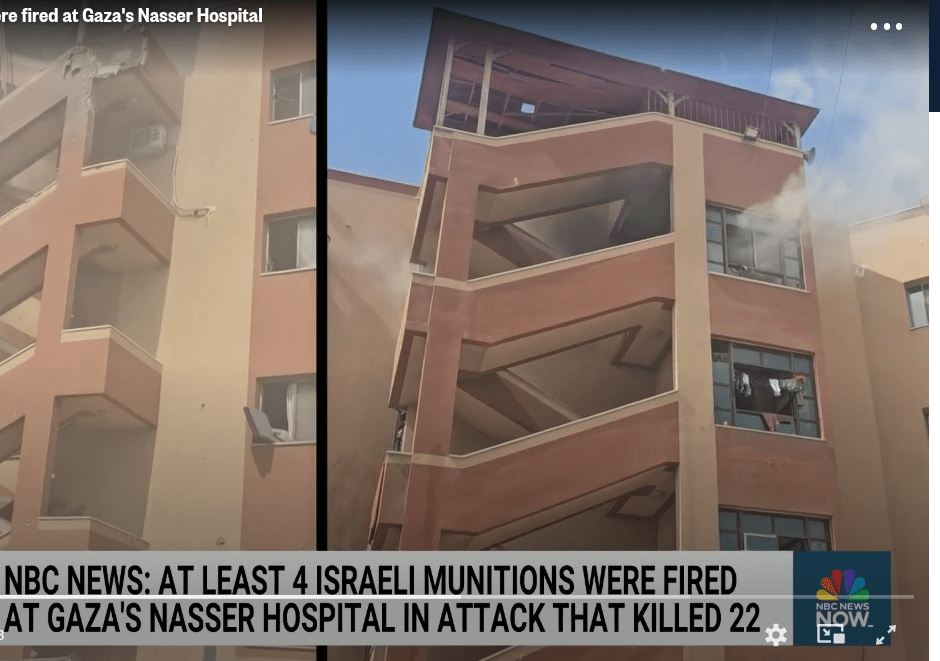
BBC Verify subsequently pointed to evidence that the north side of the building, where there is another external stairwell was also struck. This seems to have been confused. Reviewing the evidence, the ‘hit’ seems only to be smoke coming out of a fourth floor window. With no sign of damage in that part of the building – see this screen shot from NBC coverage.
It seems likely that after the first munition hit the balcony, smoke blew along a corridor and out of the window. Or quite possibly, the impact and ensuing chaos resulted in a relatively minor secondary fire inside. Whatever the origin of the smoke, there is no obvious damage to the north side of the building to suggest it was also hit then. Nor, to my knowledge, is there any witness testimony concerning a strike to this part of the building that morning.
Nine minutes after the initial shell fire, as rescuers attended to al Masri’s body, another strike happened; resulting in 19 additional fatalities, four of whom were also journalists.
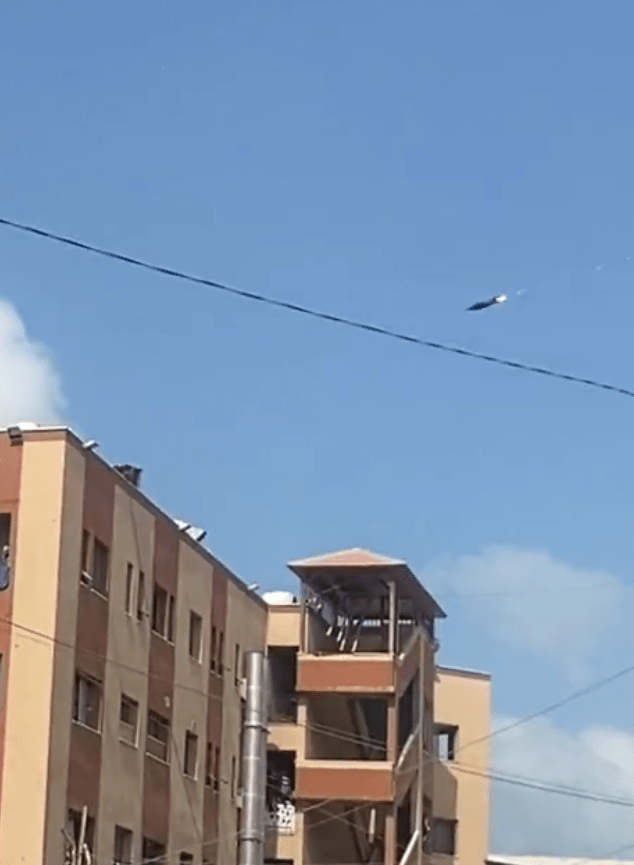
It was captured on mobile phone footage, which revealed two munitions hitting the NNE facing corner of the stairwell, almost instantaneously. This footage indicates a firing position from approximately the north/north-east; distinct from where the tank fire came from.
This video of the follow-up strike indicates use of missiles, rather than tank shells. Available evidence points to short-range Spike missiles. That the pair hit near instantaneously, on close trajectories strongly suggests they were fired simultaneously, and from a single platform.
Some experts, commenting at the time, suggested tracer tank rounds. However, not only would that imply two tanks firing from the same position simultaneously, and both accurately. It also does not sit with the observation that tank shell projectiles fly too fast to be discernible to the eye. A shell fired from a tank travelling at approx Mach 2.5 could not be discerned by the naked eye, or at a normal video recording rate. Technical forensic video analysis would be able to give an appoximate speed for the projectiles. Spike missiles are said to reach Mach 0.45.
The day following the attack, a report in Israeli media claimed a drone strike on the position had first been intended. According to the account, Golani Brigade troops spotted a ‘Hamas surveillance camera’. They requested a drone strike on the position, which was approved by Southern command. Shortly after, the troops identified an ‘apparent rifle scope’ at the position. Classing it as an “immediate threat”, they made an urgent request for tank fire, which was also approved. However, IDF statements subsequently disavowed that tank fire was approved by Southern Command.
The earlier reporting did not suggest that once tank fire had hit the camera position, the drone mission was aborted. Which rather suggests that an armed drone still fired.
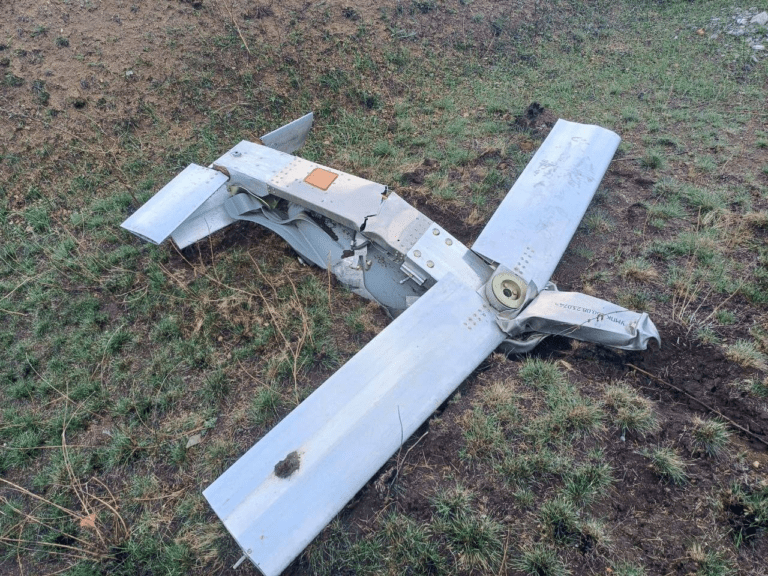
A remote piloted drone (probably a Hermes) firing two Spike missiles from the north/north-east seems to be the most plausible fit for what is seen in the footage. Dheifallah Al-Dabboubi, a weapons analyst, noted that the destruction pattern at the site was unusually precise, consistent with a guided strike. And pointed to the use of ‘fire and forget’ Spike missiles. This is consistent with the short range Spike missiles carried by Israeli Hermes drones.
A trace of the rocket stream is visible behind the burner
For some reason BBC Verify analysts seem to have believed ground launched LAHAT missiles were implied; probably as tank fire was implicated in the incident. I think LAHAT missiles can be ruled out here. Two tank fired LAHAT missiles fired simultaneously is implausible. Nor has there been been any documented use of LAHAT missiles (which are longer stand-off range weapons) from aerial platforms over Gaza since October 2023.
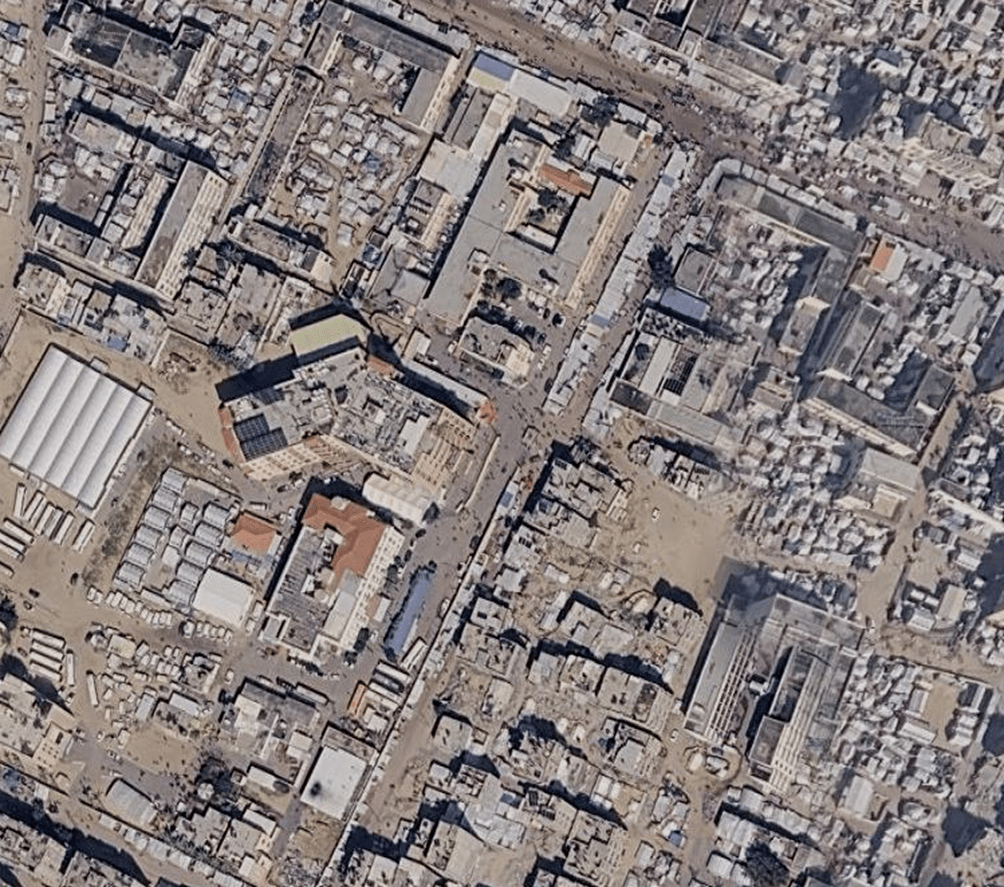
Satellite imagery from Planet Labs had apparently shown tanks positioned to the north-east. The position was said by BBC Verify and CNN to be 1.5 miles (2.5km) While I can’t rule out that tank shells were fired from there. Some difficulties with this should be noted:
The Planet Labs imagery shown in different outlets doesn’t obiously match up. Associated Press and Times of Israel had a different image of a position, said to 4km to the north-east.
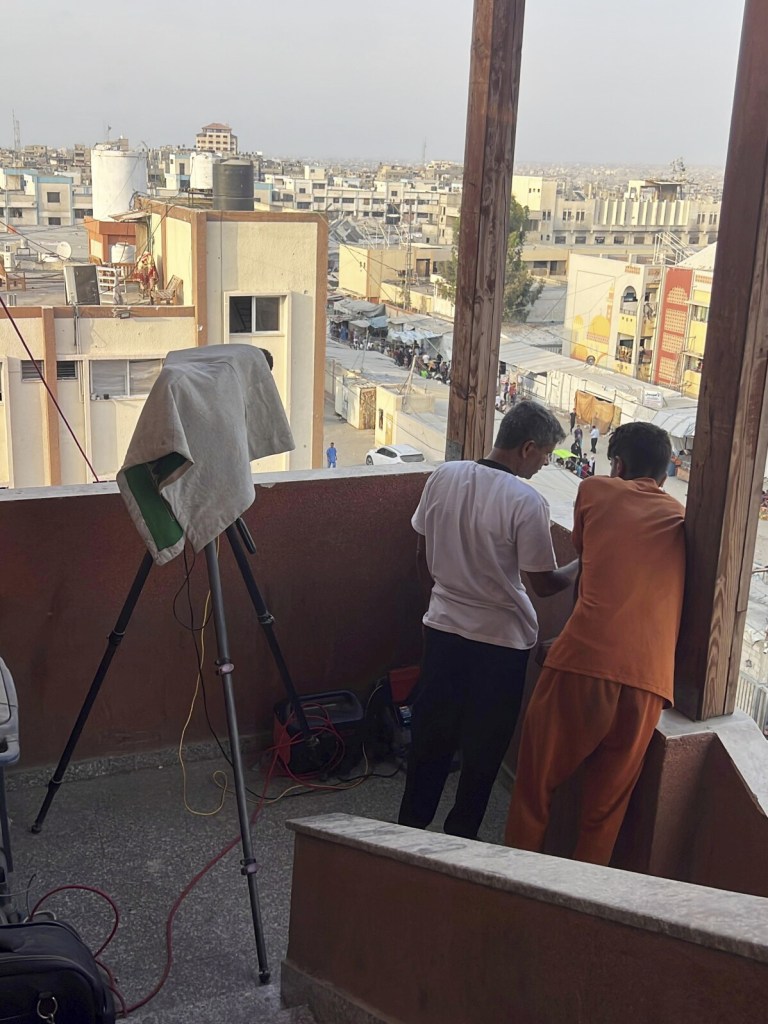
Below is a recently prior view from the balcony – looking to the north-east. It strikes me as questionable that a single, accurate line-of-sight shot could be attained at such range across the urban terrain of Gaza. So, I doubt that the initial tank shell was fired from either of those positions.
Consistent with the above, the first impact that morning was with a tank shell (perhaps more than one). While there is no video available of that strike, the initial damage appears consistent with a relatively straight-on hit, and from an east/south-east sector.
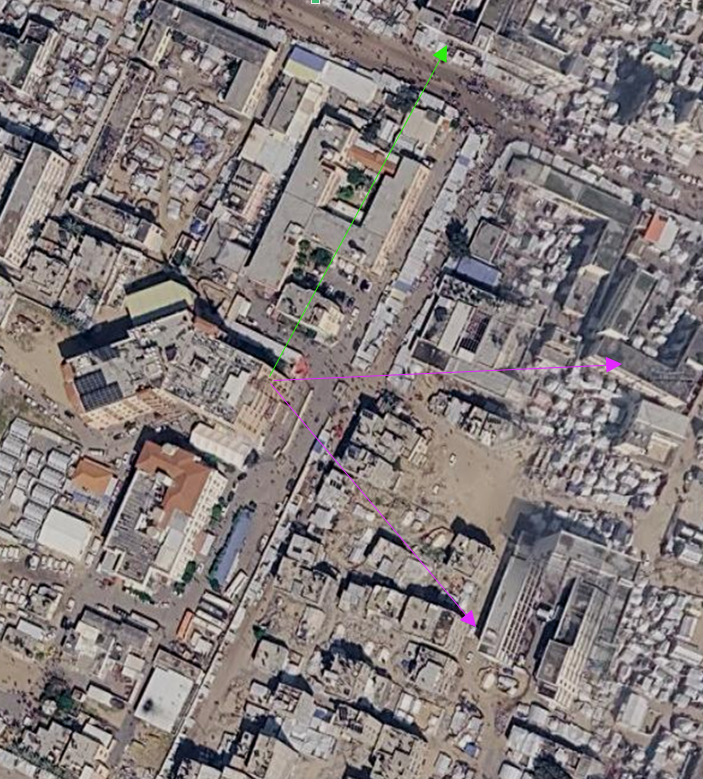
The missiles arrived from the north/north-east. A Hermes drone firing two Spike missiles together is the most plausible attribution for the deadly second strike.
Green indicates direction from wich Spike missiles came. Magenta lines indicates likely range of directions from whcih tank fire came.
Israeli accounts sought to refute that the secondary strike was a ‘double tap’ as such, and due to a mishap, or failed communication. According to their account, a drone strike had been ordered before the tank fire was carried out. However, the IDF did not acknowledge that a drone did in fact still fire; falsely putting all hits down to tank fire.
A surveillance quadcopter was filmed over the scene four minutes after the first tank shell hit, and this obviously raises the question of why the drone strike mission was not then aborted. Given the obvious presence of rescuers and journalists on the stairwell, the evidence weighs against any Israeli claim that the second strike was simply an oversight.
Article amended August 25, 2026 – to reflect that the tank postion(s) identified from Planet Labs satellite imagery are said to be to the north-east (not the north-west). And to note apparent inconsistencies around this imagery evidence in reporting.
If you value this content, please share it or support me atBuy me a coffee
…we had five or six addresses for evacuation from Yarova [addresses provided by police, local organizations, and volunteers]. Four families refused to go. They said things in the area were quiet. The rest left with us. We also passed by the spot in the center of town where there used to be a post office, right next to a church. A large crowd had gathered there, and we stopped to ask for directions. On our way back to Sloviansk, we got a call that said there were a lot of dead and injured. Police told us: bring body bags and go collect the dead. We grabbed the bags in Sloviansk and drove back. By the time we got to Yarova, the military had already finished everything: all the wounded had been taken to the field hospital, all the dead to the Sloviansk morgue.
Vladyslav – Sloviansk resident, evacuation vehicle driver for the charitable foundation Breath of Hope Mission
On September 9th reports appeared of a Russian strike on civilians near the frontlines in Donestk region. The attack would be described by commentators as an act of ‘brutal savagery’ and ‘pure terrorism’.
These reports followed footage and photos, posted on official and semi-official Ukrainian channels, including President Zenlenski’s, of a group of civilians evidently killed by some explosive strike. Up to 25 people were later confirmed dead, according to Ukrainian sources.
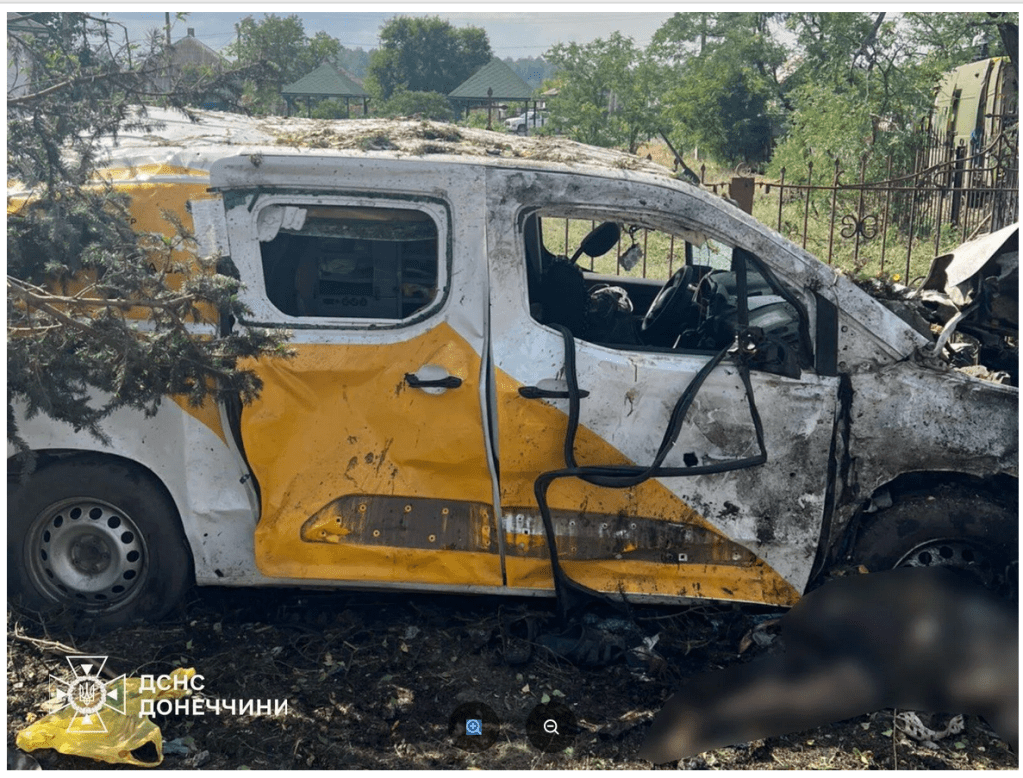
The group were, it was said, queuing for their pension payments around a Ukrainian postal service van, in the rural township of Yarova. The usual post office, situated close by, was apparently out of service. The group of pensioners gathered around the van had evidently been targeted in a precision strike, timed to horrific effect.*
The Gereral Director of the post service Ukrposhta was soon quoted as saying:
“Since the beginning of the war, we have been constantly changing security procedures, and as you can see in the video, the car stood under trees to reduce the risk of being spotted. But, apparently, someone gave away the coordinates.”
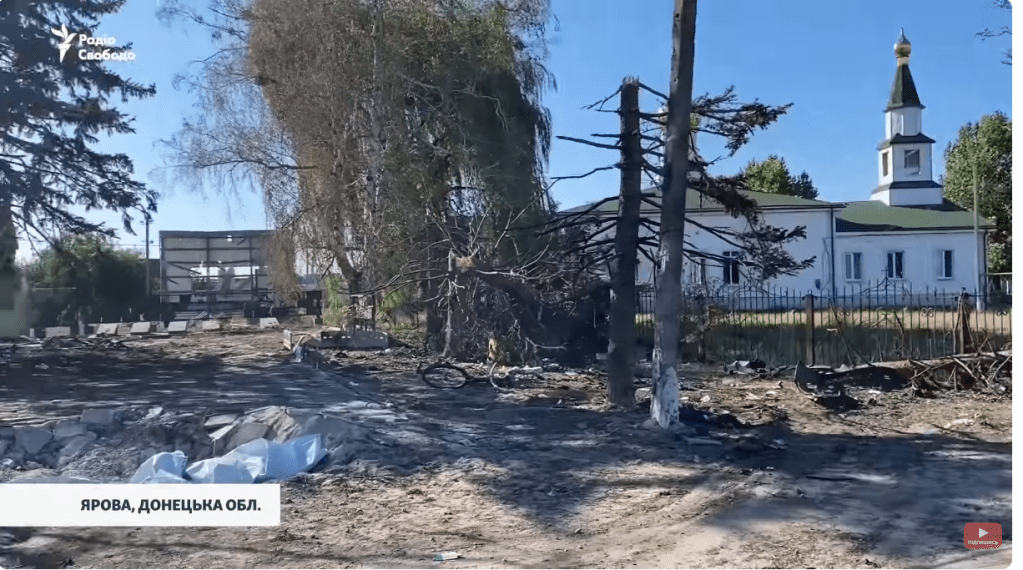
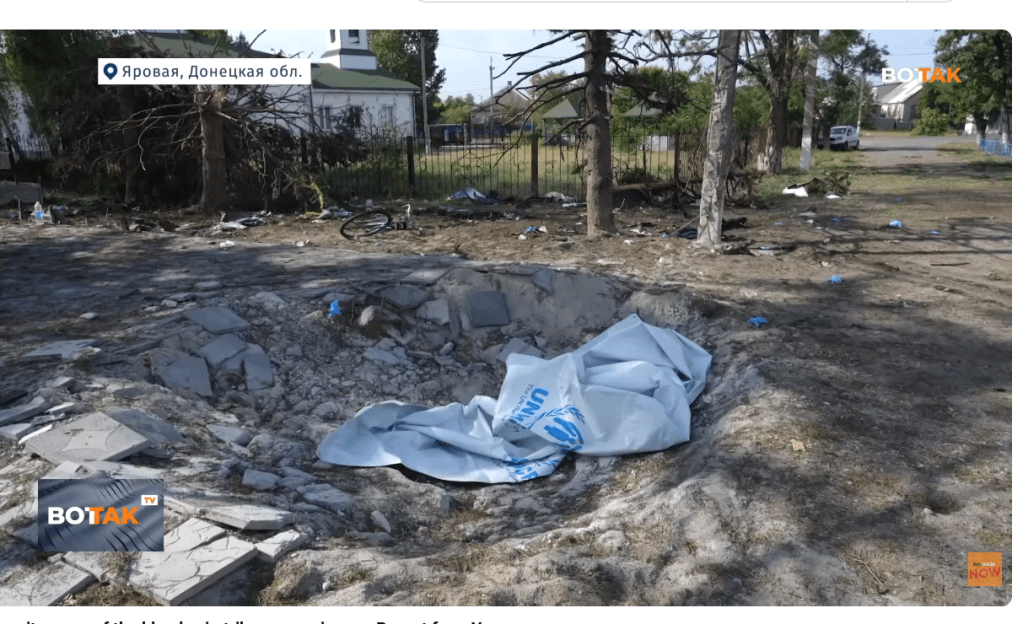
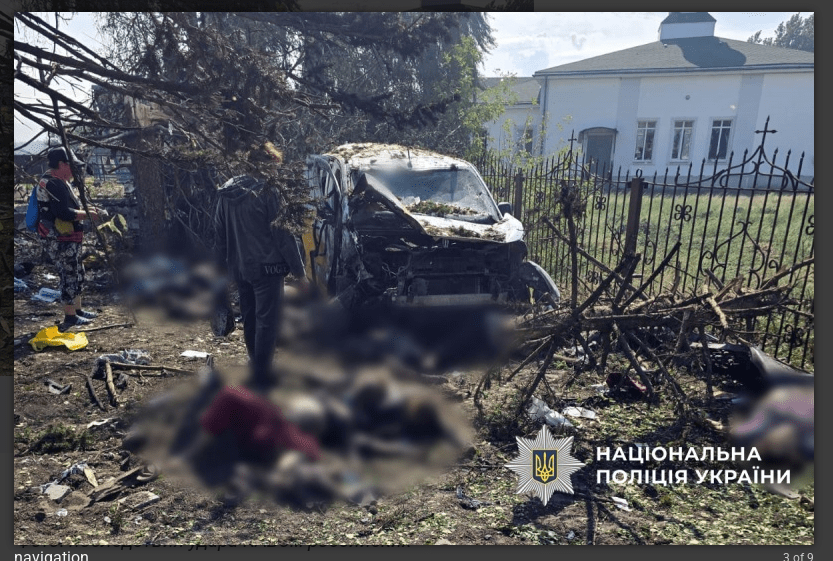
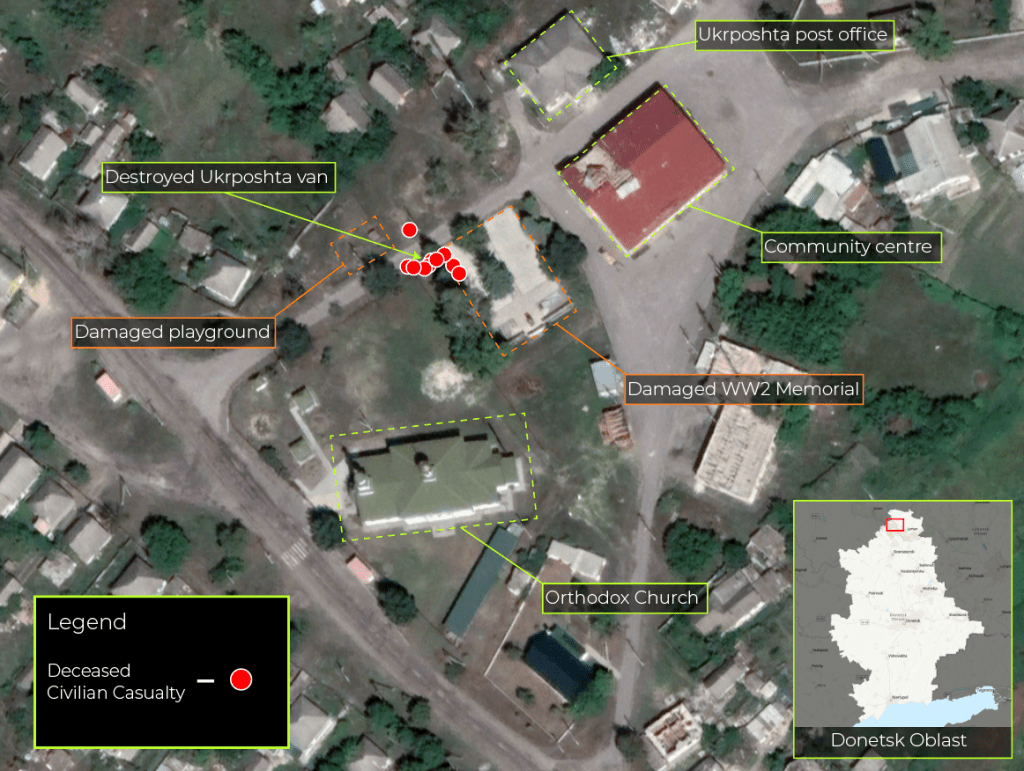
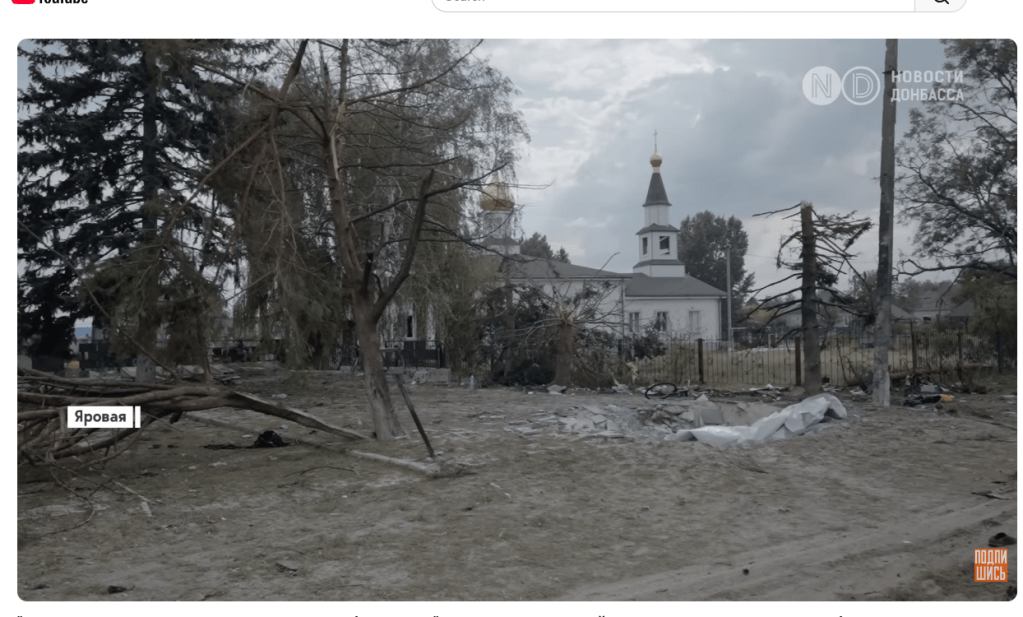
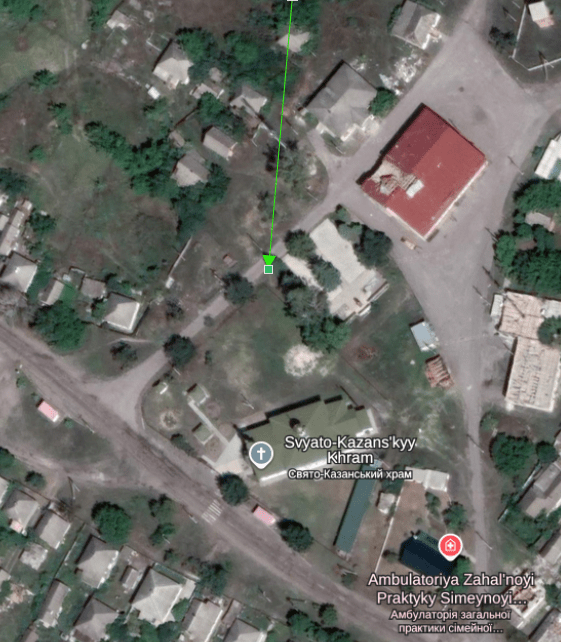
A WWII memorial lies next to the grounds of the St. Kazan Church – Ukrainian Orthodox Church of Moscow Patriarchate. The Postal van was situated next to the fence, between where the two fallen trees stood.A small outpatient clinic is located behind the church.
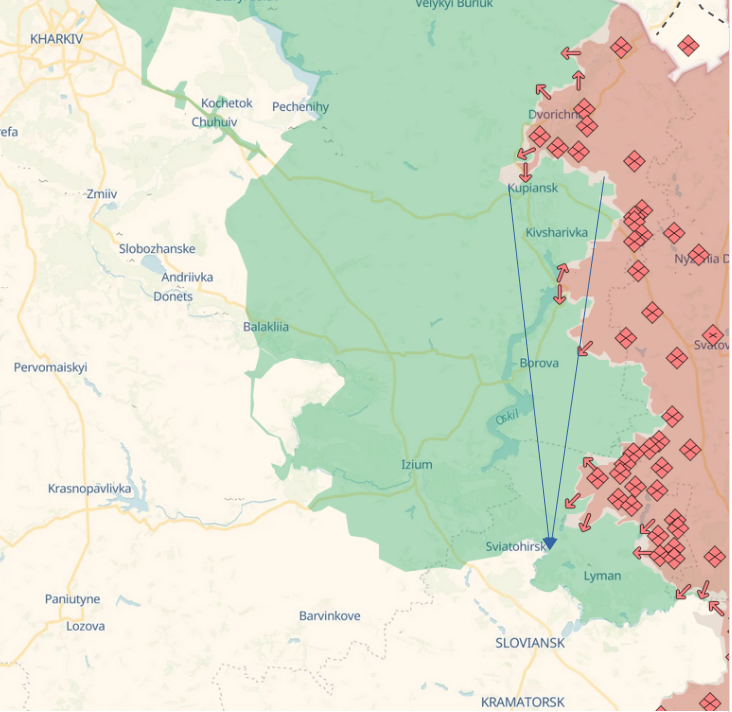
Yarova (sometimes transliterated as ‘Yarovaya’) is located in the north of the Donetsk oblast, close to the border with Karkhiv oblast. It lies between Lyman and Izium. By September 2025, it was again close to the frontlines – in a sector where Russian forces had been making creeping gains. Advances that meant that Yarova was now within 10km.
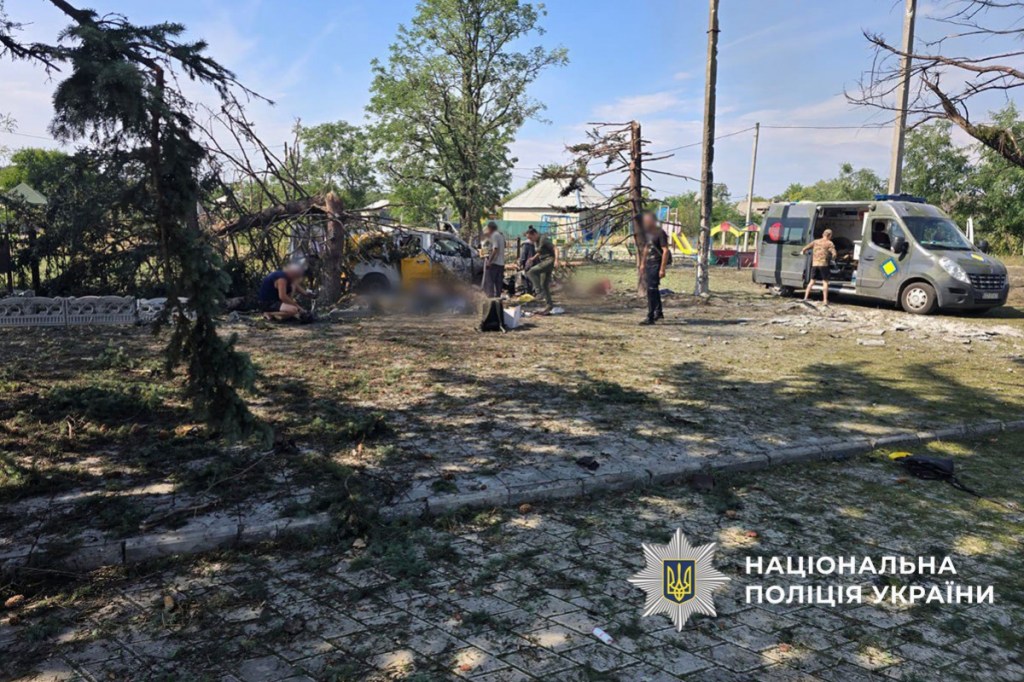
The carnage at the scene was filmed by Ukrainian military and police personnel; who were the first services responding to the strike, rather than civilian paramedics or fire fighters. According to the reports: “An investigative team, bomb disposal experts, and the White Angel special police unit have also arrived at the crime scene.”
Graphic video uploaded to Ukrainian Telegram channels
As the strike was in a Ukrainian held area, close to the frontline, western media did not hesitate to blame the atrocity on Russia.
There would be scant withholding of judgment in their reports. Even the UN website would scarcely maintain any objectivity, saying: “A Russian airstrike on a Ukrainian village in the frontline region of Donetsk on Tuesday has reportedly killed more than 20 – including many elderly civilians who were lining up to collect pension payments.“
The following day, the South African government officially expressed its condemnation of Russia for this incident.
In what follows, I’ll show why this reaction in international media appears to be, at the very least, a careless rush to judgment. Such a straightforward take on the incident overlooks the political, historical and cultural realities of this part of the territory of the former Soviet Socialist Republic of Ukraine; as well as the nature of the Ukrainian conflict – not just since February 2022 but – from early 2014.
I’ll return to that wider context shortly, after discussing the specifics of this incident; and the basis for the attribution made, or rather, the lack of any such basis.
Ukrainian based media are the only sources for all the images and video of the scene available online, from which to verify the claims.
Ukrainian officials stated that a Russian FAB-250 glide bomb had struck the gathering. FABs are air-dropped Soviet era dumb bombs, retrofitted with recently fashioned UPMK wing-kits and guidance units, making them very effective and economical weapons. They are not, though, systems of the highest precision.
Lack of supporting forensic evidence
In their reports and media presentations, no forensic evidence of components or fragments consistent with a glide-bomb weapon, like a FAB-250, were shown. And this despite the presence of technical military teams, inspecting the scene and being able to recover any critical forensic evidence,
Having tried to review the available photos and video of the scene, there were not any obvious weapon system fragments visible. FAB glidebombs have a distinctive wing assembly. So you’d expect that easily identifiable remnants of a wing-kit would be found in the vicinity of the blast.
The operation of the wings and fins on glide and guided bombs produces a characteristic whistle/screech noise, as they fall. No witness testimonies mentioned hearing such a noise immediately before the explosion. Nor, for that matter, did any witnesses mention hearing the sound of an aircraft, or a large UAV drone, just before the blast,
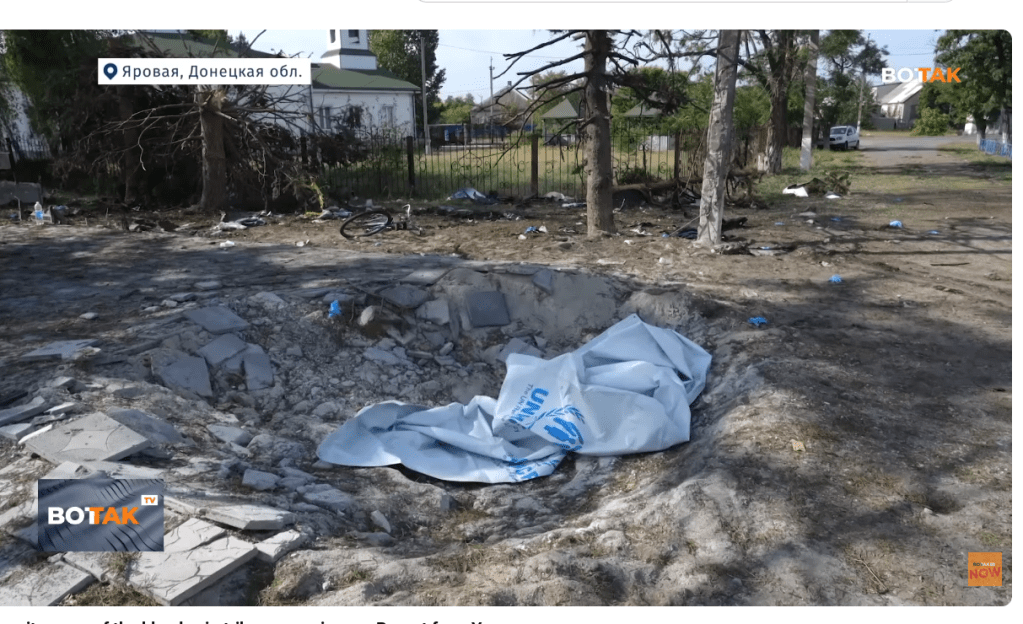
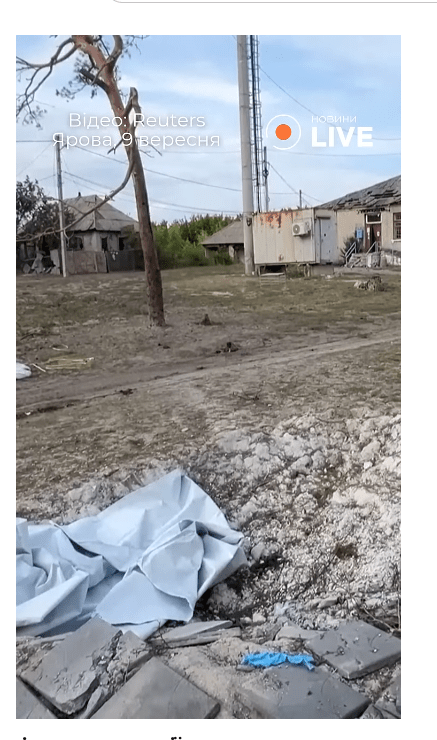
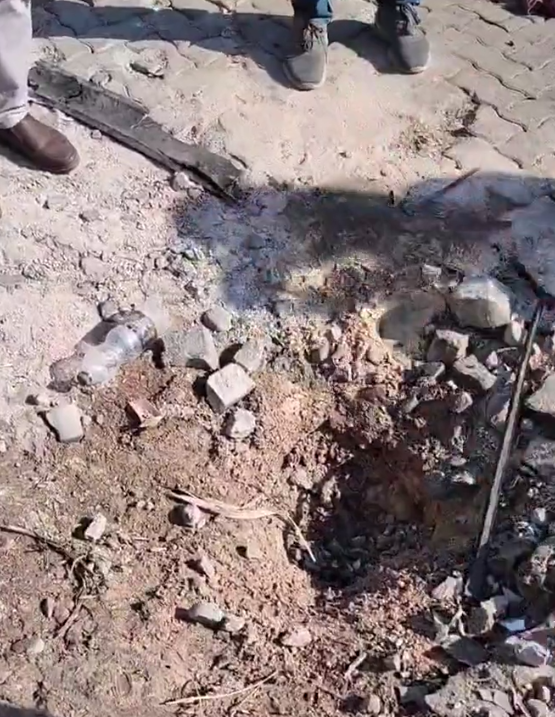
More crucially still, the modest size of the crater from the explosion is markedly inconsistent with what would be expected from a 250kg bomb (roughly equivalent to a US 500lb Mk-82), carrying 100kg TNT equivalent. That could have easily produced a crater near 2 metres deep and five metres wide.
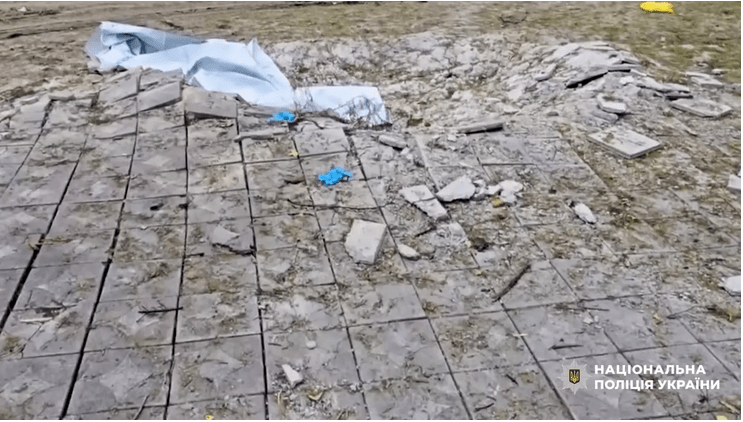
The crater here is not more than 0.5 metres deep and betwen 1.5 and 2 metres wide. The actual level of damage seems consistent with an explosive charge of 20-30% of that contained in a FAB-250.
Naturally, the question arises: Why could the Ukranians not present any fragments of the munition recovered from the debris?
And why did they point to a specific Russian ordnance that would’ve produced a much larger blast than that observed at the scene?
Perhaps, you might think that these apparent faults could just be down to unfortunate confusion amongst overstrained emergency responders. But such a scenario is clearly unsustainable in light of the actual response on the ground.
Reviewing video footage and photos posted of the aftermath: the military experts and police agency responders appeared to show little regard for the dignity of the deceased, leaving their bodies unattended and exposed. They were though, it seems, concerned to remove or conceal anything could provide critical forensic evidence about the strike.
Woman (centre) appears to be stamping on something. The personnel do not attend to the bodies. The scene is inspected and cleared before filming.
A rush to judgment or foregone conclusion?
Attacks hitting civilians in crowded locations in Donbas merit due diligence.
A civil war had erupted in the Donbas following the events of the ‘EuroMaidan’. In April 2014, following mass protests, the breakaway ‘Popular Republics’ of Donetsk and Lugansk proclaimed their independence. Kiev then initiated its ‘Anti-terrorist operation’ against the militias and people of the ‘separatist’ republics, who would defend their territory against Kiev’s often fanatical military.
As John Pilger wrote in the Guardian near the time:
These Russian-speaking and bilingual people – a third of Ukraine’s population – have long sought a democratic federation that reflects the country’s ethnic diversity and is both autonomous of Kiev and independent of Moscow. Most are neither “separatists” nor “rebels”, as the western media calls them, but citizens who want to live securely in their homeland.
Like the ruins of Iraq and Afghanistan, Ukraine has been turned into a C.I.A. theme park – run personally by C.I.A. director John Brennan in Kiev, with dozens of “special units” from the C.I.A. and F.B.I. setting up a “security structure” that oversees savage attacks on those who opposed the February coup.
In Donetsk oblast most of the poulation are Russian speaking and more than 75% voted to secede from Ukraine in 2014. The figure was over 90% in neighbouring Lugansk. This population in the Donbas region tend to be more aligned with Russian culture, identifying more with the history of the Soviet Union, than with the revisionist histories of Ukrainian nationalists – who succeeded in inculcating virulent anti-Russian sentiments among many, further west.
So, there has been considerable antipathy towards the population in the Donbas region amongst powerful ultra-nationalist elements of the military and security state. Ordinary people here, often the older generations, may not be especially loyal to Kiev. So, in the eyes of the nationalist security and intelligence apparatus they are unworthy citizens. A normal soldier, you’d think, wouldn’t countenance killing “their own people”, but for many Ukrainian ultra-nationalists, these civilians in the Donbas are not “their own”.
However, this part of the backdrop to event in Ukraine has largely been airbrushed out of reporting on the conflict in western media. Coverage often seems to skirt over the contempt those working under Kiev’s authority have for the people of these regions.
The apparent high accuracy of the strike, together with its timing, suggests a co-ordinated strike using a precision guided munition. Use of an air delivered munition doesn’t fit with observations and testimony. A ground launched missile or rocket would then be the most plausible possibility.
What direction did the strike come from?
The front right corner of the van appears to have born the main brunt of the blast. Alongside the churchyard railings, the van is facing roughly North-West.
From collating imagery of the scene, together with the geolocation, it is possible to orientate photos and stills of the scene – that show the effects of the munition’s impact and the pattern of damage. Observing these effects and the properties of the crater, it is possible to infer the direction from which the munition was launched.
(right click to view full images)
Greater deformation can be seen on the left side of the craterLooking SSW. Looking NNE towards the radio/telecomms mastCIR InfographicThis line of sight is approximately in line with that marked over the satelite image below.
Looking at the crater, the greatest displacement of earth and rubble – reflecting the munition’s forward inertia on impact – is on its S/SSW side. Suggesting the munition’s trajectory was from the N/NNE. The impact was on a semi-hard surface, so there is not much ejecta. But greater deformation is visible on that side.
The way the upper parts of the two trees had fallen is consistent with the overall direction of the blast being on a line between them, from the point of impact.
It might be further noted that the point of impact was close to a large radio or telecomms mast (situated adjacent to the disused post office building). And that this mast is approximately in line with my inferred direction of orgin.
Line through the radio mast to crater from the N/NNWA rough indication of probable attack vectors to a 70-80k range. – the sector is largely within Ukrainian lines at the time, although close to the frontlines in the Lyman/ Kupiansk axis.
Why this incident is suspect
On August 12, 2025. The Russian Ministry of Defence put out a urgent statement, saying they had intelligence Ukraine would stage an attack on civilians, to incriminate Russia in the eyes of the international community and disrupt diplomatic initiatives:
Immediately before the summit on Friday, the Ukrainian Armed Forces plan a provocative strike using drones and missiles targeting a densely populated residential area or a hospital, resulting in significant civilian casualties. This incident is intended to be immediately “documented” by the Western journalists brought in for this purpose.
As a result of the Kiev regime’s provocation, full responsibility for the strike and civilian casualties will be attributed to the Russian Armed Forces, with the aim of creating a negative media narrative and conditions to undermine Russian-American cooperation on resolving the conflict in Ukraine.
General observations of the scene, reports and circumstances are consistent with this type of co-ordinated ‘black op’ having been carried out; together with a ‘for the cameras’ narrative management focused follow-up, from the attending agencies. This allowed the Ukrainian state to capitalise, in real time, on the propaganda value of images of slaughtered civilians.
Red flags are raised by:
The lack of supporting forensic evidence for the attribution of weapon type.
The rapid clean up of debris; carried out by military and police units rather than civilian rescuers or firefighters.
Reports indicating recent pressured evacuations in the locale, involving “humanitarian” agencies or special units of the Ukrainian police. Locals were often reluctant to evacuate when confronted by these personnel.
Uncanny coincidence – According to testimony given to Russian opposition outlet Meduza by an ‘evacuation driver’, he had stopped and asked people in the group for directions. And later got a call from police instructing him to return with bodybags. Had he really stopped to share the coordinates of the location? Or send a message to confirm the group’s presence there?
The Associated Press team later present, appear to have co-ordinated their reporting with the ‘White Angels’ police unit managing the emergency response; effectively disseminating the official narrative.
As discussed, use of a precision ground launched weapon is implied by examination of the scene and testimony.
No signs of fragmentation elements in the side of the vehicle closest to the blast
In photos of the aftermath there is no discernible sign of the warhead having contained fragmentation elements. The side of the van exposed to the blast would show multiple punch holes from such anti-personnel elements. So, it appears that a unitary high explosive warhead was deployed for this strike.
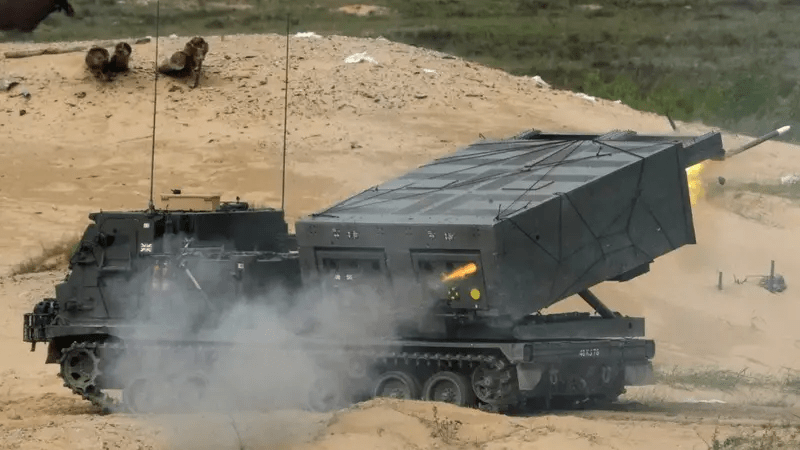
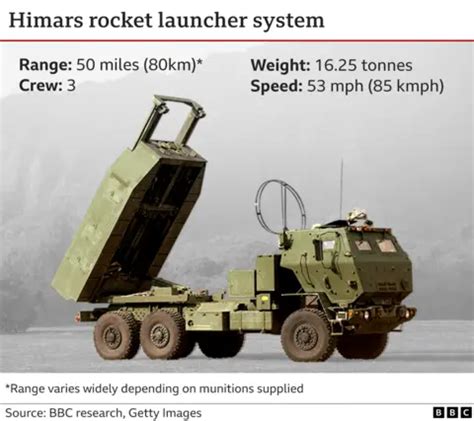
One such rocket, capable of precision strikes, is the M31A1. These have been in service for Ukraine, since the summer of 2022, in tandem with HIMARS or M270 GLMRS universal launch systems. HIMARS launchers have been provided by US. And the UK sent 6 M270s in early summer of 2022 and even provided training on the use of the systems on Salisbury Plain. France sent two M270 launchers also.
M270
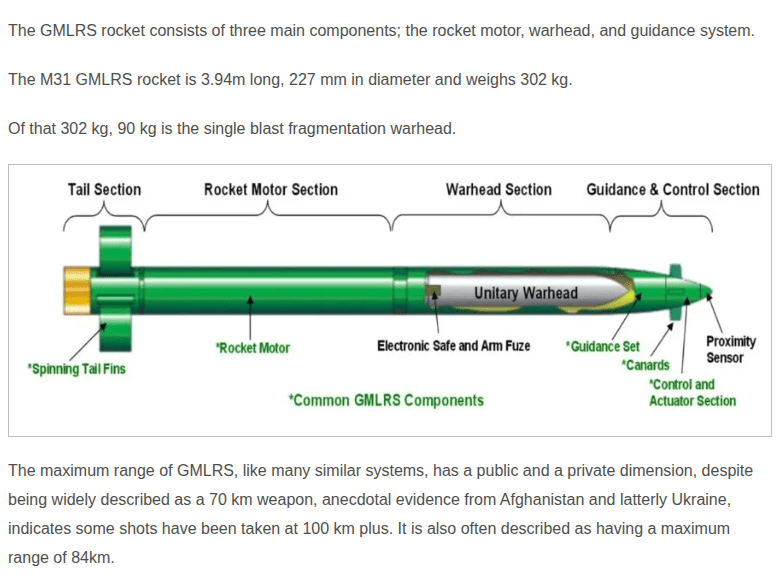
Considered to be systems of ‘extremely high accuracy’, sometimes called the ’70km sniper’, M31A1s have been employed by Ukraine specifically for precision strikes. Their maximum range is near 90km. However, the target must be at least 15km from the launcher.
Typically, for a strike on a point target a unitary warhead is preferred. And this is the type of warhead M31s are fitted with – containing 51lbs of PBX-109 high explosive, equivalent to between 61 and 74lbs of TNT.
The M31A1s are said to work with (EW jamming proof) GPS and Ineritial navigation; meaning they are reliable weapons in this densely contest battle-space. The Russians don’t rely on GPS, having differently based systems.
While no munition fragments from the scene were publicly documented and only circumstantial evidence is available; a M31 rocket looks to fit well; with the size of the crater and level of damage. And is documented as in use on the frontlines of this war.
It may be the case, then, that this atrocity was made possible by NATO countries’ provision of Himars and M270 launchers with M31A1 rockets to Ukraine’s military.
An article for Britain’s most prestigious military thinktank, about the capabilities afforded by MLRS systems sent to Ukraine, noted that the UAF employ a range of targetting methods for strikes. Including “the use of mobile phone software that enables Ukrainian citizens to report the location of Russian troops using an app.”
Since February 2022, Ukraine in conjunction with its mobile network providers has developed what can be called a “crowd sourced kill-chain“.
Specifically, the Ukrainian army has setup multiple formal methods in which that people could report the positions of Russian forces, these include a Telegram channel, a website and even an app called Bachu that uploads details once data connectivity has been re-established…This “kill-chain crowd-sourcing” … has probably been the first time that civilian input into military operations and what to target has been automated to such a degree. No doubt there have also been a myriad of informal ways that enemy positions have been communicated to Ukrainian commanders through sending of pictures or reports via Voice, SMS or messaging.
Quite possibly then, someone treacherously used such a mobile application to finalise arrangements, shortly before the pensioners’ lives were extinguished.
Means, motive and opportunity
The above shows that Ukrainian agencies had:
the means to carry out this strike – with a M270 or Himars launcher.
a motive and willingness to carry out such a strike – to further demonise their enemy, at a time when it had commenced negotiations with Ukraine’s most important backer, the US.
the opportunity to manipulate and control the behaviour of local people. And pass live information from ‘civilians’ to military commanders. While Ukrainian reporters could be expected to accept and disseminate the desired narrative, both in Ukrainian media, and internationally through Associated Press.
The Ukrainians probably also understood that western media coverage would not bother to distance itself from their claims, much less to question or critically examine them. As this has been a consistent pattern in its coverage of atrocities in this conflict.
The above is my write up of prior work examining and analysing sources openly compiled on acloserlookonsyria
Edits, additions or updates may be made.
* Some witness later mentioned one or two other blasts, but available photos and video footage show only one crater at the scene – where the causalties were reported. Much of the reported testimony was unclear and sometimes plainly exaggerated.
…As I indicated last week, we have taken care to look at all the evidence currently available. Mr Speaker, I can now share our assessment with the House. On the basis of the deep knowledge and analysis of our intelligence and weapons experts…the British government judges that the explosion was likely caused by a missile – or part of one – that was launched from within Gaza towards Israel.
The misreporting of this incident had a negative effect in the region – including on a vital US diplomatic effort – and on tensions here at home. We need to learn the lessons and ensure that in future there is no rush to judgment.
This is how the British Prime Minister addressed the House of Commons, about the horrific Al Ahli attack, on October 23, 2023.
You’ll probably have registered the qualifier ‘likely’ used in the statement. It’s curious, because in recent times the official conclusions of British Intel agencies on high profile international incidents such as this, have often been prefaced with ‘highly likely’.
For what it’s worth, my own assessment remains that this was an intentional attack by the Israeli Air Force with a bomb and not a missile. Others with greater investigatory experience and skills than me have also reached this conclusion reviewing both the impact scene and video footage of the night skies. See this comprehensive report by Michael Kobs.
Although the type of bomb used is not 100% confirmed, as I speculated in the week following the attack, it was most probably a variant of the GBU-39 ‘Small Diameter Bomb’. Photos and videos of the scene the next morning reveal pieces of debris that could fit with the ‘Diamond Back’ wing assembly employed on these munitions. (See also the updates on my last post).
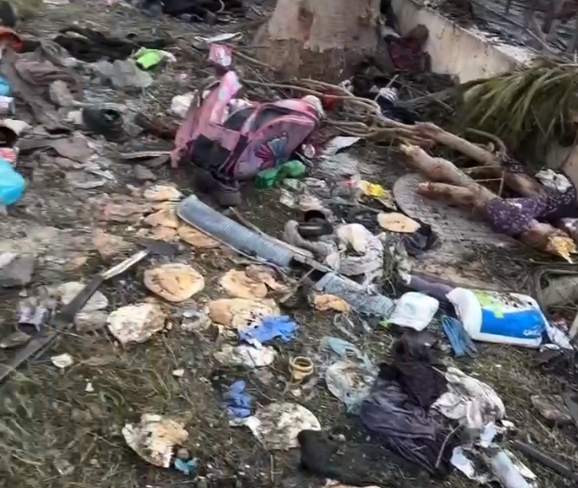
A screen grab from mobile phone video footage. The metallic rectangular object (centre, in front of the child’s backpack) looks like the underside of a ‘diamond back’ wing
I suspect the object bottom right in the BBC graphic is a part of a diamond back’s cover.
I wrote before that a variant of this type of smart bomb – the GBU-39 (A/B) Focused Lethality Munition (FLM) – had properties that could fit with the observed general characteristics of the blast.
A museum model of Boeing’s FLM
Michael Kobs’ report is conclusive that the blast was not an air burst. Although there are some unusual features of the impact site indicating it was probably not a regular high explosive munition with a conventional bomb casing. The Boeing FLM with its Dense Inert Metal Explosive looks the most likely candidate. As a Defense Industry Daily article on the FLM informed:
A carbon-fiber bomb body disintegrates instead of fragmenting, which adds explosive force nearby but largely removes shrapnel issues beyond. Inside, metal particles turn the explosive material into short-range projectiles.
This, in my view, accounts best for the unusual features at the impact scene – wide effects, but low amount of fragmentation marks. Videos of the aftermath that evening are truly shocking. Even if the death toll according to authorities in Gaza might be inflated, the courtyard was evidently packed with families.
To me, all this now seems fairly clear. What I do find hard to understand, though, is how the initial sense of media reporting on the night could have seen such a ready volte-face.
A BBC TV reporter who said, as the horrific aftermath was unfolding:
‘It’s hard to see what else this could be really, given the size of the explosion, other than an Israeli airstrike or several airstrikes because when we’ve seen rockets fired out of Gaza, we never see explosions of that scale. ‘We might see half a dozen or maybe a few more people being killed in such rocket attacks but we’ve never seen anything on the scale of this sort of explosion on the video I was watching earlier, which as you say, is still to be verified.’
…was, in the days following, publicly shamed for this quite reasonable and appropriate assessment.
BBC senior management would apologise for ‘speculating’, as the Israelis put out a gish-gash of self-contradictory messaging in their attempts to deflect the blame. Kobs’ report demolishes these claims, along with those of a London based academic ‘research agency.’
But could the analysts of official British agencies have earnestly reached the conclusion that it was a missile from Gaza. And what does their term “likely caused” really imply?
If we assume that an assessment of ‘highly likely’ would be intended to signal a high degree of confidence – as their US counterparts were said to have in the same conclusions. Does ‘likely’ signal just moderate confidence, or less perhaps?
A worthwhile (2017) article from former Canadian Intel analyst Patrick Armstrong – ‘When Intelligence Isn’t‘ – can help us understand what could be going on behind pronouncements like this from officialdom. In these times, national security analysts can have high confidence, most of all, in knowing what their paymasters expect them to say.
It seems likely to me then, that some of the British analysts felt uncomfortable and wanted to signal their distance from the conclusion they inevitably had to draw.
The British establishment hasn’t exactly been coy about showing where its sympathies lie since Hamas’ raids on October 7. A dissenting voice from within its ranks who called for a ceasefire in parliament quickly experienced a ‘fall from grace‘.
10 Downing Street in the days after October 7
Will the increasingly massive civilian death toll in Gaza prompt the illumination of Downing Street with the Palestinian flag in a display of solidarity? It seems unlikely, given that widespread calls for the British Government to demand a ceasefire are dismissed by the leadership of both main parties. That would, they assure the public, only be ‘perfomative’ and ‘symbolism’ and wouldn’t really achieve anything.
On October 17, 6.59pm local time an explosive strike hit the courtyard of the Anglican Al-Ahli Hospital, in the Gaza strip. Reports suggest many people were crowded in the courtyard outside at the time. This video from the morning after gives some impression.
After reports began to circulate Hannanya Naftali an advisor to the Israel PM tweeted:
“BREAKING: Israel Air Force struck a Hamas terrorist base inside a hospital in Gaza. A multiple number of terrorists are dead.”
Soon after he deleted the tweet.
In the days after there has been much focus on video evidence from CCTV cameras with different views of events in the skies over Gaza, with claims from the Israel Defence Forces that an intercepted rocket fired by Palestinian combatants had fallen on the hospital grounds, and hence the IDF was not responsible.
Major Western media outlets would swing round to amplify this claim. An informational barrage, seemingly intended to obscure the facts and distract audiences from the wider context. The IDF also released a doctored audio purportedly of Palestinian Islamic Jihad fighters acknowledging the explosion was due to one of their downed rockets. Both these claims have now been debunked.
My analysis here does not focus on the released CCTV footage and speculation about what the lights in the sky might show. Instead I focus on the strike itself, the scene, and the best inferences that can be made about the weapon deployed, based on a wider background of relevant sources.
There are number of unusual aspects to the strike and the nature of the blast and impact that seem confounding. Here, I mean to show how they are reconciled. Analysis of the scene and the crater – some of which is compiled on the ACLOS research wiki – is consistent with the following:
Some indication of downward pressure, suggesting possible above ground detonation (air burst)
Lack of major damage to the buildings
High casualties
Sound signature characteristic of a guided bomb, immediately before detonation, but with no sound of a jet overhead
Reportedly, a lack of fragments from the munition found at the scene
That Palestinian resistance groups have such a weapon in their inventory is not sustainable.
By examining the range of weapons the IDF uses for strikes in densely packed urban environments – and accepting the logical necessity than that an attribution to any particular weapon system must show properties consistent with all of the above – one can narrow down the options. This looks to me to be a more logical approach than pouring over CCTV footage. Which is likely to be of limited relevance. There is no reason why such footage would necessarily give any indication of the nature of this particular strike. The IDF was conducting multiple operations at the time, as it had been since the beginning of its retribution on Gaza.
In the days after Hamas’ raids into the south of Israel, Boeing accelerated the shipping of 1000 smart bombs. These were GBU-39 Small Diameter Bombs (SDB) which Israel had purchased in 2021 for $735 million, according to Defense Post. A plane with such a shipment arrived in Israel on October 11.
This ‘small diameter bomb’ has a relatively small warhead compared with other bombs. A glide bomb with fold-out wings, it can be deployed as a stand-off weapon from up to 60 miles away, according to the manufacturers. The Israeli Air Force routinely conducts air strikes in the region – including against targets in Syria – while operating over the Mediterranean. An engagement like this would be consistent with crater analysis implying the bomb came from the West or WNW.
Analysis of the scene indicated a steep trajectory rather than a shallow one. These ”sky-riders” can come into the target not at vertical, but at a steep trajectory (as shown here). They can be fused to detonate on impact or just above (in an air burst).
The GBU 39 is specifically designed to minimise collateral damage in close environments. One variant in particular the GBU-39A/B FLM (Focused Lethality Munition) comes with a carbon composite case rather than a steel one, for the purposes of minimising fragmentation – as opposed to optimising penetration. These cases simply disintegrate in the explosion. It also uses a multiphase blast explosive with enhanced explosive effects/lethality (See here on ACLOS for more).
As I understand it a multiphase blast comprises first a ‘gas phase’ with build up of pressure and then a ‘particulate phase’ that imparts momentum. If the detonation was with a proximity fuze, then this looks consistent with both the signs of downward pressure and the direction implied by the spray pattern around the impact crater.
In my view, the characteristics of the GBU-39 FLM fit with the takeaway features from analysis of the scene of impact.
Small crater
Steep angle of impact
A sizeable blast
Some indication of downward pressure effects, suggesting possible above ground detonation (air burst)
Lack of major damage to the buildings
High casualties
They also, I believe, account for the characteristic sound signature heard on the footage immediately before the explosion. In addition a FLM bomb with a disintegrating carbon composite case would explain the inability of Palestinian authorities to produce fragments/ shrapnel from the weapon itself. It also fits with the original claim from Hannanya Naftali that it was their Air Force who struck at the hospital.
Update 26/10/23
This screenshot from video of the scene clearly shows two parts matching those of the GBU-39’s fold-out wing assembly. It is surprising the Palestinian authorities have not produced them. They may have been discarded, and their significance overlooked. But now we have concrete supporting evidence.
Some have suggested Hellfire missiles fired from UAV’s or helicopters may account for the carnage. I believe this is inconsistent with the incoming sound signature, and the explosive force. And such missiles do not have parts like we see here.
——–
For the time being I do not speculate on the motivation for the targeting. Scott Ritter has suggested that the IDF could have received intel of a high profile target at the location. In any case it appears that the courtyard was crowded with Palestinians seeking safety and medical aid.
To the best of my knowledge the death toll and causality figures produced by Palestinian authorities still lack independent verification.
Update 28/10/23
This close up from a photo of the scene (lead image above) also shows an object which also looks to match with the GBU-39’s wing parts.
Another investigator, with greater technical background and forensic skills than me, thinks apparently that the level of fragmentation is not consistent with a carbon case – as with the FLM variant. The Defense Post article stated the 1000 bomb (2021) contract with Boeing was for the 39B – a “multipurpose” version with a more conventional casing.
However, at this stage, the question of which particular GBU-39 sub-type was used seems largely academic.
Edited to remove a muddled reference to a motor on the GBU-39. There is a ground launched adaptation with a rocket motor attached. But that is not relevant here.
Edited to adjust implied direction of origin from others’ spray pattern analysis from WSW to WNW. Due to my initial off hand orientation of scene photos.
Timings indicate no use of explosives to blow the dam:
The reported seismic event said to indicate a large explosion occurred at 2:54am local time, but footage revealed the dam had already been breached by 2.46am. This indicates that the seismic signal was most probably produced by the further collapse of the dam structures – like the Hydroelectric Power Plant (HPP) building giving way – rather than the use of explosives.
An earlier weak signal at 2.35am subsequently reported by NORSAR, is then likely to be the first breaching event. NORSAR later removed text from the web page.
The facility had been hit repeatedly by Ukraining shelling:
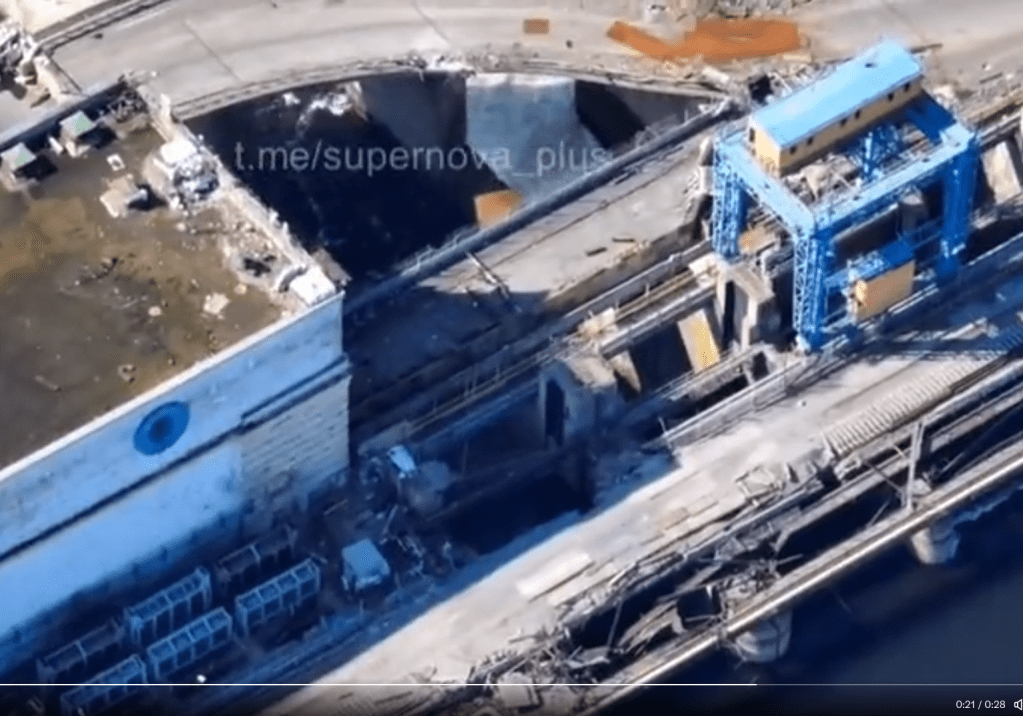
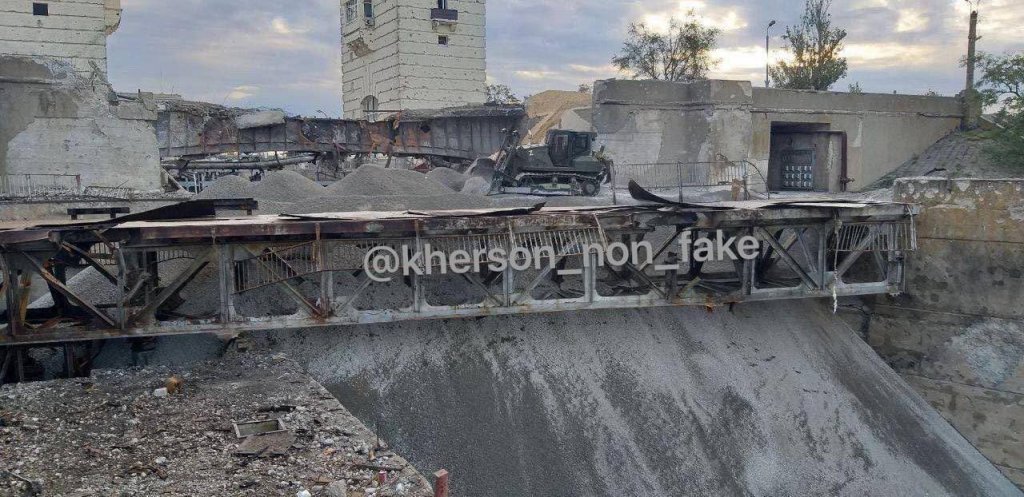
The dam was on the frontline, with Russian forces present. Ukrainian shelling of the roadway caused marked damage to the dam close to the HPP.
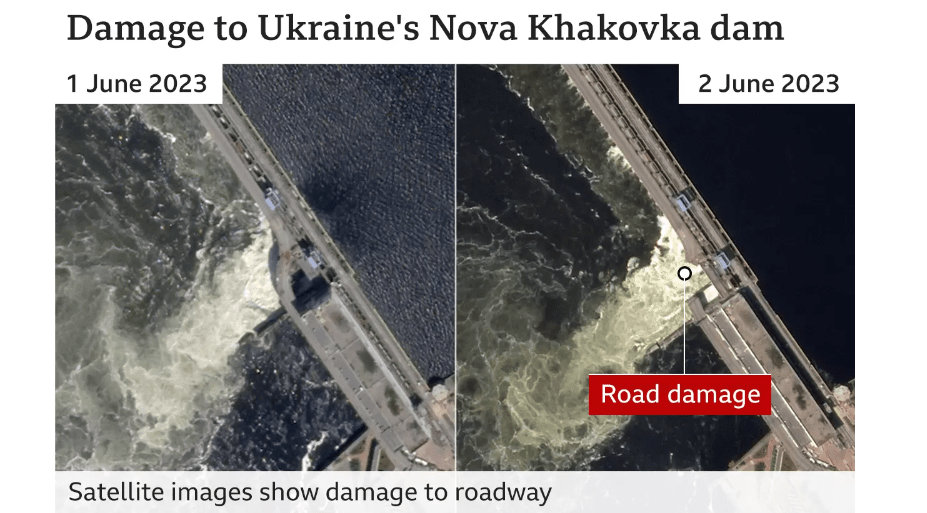
Supporting columns for a road section over the barrage had collapsed five days earlier:
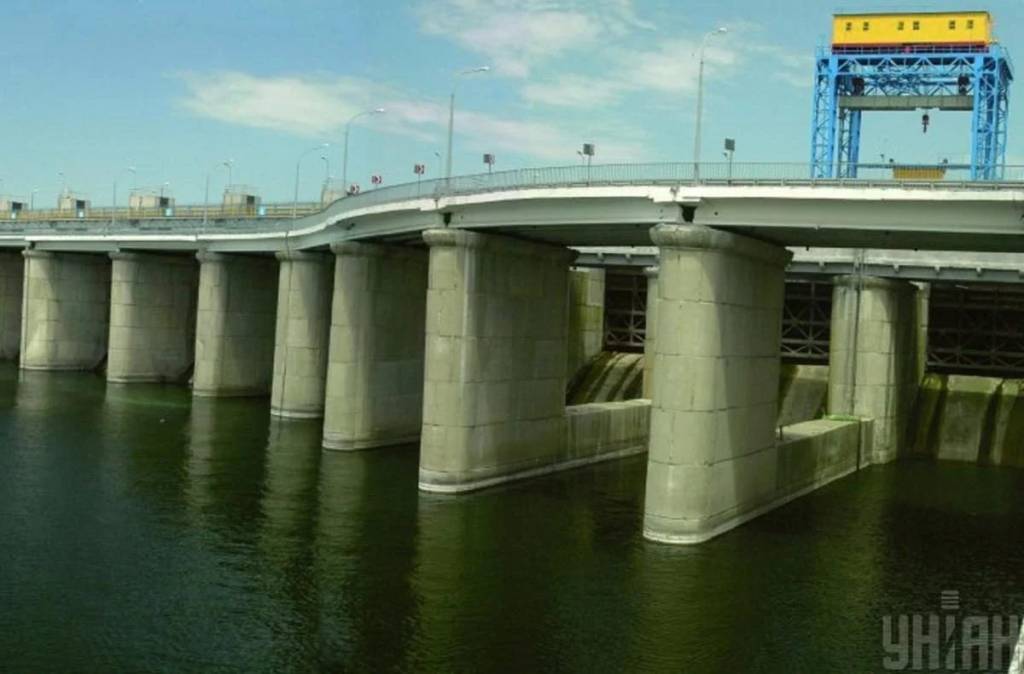
Two thick concrete columns – supporting a previously shelled section of roadway close to the HPP – collapsed and were washed away between 1-2 June, according to satellite photos from the dates. Those supports formed part of the spillways for sluice gates 2,3,4, close to the HPP. The initial breach occurred on that side of the central barrage section.
Two sluice gates were damaged months earlier:
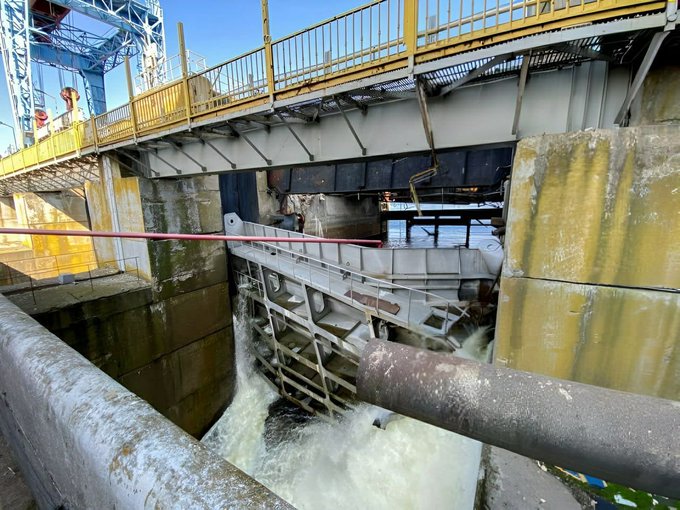
Sluice gate 1, closest to the HPP had sustained significant damage from Ukrainian shelling months earlier. Resulting in more turbulent flows from that section.
The damage likely dates from November 6, 2022 when a HIMARS strike was reported.
This would match with later comments in the Washington Post: ”The Ukrainians… even conducted a test strike with a HIMARS launcher on one of the floodgates at the Nova Kakhovka dam, making three holes in the metal to see if the Dnieper’s water could be raised enough to stymie Russian crossings but not flood nearby villages. The test was a success…” – said Ukrainian Maj. Gen. Andriy Kovalchuk.
“The threat from Ukrainian forces including snipers was reported, by the local Mayor in March, 2023 as preventing repair and maintenance operations.
The lock canal was filled-in during September ’22 by the Russians to build a new road crossing, after Ukrainian HIMARS strike had destroyed the road bridge. This would then prevent the canal being used as a slipflow around the dam in the event of high water levels.
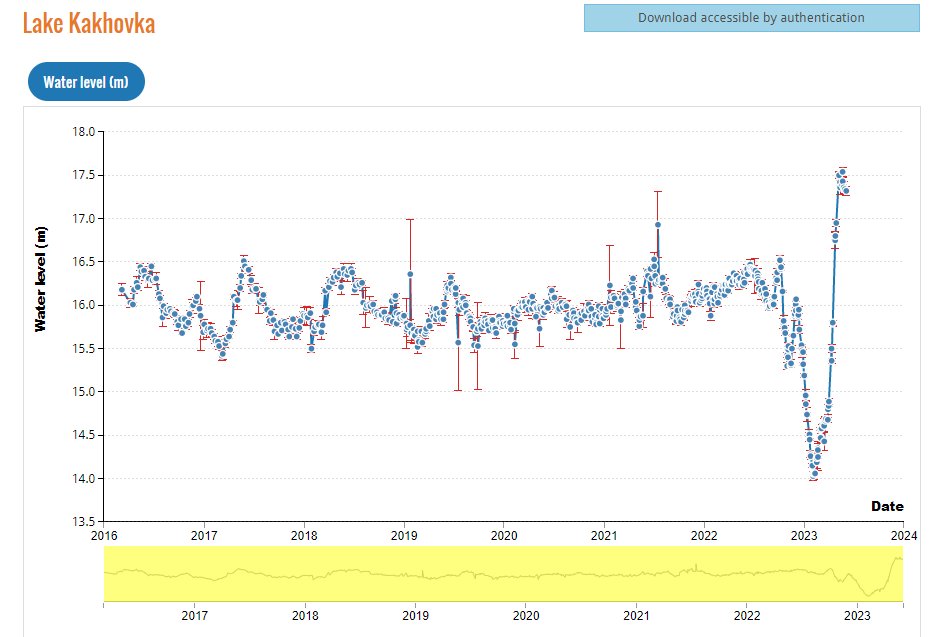
Unusually high water levels in the reservoir:
The high levels appear to be due to heavy rain and some amount of excess discharge from the Ukrainian controlled dams upstream the Dnieper. The Kakhovka dam did still release a lot of water downstream in the weeks prior, although this was only through a few gates close to the HPP. Normal rotations and maintenance could not be carried out.
Adam Larson surmises that the concrete ‘apron’ underlying the spillways had sustained damaged from HIMARS strikes landing underwater. The high water level in the reservoir and its release through just a few (damaged) gates, generated intense flows – which would be sucked into and around any cavities and damage of this concrete shelf.
Scouring erosion of this base, underlying the thick columns supporting the roadway, then most likely accounts for their collapse. With an integral part of the structure washed away, the further main collapse event was pretty much inevitable.
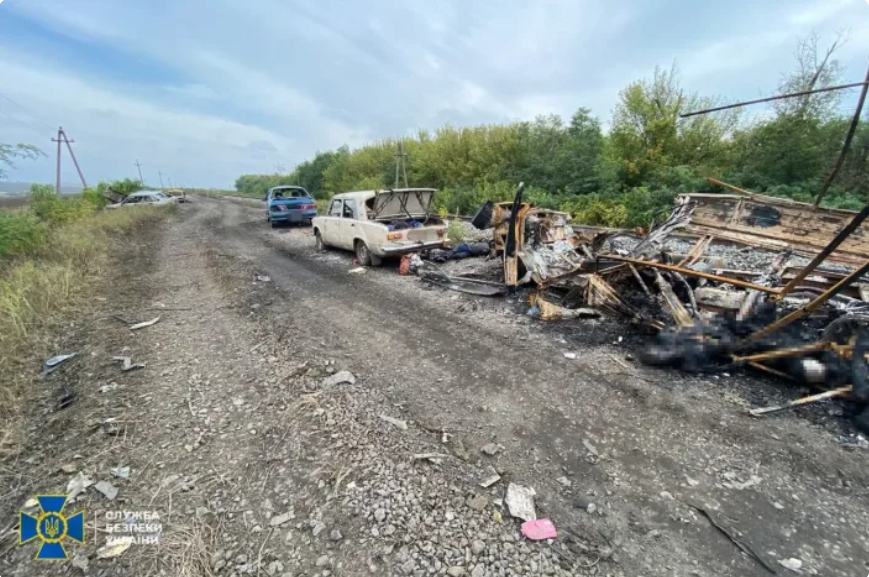
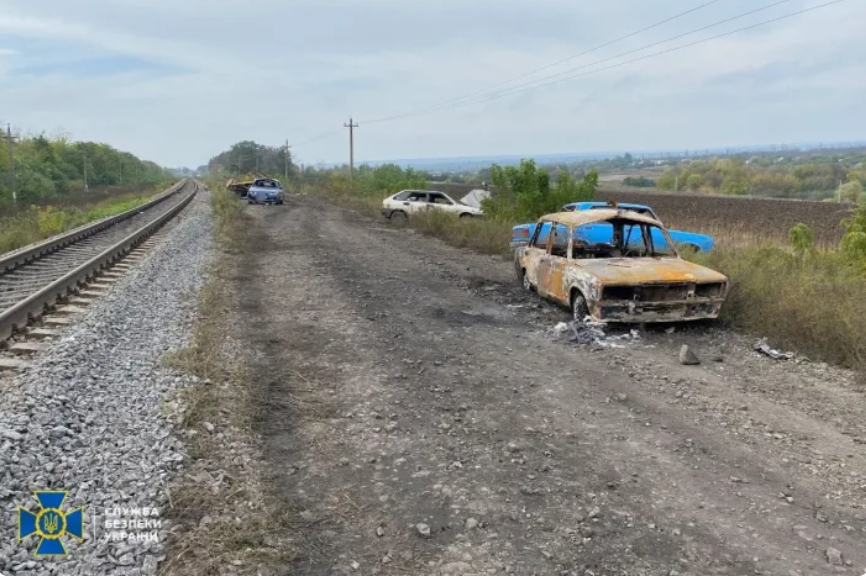
On October 1st reports about a ‘cruel’ massacre of civilians and children appeared in the western media. In all 26 people, including 13 children, fleeing in a small convoy of five cars and a truck, are now reported as killed in this atrocity. In photos and video footage of the scene, bullet holes could be seen in vehicles, with the dead inside. One man lain on the ground alongside a car. At the rear of the convoy the truck and its wagon had burnt out along with the corpses of their occupants. Ahead a small car had also burnt out. The victims bodies had been at the scene for a few days before the incident came to light. Video footage showed victims with flies buzzing around their bodies in the cars.
The date the attack took place has not been independently confirmed. Ukrainian sources reported the massacre took place on the morning of September 25th. It is not stated how this detail was known. Nor is it explained, consequently, why the incident wasn’t reported for five days. The dead had apparently been left unattended at the scene during that period. The savagery was attributed to a Russian ‘reconnaissance and sabotage group’. No supporting evidence for that claim was provided at the time.
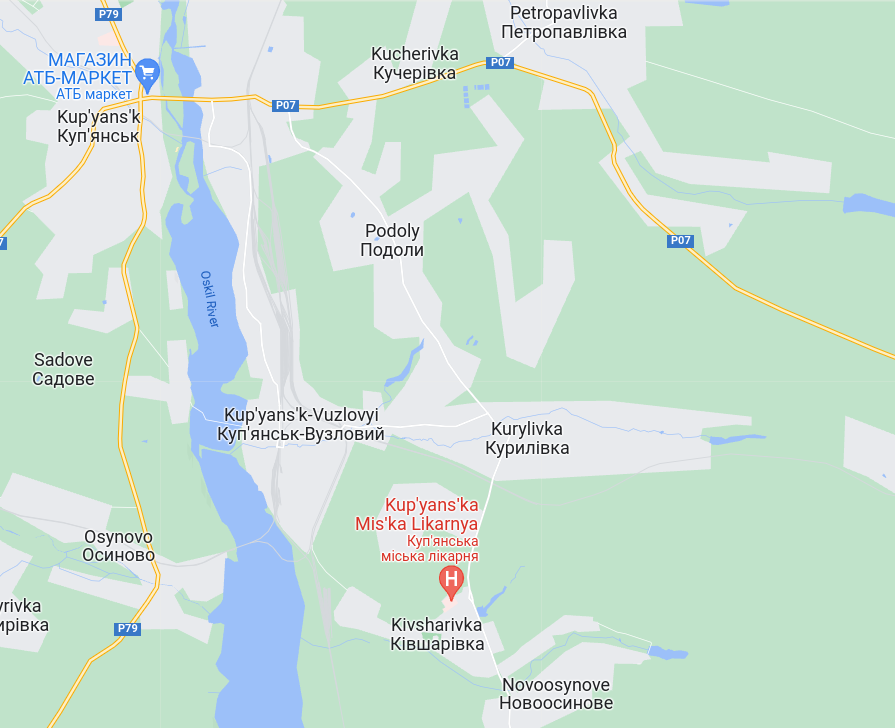
The convoy was heading east away from the East Kupiansk area, recently recaptured by the Ukranians, and towards Svatove in LPR/Russian controlled territory. A Ukrainian TV channel later produced some dubious testimony. The purported survivors were at pains to explain why the convoy were headed to Russian controlled Svatove, implausibly claiming that it was the only route they could take to Dnipro. Which is well to the south-west. The most natural explanation is that they were Russian speakers who felt safer fleeing away from Ukrainian forces conducting “mop-up” operations.
Here, examining the location and context of the attack, I present the case that the atrocity was the work of a Ukrainian ‘Kraken’ unit. Kraken is a Kharkov based affiliate of the extremist Azov Battalion. According to the Washington Post, it “operates somewhat in a gray zone — a force that answers to the Defense Ministry but is not part of Ukraine’s armed forces.” The group’s conduct has raised human rights concerns.
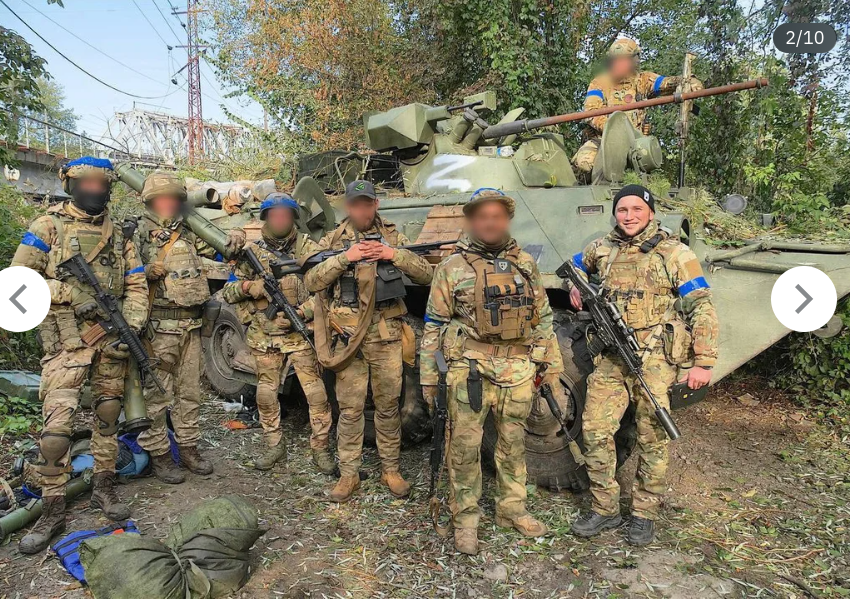
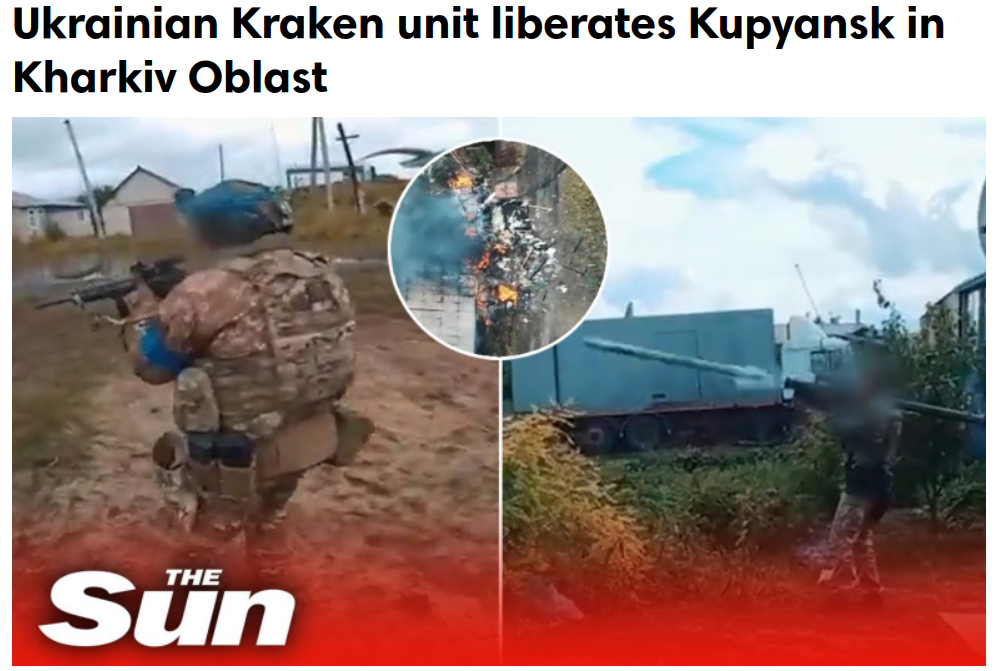
A Kraken unit is documented to have been active in the locale in late September. Ukrainian media had announced the group taking control in East-Kupiansk on Sept 16 and then in Kupiansk-Vuzlovyi on Sept 27. Graphic photos and video the Kraken group had taken in that locale in late September, were shared on their telegram account.
Their faces are obscured in the published photos, except for one; the group’s deputy leader, Sergey Vilichenko aka ‘Chile’, an infamous criminal who had like other Kraken members been released from prison to fight. In March, he was responsible for the shooting in the knees of surrendered Russian PoWs. The perpetrators had filmed their own crimes. Vilichenko is wanted by the Russian authorities who put up a reward for his capture.
Posing in front of a captured Russian APC, likely a BTR-80A
The BTR-80A is fitted with a 30mm 2A72 automatic gun and 7.62mm PKT coaxial machine gun….The 30mm gun has a maximum firing rate of 330 rounds a minute and can fire AP-T (armour piercing – tracer), HEF-I (high-explosive fragmentation – incendiary) and HE-T (high-explosive – tracer) rounds.
Returning to the convoy, it was heading out eastwards along the railway line just beyond the far end of Kurylivka (a stretched out settlement east of Kupiansk-Uzlozovyia). The line then curves round to the south-east towards Svatove. The old cars were packed with heavy travel bags. This was not any day excursion.
When the convoy passed the farthest point of Kurylivka it would, presumably, leave the road (‘vulytsia Lozova’) using a cut-through to join the track that runs alongside the railway (Satellite view). They would only be some 250-300 metres further on from that point when they were killed. Had the convoy made it further to the next settlement of Pischane, some 2km on from the scene, it would have passed into the then LPR/Russian front lines.
According to quotes from French investigators working under the auspices of the local prosecutor, 30mm and 45mm high explosive rounds, that come from heavy military vehicles were used. In addition, fragments of Vog17 and Vog25 grenades – which can be used with under barrel grenade launchers – were also reported. Both Vog17 and Vog25 grenades are used by the Ukrainian military.
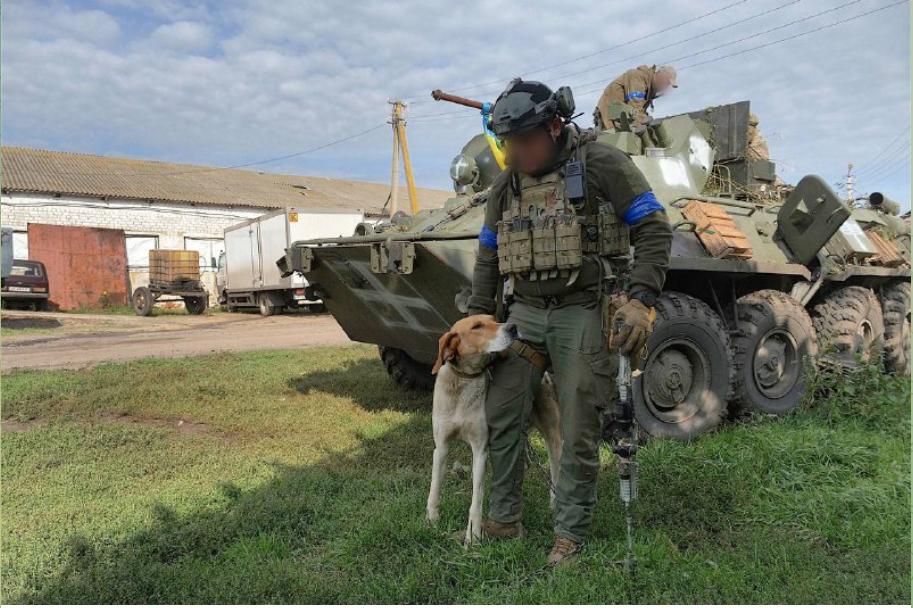
A compound the unit were using. The captured APC’s ‘Z’ markings had been painted over.
It seems likely that the unit attacked with their heavy vehicles, probably including the captured BTR-80A (pictured). The unit had boasted of two captured APC’s. The use of a captured Russian fighting vehicle could allow that forensic findings falsely point towards Russian forces. Their photos also show they had a Canadian made Roshel Senator (Infantry Mobility Vehicle) and a pick-up.
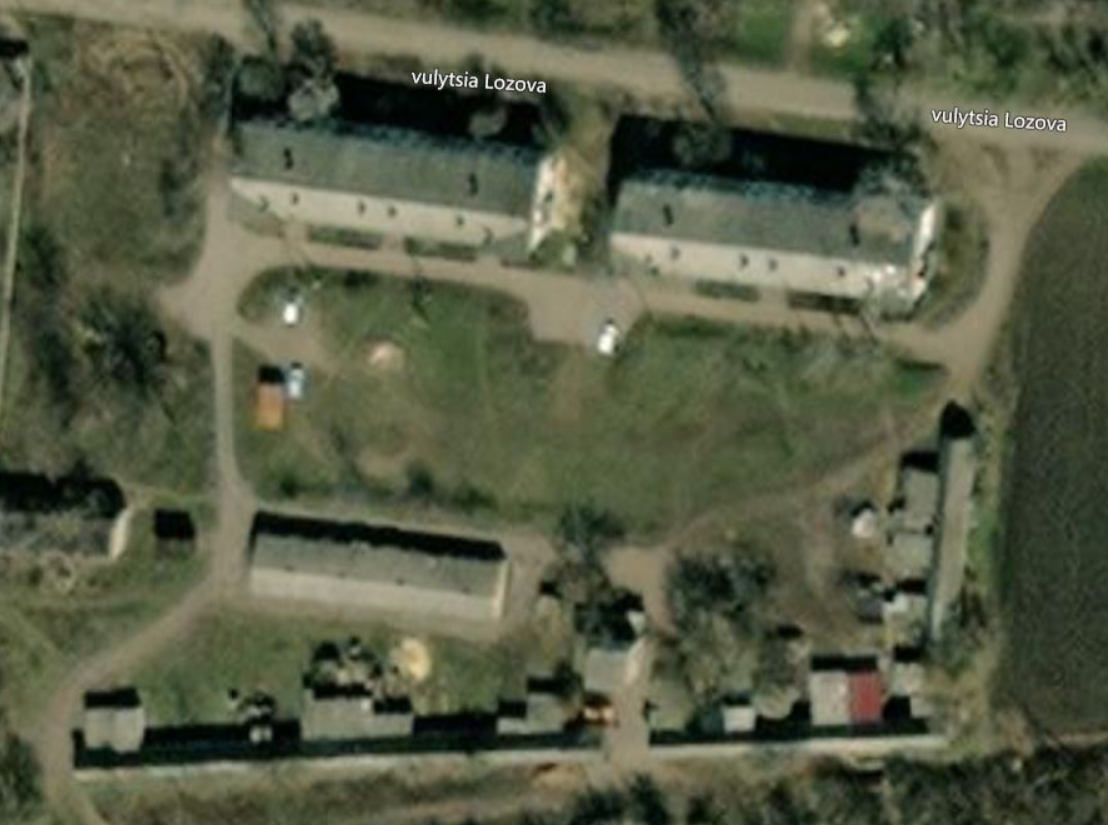
A matching compound to that shown above, close to the scene of the atrocity. To the front (north side) of the compound the road vulytsia Lozova. The rear (south side) backs on to the tracks with cut-throughs to the railway embankment. (Geolocation)
1km before the scene of the attack, the convoy would have passed, towards the end of the village, a small compound backing on to the the railway. The photo above suggests it was used by the Kraken unit. Operating from the compound, it would have been easy for them to see the convoy passing – on one side or the other – perhaps without alerting the civilians to any threat. Once the convoy had passed, the sadistic men could easily drive their vehicles onto the track, pursue the convoy and open fire using the heavy automatic guns on their vehicles. Then used their automatic rifles, some fitted with under-barrel grenade launchers.
Looking back towards Kurylivka. Photos suggest that the rear of the convoy was passed on its left side by the Kraken vehicles – as shown by bullet holes on their left (driver) sides. Whilst the front cars of the convoy went (or were shunted) off the embankment to the left, with the attackers passing and firing from behind and the right of the cars. A pick-up and quad bike may also have been used to hunt down anybody trying to run. Ukrainian sources subsequently reported, that two other bodies were found nearby.
I believe the scenario I have just outlined accounts quite simply for the basic ‘logistics’ of this attack. The answers to ‘who’, ‘how’ and ‘from where’ are all supported by the evidence provided. ‘Means’, ‘method’, ‘opportunity’ and ‘motive’ are accounted for:
Means – fighting vehicles, including captured Russian fighting vehicle
Method – let the civilians pass, then pursue, attack with the vehicles’ guns, and then semi-automatic rifles with under-barrel grenades.
Opportunity – provided by the location of the compound between the road and the tracks where the civilians would just have passed.
Motive – fanatical hatred of Russian identifying Ukrainians, by those with a known record of extreme violence.
Different explanations or attributions will likely produce a more complicated scenario or leave rather more unexplained.
Footage of the scene was uploaded to Telegram on the 30th, probably by a different Ukrainian unit. Which may, conceivably, have been unaware of who carried the massacre out. The incident could and would, though, be used to bolster the narrative of Russians wantonly killing civilians that was featuring in the media that day.
On the southern front a convoy of civilian cars looking to leave Ukrainian held Zaporozhzhia and cross into Russian controlled territory, were killed by an explosion, whilst waiting at a transit point that morning on the edge of town. This time there would be no delay in media reports circulating and blaming the Russians. That the civilians were attempting to leave Ukrainian control was explained away. Officials claimed that they were on a ‘humanitarian mission’ and planning to deliver aid, before returning. Pictures of the aftermath revealed families travelling with pets and their vehicles jammed full of personal belongings. But such insults to the intelligence of western news consumers often seem to go unregistered.
*The working out of this account was done openly on the research wiki A Closer Look on Syria. The sources, reports and geolocations referenced above were compiled here.
Update: November 30, 2022
Kraken’s official YouTube channel published on November 6, this video of their claimed exploits in Kupiansk area in late September. With sections focusing on Kupiansk-Vozlovi and Kurylivka.
The British tabloid The Sun published shortly after a shortened version of the video. There are many supportive comments of these “heroes”. The Kraken youtube account commented back to The Sun:
We are very grateful for the support of all our friends and allies from other states. All Ukrainians and fighters of the Kraken unit see this support, your kind words and appreciate it very much, this is important for us, do not doubt. For our and your freedom, on guard of Europe and the whole world! Together we will win!
I don’t know if the people at the Sun know they are supporting the very same criminals who carried out this attack. Which they had called ‘cruel’ and ‘evil‘. Either way, I don’t expect they will ever acknowledge the fact.